Free induction decay is a receiving signal from freely precessing transverse magnetization after excitation ends. Faraday's law of induction gives coil voltage proportional to the time derivative of linked magnetic flux, with sign set by the winding. At its envelope follows the transverse magnetization; a fixed receiver phase can absorb the derivative's near-quadrature shift. We define the calibrated complex signal below to represent magnetization, not raw coil voltage.
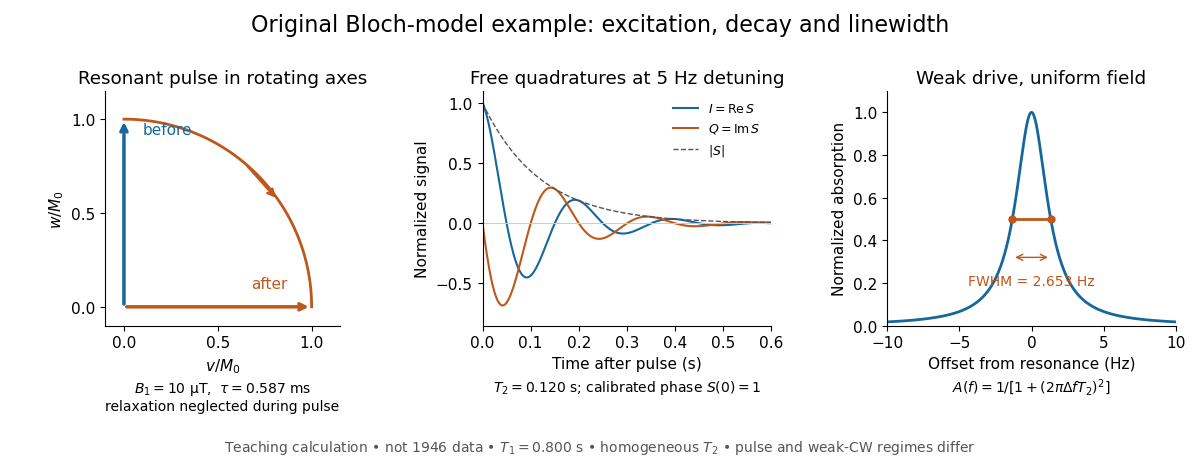
For an original teaching model, take positive , a circular drive , and axes rotating at about . Define , , and . The Bloch equations becomeA linearly oscillating field of peak amplitude has a co-rotating component of amplitude ; neglecting its counter-rotating component requires near resonance.
At resonance, a short pulse starting from gives with , neglecting relaxation during duration . A receiver phase rotation can make a pulse's initial transverse signal real. After the pulse, direct integration givesThese are the two components extracted by quadrature demodulation. Differentiating verifies ; taking its magnitude separates decay from detuning.
Choose rounded illustrative , , , and . Then and the duration is , short relative to both relaxation times. For receiver detuning and , and . These are calculated examples, not 1946 measurements.
Articles by others on the same topic


Free Induction Decay (FID) is a phenomenon observed in nuclear magnetic resonance (NMR) and magnetic resonance imaging (MRI). It refers to the signal that is detected after the initial excitation pulse is applied to a sample containing nuclei with magnetic properties, such as hydrogen atoms in water.