Gamma-chain pairing bounds from bulk composition describe what a measured G-gamma globin/A-gamma globin chain ratio can establish about the assemblies containing those chains. Assume every measured gamma chain belongs to a standard fetal hemoglobin tetramer containing exactly two gamma chains. A bulk chain fraction then constrains, but generally does not determine, how the two forms are paired. The molecular distinction between the forms is experimentally established by glycine versus alanine at residue 136.[ref]
Evidence for multiple structural genes for the gamma chain of human fetal hemoglobin by W. A. Schroeder and others. Page 537, opening paragraph
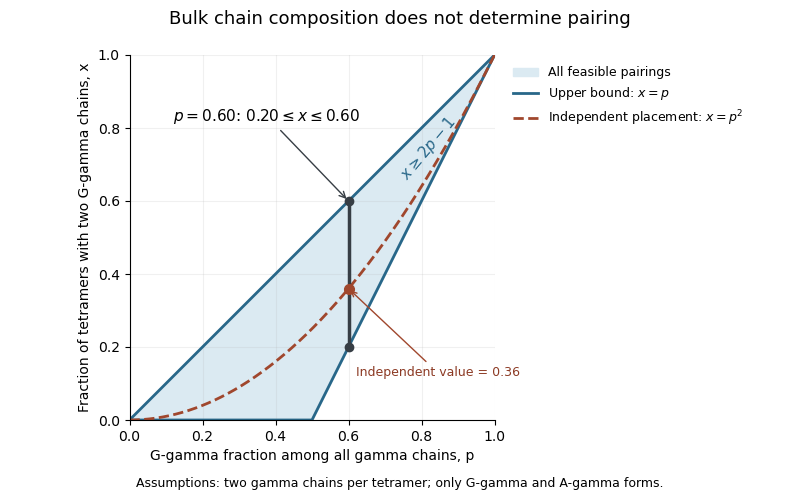
Let be the fraction of gamma chains that are G-gamma, and let be the fractions of tetramers containing respectively two G-gamma chains, one of each form, and two A-gamma chains. Counting assemblies and chains givesHence and . Requiring all three fractions to be nonnegative gives the sharp boundsEvery value in this interval yields nonnegative with the required bulk composition; a finite population additionally requires integral assembly counts.
For an original example, 100 tetramers containing 120 G-gamma and 80 A-gamma chains have . The endpoint compositions and give the same chain counts. Thus the fraction of two-G-gamma tetramers can range from to despite an exactly known bulk composition.
Independent random placement is an additional model. It selects the binomial distribution valuesAt , these are , one feasible point rather than a consequence of the measured chain ratio. The inequalities and show why the random-pairing value always lies within the bounds.
The argument does not infer actual biological pairing preferences. It identifies the information lost when an assay pools chains from many protein complexes. Free chains, other assemblies or unequal analytical responses would require a different input model. A change in bulk sequence proportions is therefore not automatically a measured change in every tetramer's composition or oxygen binding.

Articles by others on the same topic
There are currently no matching articles.