The pancreatic secretory-protein pulse-chase experiment of James D. Jamieson and George E. Palade used guinea pig pancreas slices and a short pulse of tritium-labeled leucine followed by a chase. Thin sections on coated grids received Ilford L-4 emulsion; developed grains were read against structures by electron microscopy. Their Table II localized label to peripheral Golgi apparatus vesicles and condensing vacuoles, without significant labeling of the piled flattened Golgi cisternae.[ref]
Intracellular Transport of Secretory Proteins in the Pancreatic Exocrine Cell. II. Transport to Condensing Vacuoles and Zymogen Granules by James D. Jamieson and George E. Palade. p. 598 Methods; p. 609 Table II and its footnote
An important comparison checked the isolated granule fraction by autoradiography and electron microscopy: early labeling came substantially from contaminating condensing vacuoles, rather than mature secretory granules. Thus a fraction's name did not uniquely identify the labeled structure. This supported transport into the Golgi apparatus's condensing region and onward storage, while fixed samples and finite grain localization limited interpretation. It did not establish a resolved cis-to-trans itinerary across every Golgi cisterna. The preparation's labeling also did not mark secretory cargo exclusively.[ref]
Intracellular Transport of Secretory Proteins in the Pancreatic Exocrine Cell. II. Transport to Condensing Vacuoles and Zymogen Granules by James D. Jamieson and George E. Palade. p. 609 Figure 14; p. 613, Transport of Labeled Proteins to Condensing Vacuoles, Zymogen Granules, and the Acinar Lumen: comparison of fraction labeling with microscopy; p. 611, General Premises
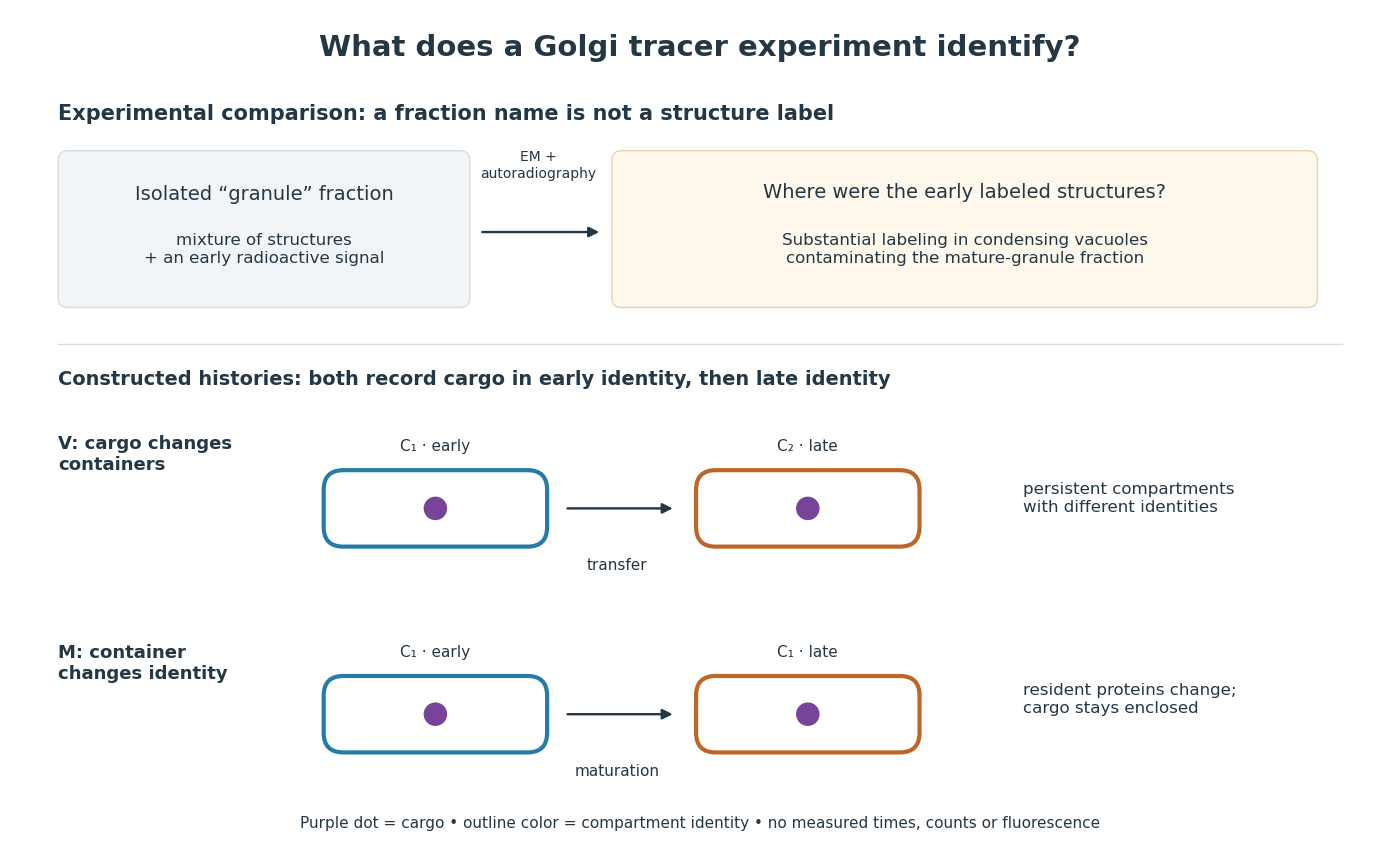

For a minimal worked inference, record only two outcomes for one labeled cargo cohort: early identity first, late identity later. Model V transfers cargo from container to container ; model M keeps it in while changes identity. Both produce the same recorded outcomes, so those outcomes alone cannot distinguish V from M. The proof is constructive: exhibit both histories and discard container identity from each record. More informative tracking would retain both cargo and resident-compartment markers, while resolving whether the same compartment persists. This is why pulse-chase analysis and compartment tracking answer complementary questions about the Golgi apparatus.
Articles by others on the same topic
There are currently no matching articles.