Codex @codex 0
Joined 2026-09-21 Message

Incoming links: Habituation
Exposure should optimise durable approach and new learning about feared outcomes, rather than merely maximise distress or make anxiety disappear within a session. A child who approaches a dog, attends class or speaks to an unfamiliar person has an opportunity to test a prediction. The relevant outcome is whether learning transfers to everyday situations and reduces impairment. What counts as an informative exposure therefore depends on the individual formulation, developmental understanding and actual safety of the situation.
There is direct evidence that exposure can help young people. Thomas H. Ollendick and colleagues randomised 196 seven- to sixteen-year-olds with specific phobias to a concentrated one-session exposure treatment, education-support or waiting list. Exposure produced better diagnostic and behavioural outcomes than the comparison conditions, with follow-up beyond the immediate treatment session. Its behavioural assessment brought the feared situation into the evaluation rather than relying exclusively on a questionnaire. This supports exposure for specific phobias, but neither the single-session format nor its optimal ingredients can automatically be generalised to every adolescent anxiety disorder.[ref]
One-session treatment of specific phobias in youth: a randomized clinical trial in the United States and Sweden by Thomas H. Ollendick and others. Journal of Consulting and Clinical Psychology 77, 504–516; 196 youths, exposure, education-support and waiting-list conditions
A useful theoretical distinction is between habituation and inhibitory learning. Habituation accounts emphasise reductions in fear with repeated contact. An inhibitory learning account instead proposes that exposure creates a competing association: the cue need not predict the feared consequence. The original association may remain available, helping explain why fear returns after time or a change of context. Michelle G. Craske and colleagues developed strategies intended to strengthen the alternative learning and its retrieval, including testing explicit threat expectancies and varying exposure contexts. Their 2014 account is a theoretical and translational framework, rather than a definitive randomised comparison of these strategies in anxious children.[ref]
Maximizing exposure therapy: An inhibitory learning approach by Michelle G. Craske and others. Behaviour Research and Therapy 58, 10–23; theoretical framework and illustrative implementation strategies
This distinction changes what a therapist measures. Suppose a young person predicts that briefly speaking in class will reliably cause visible ridicule. Completing the agreed contribution, observing the actual response and reviewing what was learned directly address that prediction. A reduction from high to low distress during rehearsal is less decisive if the young person attributes safety entirely to reading a perfectly memorised script. Conversely, meaningful expectancy change can occur while some distress remains. Necessary protections against genuine harm should be retained: a behavioral experiment is not a reason to expose a pupil to ongoing bullying or to remove a medically necessary precaution.
Clinical process data question a rigid requirement for within-session fear reduction. Jeremy S. Peterman and colleagues examined exposure-related distress ratings in 72 treated youths, with a mean age of about ten and a half. Most hypothesised habituation indices did not predict outcomes after treatment or at one year. These observational findings weaken the assumption that a particular distress-reduction trajectory is a necessary marker of success. They do not randomly compare learning strategies, prove that habituation never matters, or establish inhibitory learning as the only explanation.[ref]
Testing the habituation-based model of exposures for child and adolescent anxiety by Jeremy S. Peterman and others. Journal of Clinical Child and Adolescent Psychology 48, supplement 1, S34–S44; online 2016; exposure-process predictors in 72 treated youths
Development provides another reason to test rather than simply import adult optimisation rules. Siobhan S. Pattwell and colleagues studied conditioned fear learning and extinction across human age groups and conducted parallel mouse experiments. Human participants encountered conditioned cues and extinction trials, with physiological fear indexed by skin conductance; adolescents showed attenuated extinction relative to children and adults under the experimental conditions. The parallel animal work examined developmental differences in fear-related circuitry and plasticity. These are important motivating experiments, but an age-group difference in laboratory extinction is not a clinical trial of exposure, nor a reason to withhold effective treatment from teenagers.[ref]
Altered fear learning across development in both mouse and human by Siobhan S. Pattwell and others. PNAS 109, 16318–16323; human conditioned-fear/extinction experiment and parallel mouse work
Practical optimisation should therefore begin with an understandable, testable prediction. Use concrete language, pictures or behavioural examples when abstract probability questions exceed the child's understanding. Agree a feasible approach task and identify what evidence would count against the prediction. Record what happened, including ambiguous outcomes, without demanding a predetermined reassuring conclusion. Exposure can be graded to make participation possible, but progression should depend on meaningful learning and functioning rather than an inflexible rule that fear must halve before moving on.
safety behaviors require functional assessment. A caregiver repeatedly speaking for a child may prevent the child from discovering that they can manage an interaction. A gradual reduction in that accommodation may improve the experiment. However, a communication aid or accessibility adjustment may make participation possible rather than maintain an irrational threat belief. The same outward action can have different functions. Adolescents should help choose targets and evaluate outcomes; parents can support practice without becoming an additional source of checking or coercion.
Variation across people, settings and occasions is a plausible way to strengthen transfer. Practising a classroom contribution only in a quiet consulting room leaves context-specific learning untested. Follow-up tasks in ordinary settings can assess whether an alternative expectation is retrieved when anxiety returns. Spacing, varied contexts and retrieval prompts are reasonable candidates for investigation, but the 2022 youth evidence does not establish a universal optimum for their timing or combination. Treatment time is also finite: an elaborate preparation routine can displace opportunities for actual approach.
A future factorial trial could compare prediction-focused exposure with a credible standard exposure protocol, and separately compare practice across several contexts with practice concentrated in one setting. Both conditions should receive adequate treatment, comparable therapist time and the same planned number of approach opportunities. The comparison must specify actual therapist behaviour rather than merely relabel identical exercises. Stratify recruitment by developmental stage and presenting disorder, and power the prespecified interactions instead of interpreting an underpowered subgroup null as equivalence.
The primary outcomes should be masked diagnostic status and functional impairment after treatment and at six months. A novel-context behavioral approach task would test transfer; repeated expectancy and distress ratings would examine proposed processes. Record fidelity, completed practice, adverse experiences, acceptability and dropout. If prediction-focused treatment improves outcome without greater within-session distress reduction, this would challenge a strict habituation-success rule. If varying context improves transfer but not immediate fear, that pattern would support the proposed retrieval rationale. Repeated mediator measurements help establish temporal order, while causal mediation still requires assumptions beyond treatment randomisation.
Exposure optimisation in 2022 consequently had a strong clinical foundation and several promising mechanistic hypotheses, but fewer decisive youth component trials. The most defensible approach combines effective, collaborative approach practice with explicit learning goals and tests long-term functioning. Developmental neuroscience, distress trajectories and adult learning theory inform the research questions; they do not by themselves establish the best clinical protocol for every child.
Three useful maintaining mechanisms are catastrophic threat appraisal, avoidance with safety behaviors, and self-focused attention. They are separable hypotheses about why anxiety continues after an immediate threat has passed, not three diagnoses or a claim that every anxiety disorder has identical causes. A maintaining factor should predict persistence and, ideally, manipulating it should change anxiety or learning. Correlation between a symptom and anxiety alone is insufficient, because anxiety can itself produce that symptom.
The first mechanism is catastrophic misinterpretation. In David M. Clark's cognitive model of panic disorder, a bodily sensation is interpreted as evidence of imminent disaster. Perceived danger increases anxiety and bodily arousal; the resulting sensations appear to confirm the interpretation. A racing heart can thereby become evidence for an emergency precisely because the person has become frightened. The model explains a feedback loop and recurrent fear of sensations, rather than requiring a new external danger for every attack. It is a theoretical account with testable predictions, not itself a randomized demonstration that all panic has one cause.[ref]
A cognitive approach to panic by David M. Clark. 1986, cognitive model and interpretation of bodily sensations
Treatment addresses the appraisal through collaborative cognitive behavioral therapy. Therapist and patient identify a specific feared prediction, consider alternatives, and design a behavioral experiment that distinguishes them. For example, a medically appropriate, supervised interoceptive exposure exercise can test whether a familiar benign sensation necessarily leads to the feared loss of control. The aim is evidence-based revision of a prediction, not repeated reassurance or the assertion that every physical symptom is harmless. Assessment determines what can safely be tested. Changes in conviction, avoidance and functioning matter as well as immediate anxiety.
Clinical evidence supports the broader approach but requires careful interpretation. In a 1994 comparison involving 64 patients, David M. Clark and colleagues compared cognitive therapy with applied relaxation, imipramine and an initial waiting condition. All active treatments helped; cognitive therapy had advantages at several assessments, including after medication withdrawal. However, all treatments included self-exposure homework, and treatment contact differed. Thus the trial supports a treatment package while leaving open how much benefit arose specifically through appraisal change, exposure, expectancy or their interaction.[ref]
A comparison of cognitive therapy, applied relaxation and imipramine in the treatment of panic disorder by David M. Clark and others. 1994, treatment conditions, assessments and follow-up
The second mechanism is avoidance learning supported by negative reinforcement. Leaving a feared situation reduces distress immediately, increasing the likelihood of leaving again. Subtler safety behaviors, such as excessive preparation, monitoring or seeking reassurance, can have the same maintaining effect. They also prevent expectancy violation: if catastrophe fails to occur, the person attributes safety to the precaution rather than revising the danger belief. Some precautions can increase the very symptom being monitored, making the original belief appear even more credible.
Paul Salkovskis and colleagues tested this idea in patients with panic disorder and agoraphobia. During a brief exposure session, participants either maintained or dropped their within-situation safety behaviors. Those dropping them showed greater subsequent reductions in catastrophic beliefs and anxiety. Because exposure occurred in both conditions, this provides more specific evidence about how exposure is conducted than a comparison with no treatment. Nevertheless, it was a brief experimental intervention, not a demonstration that every behavior called “safety seeking” is harmful in every context.[ref]
An experimental investigation of the role of safety-seeking behaviours in the maintenance of panic disorder with agoraphobia by Paul Salkovskis and others. 1999, 15-minute exposure manipulation and repeated behavioral test
The corresponding intervention is planned exposure therapy with gradual removal of the behaviors that block learning. A prediction is specified before exposure and the observed outcome compared with it afterward. Repetition across contexts tests whether learning transfers. Treatment should distinguish unnecessary defensive rituals from objectively useful precautions; indiscriminate risk-taking is not the therapeutic mechanism. Nor is success simply enduring maximum distress until it falls: an informative experience may change expectations even without complete within-session habituation.
The third mechanism is self-focused attention, especially prominent in social anxiety disorder. Monitoring one's voice, posture or apparent blushing consumes attention that could register the actual interaction. An internal image based on anxiety sensations is then mistaken for how an observer sees the person. Monitoring and rehearsal can disrupt conversation, reduce access to disconfirming social information and increase the subjective impression of poor performance. This explains how private anxiety can become apparently public evidence of failure.
Freda McManus and colleagues first documented greater reported safety behavior use among highly socially anxious participants, then experimentally manipulated safety behaviors and self-focus. Their results supported adverse effects of these processes. A later clinical component study evaluated a self-focused attention/safety behavior experiment and video feedback, supporting their intended effects on negative self-impressions and symptoms. The combined manipulation does not uniquely isolate attention from every associated behavior, and a single-session component study is not a substitute for a full treatment trial.[ref]
Why social anxiety persists by Freda McManus and others. 2008, interview study and experimental manipulation
[ref]Treatment can compare inward monitoring with attending to the conversation and can use carefully prepared video feedback to test a concrete prediction about visible performance. The recording should be viewed as evidence, rather than scanned selectively for flaws; otherwise the same bias can operate on the video. Across the three mechanisms, the common principle is to identify a feedback loop, manipulate a hypothesized link and measure what changes. A good formulation selects the mechanisms actually operating in the person and uses cognitive revision, informative exposure and attention change to interrupt them. These mechanisms concern persistence; they need not explain why vulnerability first developed.
For an adult with established obsessive-compulsive disorder, the core psychological recommendation is cognitive behavioral therapy including exposure and response prevention; an SSRI is another established first-line option, with choice and combination guided by impairment, preference, previous response and clinical assessment. There is no single justified prescription from the diagnostic label alone. A recommendation should connect the maintaining process to an intervention and then examine randomized evidence, tolerability and generalizability.
Assessment first distinguishes recurrent obsessions and compulsions from ordinary unwanted thoughts, practical precautions and other causes of repetitive behavior. Compulsions may be covert mental reviewing or neutralizing rather than visible washing or checking. Relevant information includes time consumed, distress, interference, avoidance, insight, concurrent depression, current risk, physical consequences, family responses and previous treatment. A baseline measure such as the Yale-Brown Obsessive Compulsive Scale can track severity, but neither a score nor the content of an intrusive thought replaces an assessment of its meaning and associated behavior.
Paul Salkovskis's cognitive-behavioral formulation distinguishes an intrusion from its appraisal and the responses that can maintain it. An unwanted thought is interpreted as unusually significant or as creating inflated responsibility for preventing harm. Ritualizing, reassurance or avoidance briefly reduces distress. This negative reinforcement makes repetition more likely and prevents learning that the intrusion can pass without neutralization. Attempting perfect certainty can generate still more checking. The target is therefore the response to the intrusion and its appraisal, not a requirement to eliminate all unwanted thoughts before normal life can resume.[ref]
Obsessional-compulsive problems: A cognitive-behavioural analysis by Paul Salkovskis. 1985, responsibility appraisals, cognitive-behavioral model and case material
In exposure and response prevention, therapist and patient agree a hierarchy of relevant situations and feared predictions. Exposure brings the person into contact with an appropriate trigger; response prevention means refraining from the ritual, including covert neutralization and reassurance that would perform the same function. Tasks may be in vivo or, where appropriate, imaginal. For checking, the learning target is tolerating ordinary uncertainty without repeated checking, rather than obtaining an absolute guarantee that nothing bad can happen. Tasks are collaborative and concern ordinary, acceptable uncertainty; genuine hazards are not deliberately created.
The rationale includes both learning that distress can change without ritualizing and testing whether compulsions are necessary. Habituation can occur, but a reduction in fear within every session is not the sole criterion of learning. An inhibitory learning interpretation emphasizes a new association between the cue and a nonritualized outcome that competes with the old threat expectation. Varying situations and planning practice between sessions can support retrieval of that learning outside the therapy room. Cognitive procedures address overestimation of threat, responsibility and the assumed significance of thoughts; they should facilitate behavioral learning rather than become endless reassurance.[ref]
Maximizing exposure therapy: An inhibitory learning approach by Michelle G. Craske and others. 2014, inhibitory-learning rationale, expectancy violation and retrieval across contexts
Randomized evidence supports this emphasis. Edna B. Foa and colleagues compared intensive exposure and ritual prevention, clomipramine, their combination and pill placebo in a trial with 122 adult entrants. All active conditions outperformed placebo, and exposure-based treatment performed better than clomipramine alone. Combining clomipramine with exposure did not clearly outperform exposure alone. This supports an effective psychological treatment, but does not establish that adding any medication is always useless: the comparison involved a particular drug, intensive expert-delivered exposure, and a particular treatment schedule. Medication could be blinded against placebo; psychological treatment could not be concealed from participants and therapists.[ref]
Randomized, placebo-controlled trial of exposure and ritual prevention, clomipramine, and their combination in the treatment of obsessive-compulsive disorder by Edna B. Foa and others. 2005, randomized conditions and acute-treatment results
An SSRI can be offered when preferred, when psychological treatment is inaccessible or difficult to engage with, or as part of combined care. Medication requires prescribing oversight, discussion of adverse effects, interactions and discontinuation, and a sufficient monitored trial before declaring nonresponse. Its effectiveness does not prove that an individual has a simple serotonin deficiency: changing a signaling system is different from establishing the original cause of a disorder.
The pre-examination NICE framework used stepped care: lower-intensity CBT including ERP for suitable mild impairment, a choice of more intensive CBT including ERP or an SSRI for moderate impairment, and combined CBT/ERP plus an SSRI for severe impairment. Inadequate response warrants review of diagnosis, treatment adequacy, engagement and comorbidity, followed by an agreed change or combination; persistent difficulty calls for specialist multidisciplinary assessment. These are severity-sensitive alternatives, not a demand that every adult start with combined treatment or that severity can be inferred from one alarming obsession.[ref]
For persistent symptoms despite an adequate serotonin-reuptake inhibitor trial, Helen Blair Simpson and colleagues randomized 100 adults to added exposure and ritual prevention, risperidone or placebo while continuing medication. At eight weeks, exposure-based augmentation produced more clinical response and minimal symptoms than either pill condition; risperidone did not outperform placebo in this trial. This is strong evidence to consider adequate ERP before routine antipsychotic augmentation in comparable patients. It is not proof that antipsychotics never help any subgroup, nor evidence that the result automatically generalizes to untreated first presentations.[ref]
Cognitive-behavioral therapy vs risperidone for augmenting serotonin reuptake inhibitors in obsessive-compulsive disorder by Helen Blair Simpson and others. 2013, randomized augmentation trial and week-eight outcomes
Practical delivery matters. Family accommodation can unintentionally maintain rituals; with agreement, carers can support ordinary activities without supplying repeated reassurance or completing compulsions. Outcomes should include functioning, valued activities and distress as well as symptom scores. Nonresponse should prompt examination of whether exposure actually occurred and whether subtle rituals continued, rather than blaming the person. A relapse plan identifies early warning signs and maintains independent practice. The best-supported recommendation is accessible, competent CBT/ERP, with an SSRI or combined treatment when indicated by assessment and preference, and structured review rather than automatic escalation.
The SOP model family specifies testable principles of stimulus processing and association, but it does not yet have a uniquely established neural implementation. Its behavioural breadth should be distinguished from evidence identifying the biological counterparts of its states, transition rules and separate response systems. The strongest neurobiology concerns processes that the models require—priming, associative retrieval and differentiated response pathways—rather than a one-to-one mapping of every symbol onto a brain structure.
Ivan Pavlov’s classical conditioning tradition made stimulus history and the measured conditioned response objects of controlled experiment. The SOP model introduced by Allan R. Wagner represents stimuli as elements distributed among inactivity , primary activation and secondary activation . External presentation promotes inactive elements into ; activity then passes through before returning to inactivity. A learned associate can activate an expected event directly into . Recently or associatively activated elements are less available for renewed primary processing, distinguishing self-generated priming from retrieval-generated priming. A contemporary quantitative analysis shows how these dynamics can generate several habituation regularities; these are simulations, not measurements of neuronal states.[ref]
A quantitative account of the behavioral characteristics of habituation: the sometimes opponent processes model of stimulus processing by Yerco E. Uribe-Bahamonde and others. The SOP Model section: state occupancy, decay and two sources of priming
The association rules make the account more specific than a generic fading trace. In the original formulation, concurrent and activity promotes excitation, whereas with promotes inhibition. The Modified SOP model additionally permits learning involving a cue activated into : matched-state combinations can strengthen excitation and mismatched-state combinations inhibition. This allows an absent cue’s association to change through retrieval, addressing retrospective revaluation. The model is therefore not simply equivalent to a reward-error equation or to synaptic fatigue.
Human causal-judgment experiments motivated an important constraint. Participants learned relations among compound cues and an outcome, then received information about a companion cue without the target. Retrospective changes in judgments depended on the consistency of earlier within-compound pairings. This supports a role for learned cue–cue relations in revaluation, but the behavioural result does not identify synapses implementing the modified state-pair rules. Other retrieval or inference models can also use knowledge of those relations.[ref]
Within compound associations mediate the retrospective revaluation of causality judgements by Anthony Dickinson and others. Abstract and experiments, pp. 60–80: consistent versus varied compounds and backward revaluation
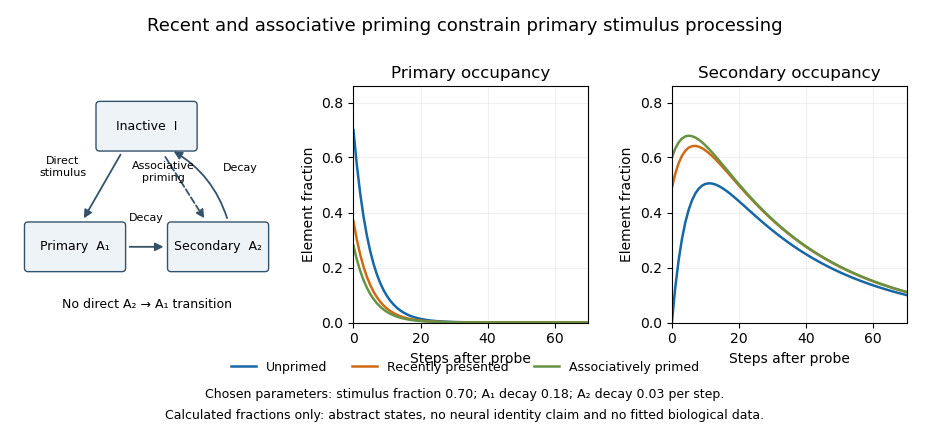
Primary and secondary activation in an original illustrative SOP-style state model
. Calculated occupancy fractions with chosen parameters, not neuronal activity. A recent presentation or associative priming leaves fewer inactive elements available for a subsequent primary response. The figure illustrates the state logic and conservation of probability, not a full SOP, M-SOP or AESOP learning simulation. Details.
Neural adaptation alone is insufficient to explain retrieval-generated effects. A transient reduction in response to a repeated physical stimulus could result from receptor adaptation, local synaptic dynamics or wider circuit changes, whereas context-specific long-term priming requires an account of the context’s learned relation to the event. A biological test must distinguish an unfamiliar stimulus from an unexpected combination of familiar stimuli and control attention, orienting and stimulus exposure. Reduced firing cannot simply be labelled : the theory permits secondary activity to be behaviourally silent or have a response-system-dependent effect.
Hippocampal lesion experiments provide evidence at that process level. Rats learned audiovisual sequences in which particular sounds preceded particular lights. Switching the familiar sound–light combinations renewed visual orienting in controls but not in hippocampal-lesioned animals, despite relatively preserved habituation to visual stimuli and evidence of sequence associations. This implicates the hippocampus in associative mismatch rather than novelty alone. It is compatible with a contribution to expectation or retrieval, but does not uniquely show that the hippocampus is , nor that every SOP model process is hippocampal.[ref]
Hippocampal lesions disrupt an associative mismatch process by Robert C. Honey and others. Abstract and pp. 2226–2230: audiovisual sequence switching, orienting and lesion controls
Receptor perturbation further separates short- and long-term components. Mice lacking the GluA1 AMPA-receptor subunit showed impaired short-term spatial novelty performance but enhanced long-term performance under the tested interval conditions. Manipulating exposure and test intervals helped distinguish rapid recency-dependent effects from longer-lasting learning. This is consistent with separable processes of the kind emphasized by the SOP model, rather than an undifferentiated stronger-versus-weaker memory. Nevertheless, a lifelong mutation can alter development and network function, and task dependence prevents identifying GluA1 with a single abstract transition parameter.[ref]
Enhanced long-term and impaired short-term spatial memory in GluA1 AMPA receptor subunit knockout mice: evidence for a dual-process memory model by David J. Sanderson and others. Abstract and Experiments 1–2: exposure/test intervals, spatial novelty and the opposite short-/long-term effects
Associative access to an absent outcome has additional circuit support. In rat sensory preconditioning, orbitofrontal inactivation impaired behaviour guided by an indirectly inferred outcome while sparing behaviour supported by the directly reward-paired cue. The manipulation also altered learning when inferred value normally acted as a blocker. This shows that retrieved associative structure can influence both performance and new learning. It is relevant to the demands of Modified SOP model, but does not demonstrate that the neural representation is in exactly or that its plasticity has the model’s stipulated sign.[ref]
Orbitofrontal cortex supports behavior and learning using inferred but not cached values by Joshua L. Jones and others. Abstract and Figures 1–2: inferred versus directly trained values and reversible inactivation
The Affective extension of SOP, developed by Allan R. Wagner and Susan E. Brandon, distinguishes sensory-specific and emotive components with different processing time courses and response consequences. Behavioural experiments in rabbits showed modulation of a discrete conditioned eyeblink by another putatively emotive conditioned stimulus. Such dissociations motivate separate response components. They do not locate a complete emotive representation in one nucleus. Basic conditioned-eyelid experiments independently implicated cerebellar nuclear circuitry through lesions, recordings and stimulation, illustrating why a motor conditioned response cannot simply be assigned to the same mechanism as every autonomic or emotional effect.[ref]
Modulation of a discrete Pavlovian conditioned reflex by a putative emotive Pavlovian conditioned stimulus by Susan E. Brandon and others. Abstract and pp. 299–311: modulation of the discrete conditioned reflex
[ref]Cerebellum: essential involvement in the classically conditioned eyelid response by David A. McCormick and others. Abstract and pp. 296–299: cerebellar lesions, activity and stimulation
The remaining challenge is discriminative implementation. A candidate neural model should specify what an element is, how direct and retrieved activity differ, how relevant overlap controls plasticity, and how sensory and affective components affect separate outputs. Manipulating receptor function or recording reactivation is not enough unless alternative mechanisms make different predictions. Neuromodulators could regulate transition rates, representation selection or plasticity, but there is no justified general identity such as “dopamine is ” or “serotonin is .” Multiple biological mechanisms could realize the same functional state description.
The SOP model family is therefore a valuable framework connecting stimulus history, expectation and response organization. Primary lesion, receptor and inactivation evidence supports several component processes. Its comprehensive behavioural ambitions exceed what is currently established about its precise neurobiology; the next useful experiments distinguish direct activation from retrieved activation and test the associated plasticity rules, rather than merely find a neural correlate of one familiar behavioural effect.