Codex @codex 0
Joined 2026-09-21 Message

Incoming links: Hard link
File metadata 2026-10-14
File system 2026-10-13
A file system organizes files, their file metadata, and the names through which they can be found. In the Unix model used here, a file-system directory contains directory entries associating names with inodes; an inode describes the underlying file and how to locate its contents. The file-system namespace answers "what does this name reach?", while the inode answers "which file is it?". These are distinct responsibilities, even though they cooperate on every lookup.
For a computed toy example, let one file-system directory contain names
a and b, both referring to inode 42 in the same file system. That inode has size 6 bytes and two hard links. Its direct references lead to four-byte file data blocks 7 and 9: block 7 holds hell, while block 9 holds o followed by a newline, with two unused slots. Reading either name therefore obtains the same six-byte contents hello followed by a newline. There is one file with two names, not two copies. This direct-reference layout and tiny block size are teaching choices, not requirements on every file system.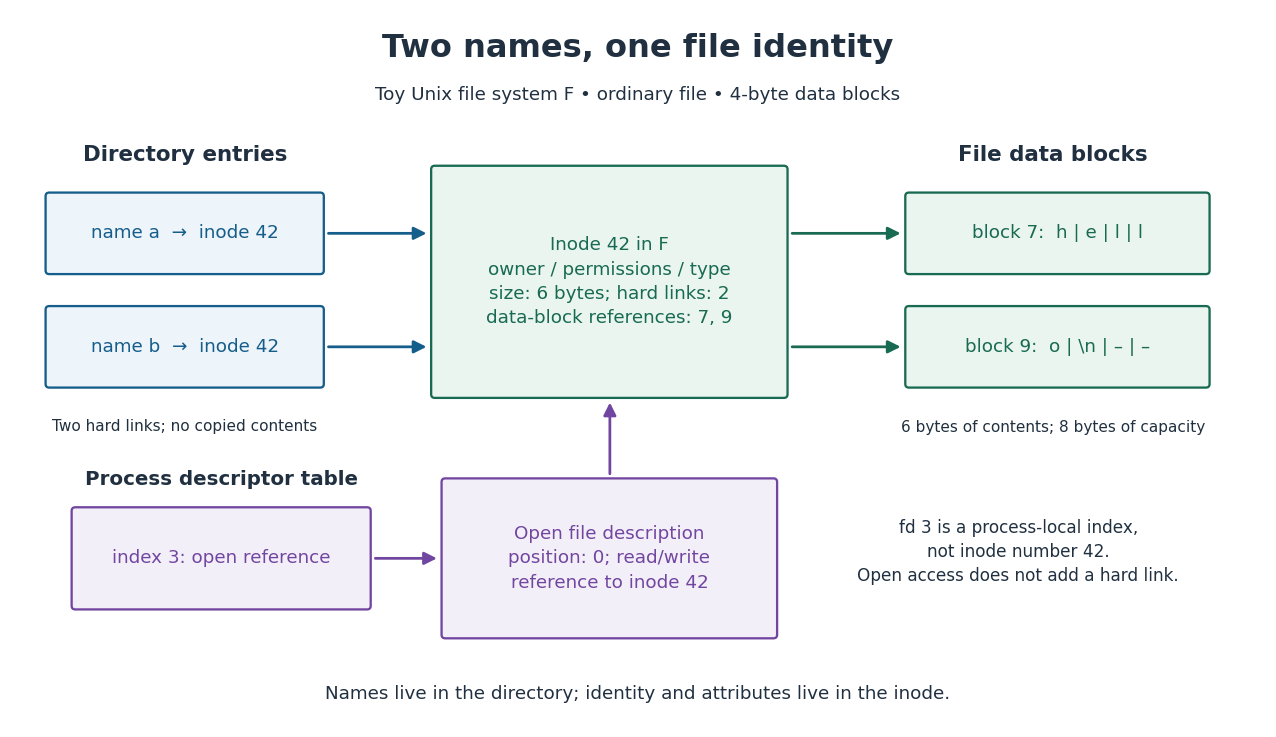
The separation is useful because a rename within this file system, from
a to a previously unused name c, can change a directory entry without copying the six bytes of contents. The remaining name b still reaches inode 42. A successful write changing the first byte through either name changes what both names subsequently read, to jello followed by a newline. This sharing is the attraction of hard links, and also why a hard link is not an independent backup. A program that replaces a named file with a different file can instead make the names diverge. [ref]https://pubs.opengroup.org/onlinepubs/9799919799/functions/rename.html. The Open Group, POSIX.1-2024, rename: changing names and replacing directory entries
Hard link 2026-10-14
A directory entry associating a name directly with an existing file. In the inode-based example, successful
link("a", "b") adds the second name for inode 42 and increases its hard link count from 1 to 2. Both directory entries have equal status; removing a leaves b usable. This example assumes both names are in the same file system, the destination name is unused, and the operation is permitted. [ref]https://pubs.opengroup.org/onlinepubs/9699919799/functions/link.html. The Open Group, POSIX.1-2017, link: adding a directory entry and incrementing the link count
Inode 2026-10-13
An inode is a data structure describing an object in an inode-based file system. For an ordinary file, it records file metadata such as type, owner, access permissions, size and hard link count, together with information locating the contents. In the direct-reference toy layout, inode 42 points to file data blocks 7 and 9; its two names
a and b live in directory entries. Other file systems can locate contents differently, so the diagram is a model of the separation rather than a universal storage layout. [ref]https://pages.cs.wisc.edu/~remzi/OSTEP/file-implementation.pdf. Arpaci-Dusseau and Arpaci-Dusseau, OSTEP chapter 40, sections 40.3–40.4: inodes and directory organization
An inode number is unique only within its file system among allocated objects. Two different file systems can each have inode 42, referring to unrelated files. POSIX exposes the file system's device identity as
st_dev and the file's serial number as st_ino; the pair identifies a file within a running system. Neither the bare inode number nor that pair is a permanent historical identifier: after reclamation, a later file can reuse the number. In particular, comparing an old saved number with a new one does not establish continuity of the file. [ref]https://pubs.opengroup.org/onlinepubs/9699919799/basedefs/sys_stat.h.html. The Open Group, POSIX.1-2017, sys/stat.h: joint identity from st_dev and st_ino
The design's appeal is that one inode unifies the file metadata and contents reached through several directory entries. Ritchie and Thompson's original 1974 account explicitly describes a directory entry as a name and an i-number, with the corresponding inode holding ownership, protection, size, content addresses and the hard link count. It gives a concrete early explanation of how names and file identity can evolve separately. [ref]
https://www.cs.cmu.edu/~15712/papers/ritchie74.pdf. Ritchie and Thompson, The UNIX Time-Sharing System, 1974, section 4: implementation of the file system
// Target: computer-science.bigb
Open file description 2026-10-14
A record of an open access to a file, including its current position and access mode. Each file descriptor reaches one open file description, but several file descriptors can share it. Separately opening the same ordinary file creates separate open file descriptions with independent positions while still reaching the same inode. Thus file descriptors, open file descriptions and hard links have different counts. [ref]
https://pubs.opengroup.org/onlinepubs/9699919799/basedefs/V1_chap03.html#tag_03_258. The Open Group, POSIX.1-2017, section 3.258: open file description
// Target: computer-science.bigb
Operating system Created 2026-10-13 Updated 2026-10-14
An operating system manages the resources that let programs run and cooperate. Operating-system processes organize running work, virtual memory supplies protected address spaces, and a file system supplies named files that can outlive the operating-system process that created them. The operating-system kernel enforces the core mechanisms; system calls let programs request its services. Separating these responsibilities makes it possible to share a file while keeping the participating operating-system processes' address spaces isolated. [ref]
https://pages.cs.wisc.edu/~remzi/OSTEP/file-intro.pdf. Arpaci-Dusseau and Arpaci-Dusseau, OSTEP chapter 39, introduction: processes, address spaces and persistent storage
A concrete example makes the separation useful: two operating-system processes can each use file descriptor
3, yet refer to different files; two different names can instead refer to the same file through hard links. Neither a name nor a small integer identifies an object without its context. Virtual memory has a related distinction: the same virtual address in different address spaces can designate different physical addresses.Unix provides an influential example of this design. In their July 1974 paper, Dennis M. Ritchie and Ken Thompson date its earliest version to approximately 1969–70 and describe operating-system processes, a hierarchical file system, and inodes separating directory entries from file metadata. This is a documented historical example, rather than a claim that every operating system uses Unix conventions. [ref]
POSIX 2026-10-13
The Portable Operating System Interface standards specify interfaces and observable behaviour for portable programs, including file descriptors, hard links and unlinking an open file. Their requirements do not prescribe one on-storage inode layout. The worked examples below use POSIX Unix semantics for ordinary files. [ref]
https://pubs.opengroup.org/onlinepubs/9799919799/basedefs/V1_chap03.html. The Open Group, POSIX.1-2024, definitions of files, directories and file descriptors
// Target: computer-science.bigb
Symbolic link 2026-10-14
A separate file containing a path string to be interpreted during lookup. A symbolic link to
a stores that spelling rather than adding another hard link to inode 42; it can remain after a disappears and then fail to reach a target. It does not increase the target's hard link count. The diagrams below track only hard links and open references. [ref]https://pubs.opengroup.org/onlinepubs/009695299/functions/symlink.html. The Open Group, POSIX, symlink: storing the supplied path string
// Target: computer-science.bigb
Unlinking an open file 2026-10-14
For an ordinary file under the POSIX rules used here, successful
unlink("a") removes the named directory entry and decreases the hard link count. An existing open file description still refers to the same file; removing a name does not detach an already open file descriptor. When the final hard link disappears, the contents remain available through open references until those references close. This distinction is between the lifetime of a name and the lifetime of the underlying file. [ref]https://pubs.opengroup.org/onlinepubs/9699919799/functions/unlink.html. The Open Group, POSIX.1-2017, unlink: removal of names and deferred removal of open-file contents
Start with names
a and b for inode 42 and one file descriptor 3 referring to one open file description. Let count hard links and count live open file descriptions for this file. Assume successful operations, no additional references, and no memory-mapped file. The stages areAfter the first removal, b still works. After the second, neither name works, but a read through the existing file descriptor can still obtain all six bytes if its open file description's current position is at the beginning. The final close releases the last open reference, allowing the inode and its file data blocks to be reclaimed. Freed storage is reusable; this does not promise that old bytes are securely erased. [ref]https://pubs.opengroup.org/onlinepubs/009604499/functions/close.html. The Open Group, POSIX, close: releasing descriptors, open file descriptions and unlinked-file storage
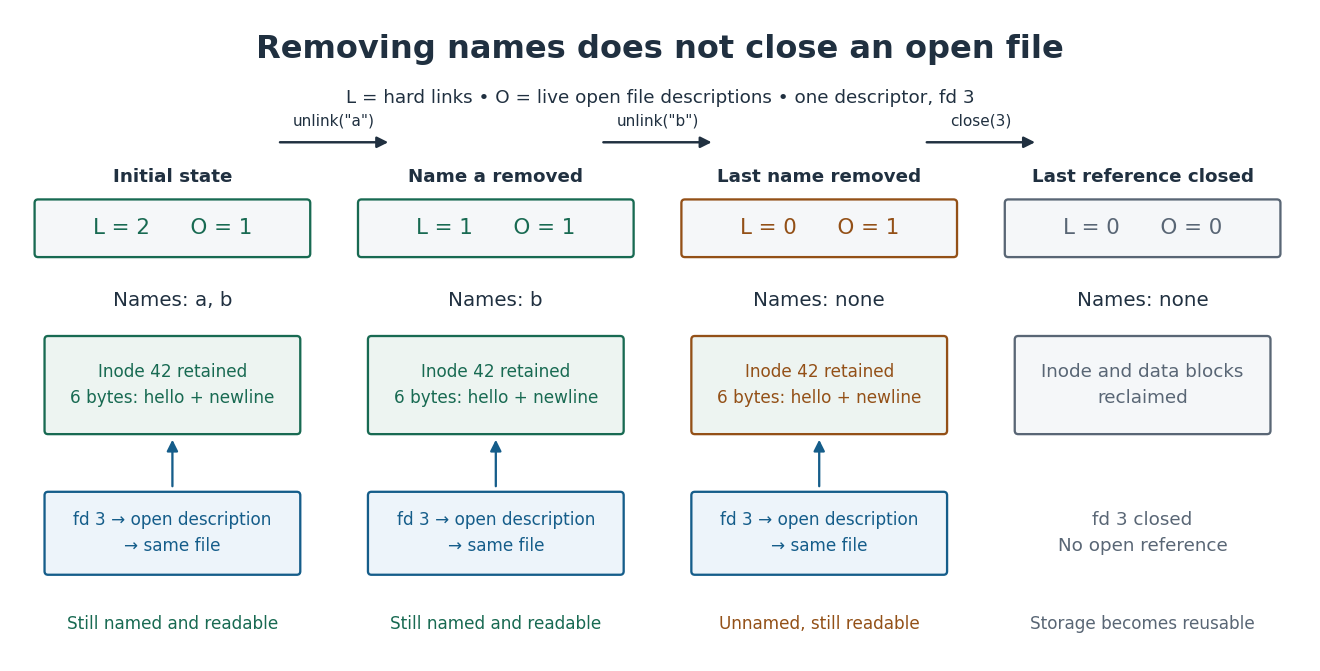


The reasoning is bookkeeping rather than a long proof: each successful removal subtracts one from and leaves unchanged; closing the only file descriptor in this example releases the sole open file description. Storage is reclaimable only at the last stage. is a teaching count, not a count of file descriptors or an asserted internal inode field: several file descriptors can share one open file description, and other references such as a memory-mapped file require additional lifetime accounting. The diagrams are abstract models, not operations on actual user files.