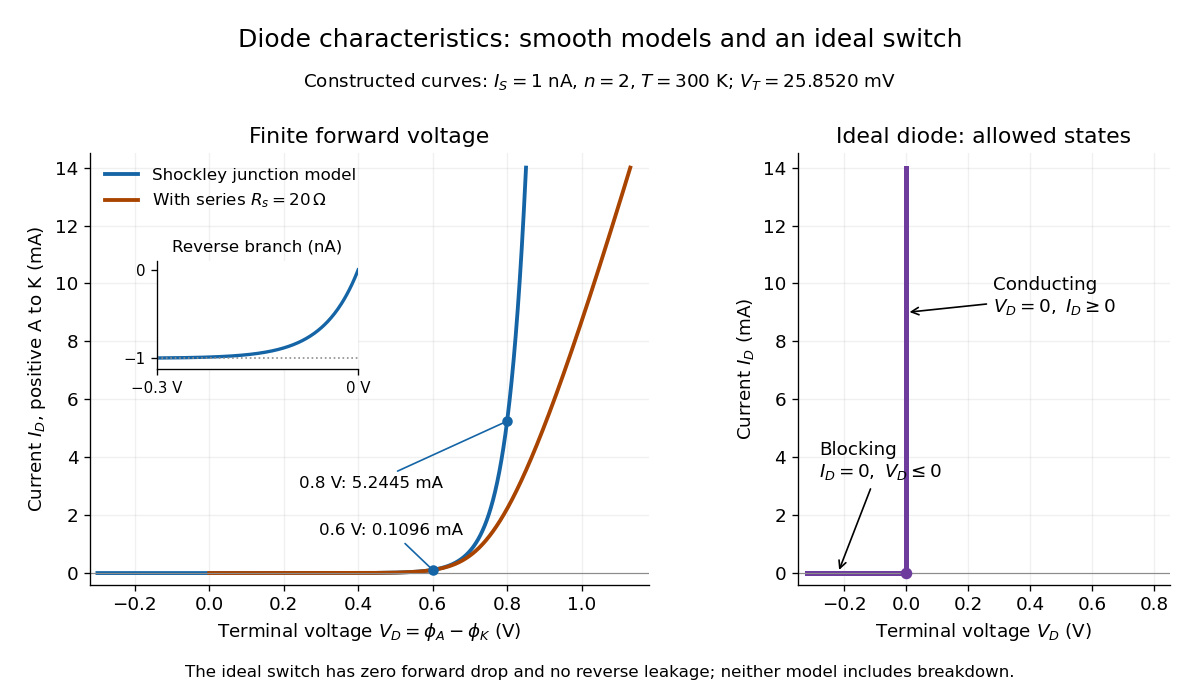
The ideal diode model sets the conducting electric potential difference to zero and the blocking electric current to zero. With the stated orientation,[ref]
The Junction Diode by W. Marshall Leach, Jr.. The Junction Diode, §1.12.1, printed p. 30: zero forward voltage and zero reverse current idealization
The surrounding electrical circuit chooses the state and remaining value. The two branches meet at . Their product vanishes, so the ideal diode dissipates no power: .
The ideal diode model omits forward drop, reverse leakage, diode reverse breakdown and switching delay.

Articles by others on the same topic
There are currently no matching articles.