Include Alice's detector and environment before taking a partial trace. Ideal measurement produces the global state
Orthogonality of the two record states removes their cross terms from the reduced state of the particles:
This nonselective quantum measurement has changed the initially entangled singlet into a separable, classically anticorrelated reduced state. Its entropy is one bit, although the full particles-plus-records state is still pure under the assumed unitary dynamics. The reduced density matrix is an improper mixture; tracing the environment does not by itself assert a literal collapse of that global state.
The Born rule gives Alice outcomes zero and one with equal probability. Conditional on a recorded result, the selective quantum measurement assigns or to the particles. The unitary measurement coupling and orthogonal records explain decoherence in this basis; they do not supply an additional rule selecting a unique outcome. That is part of the measurement problem. In a collapse postulate the individual outcome is stochastic; other interpretations account for outcome experience differently while retaining these operational probabilities.
When Bob makes the same kind of measurement, the global state becomes
Tracing both laboratories gives the same reduced matrix, . Bob has added a correlated record, not restored the lost reduced coherence. If Alice's outcome is known, Bob's opposite outcome is certain in this ideal common basis. Without that record, his marginal is , so his outcome remains equiprobable. Alice cannot choose her random result or use this correlation for faster-than-light signalling, consistently with quantum no-signalling.
These common-basis measurements alone do not distinguish quantum predictions from a local source sending opposite preassigned bits. To test that explanation, prepare fresh singlets and let the observers independently choose among incompatible measurement axes before recording each result. For singlet spin measurements along unit vectors , quantum mechanics predicts . The CHSH inequality bounds for Bell-local models with measurement-independent settings. Choosing
gives . A suitable Bell test constrains that class of explanations. Independently chosen settings, control of detection bias and separation of the measurement events matter when interpreting an actual experiment.
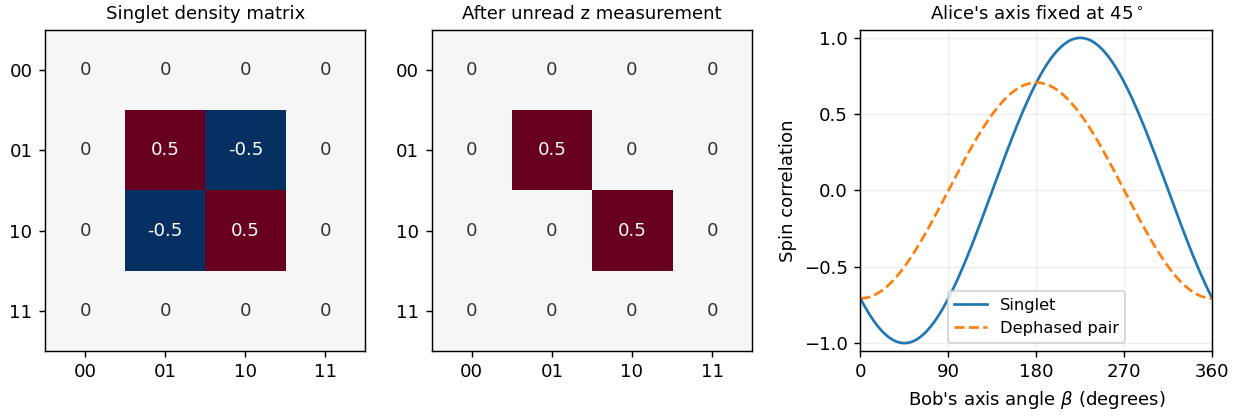
Figure 1.
Singlet coherence is lost from the reduced density matrix after a local unread measurement; common-axis anticorrelation survives
. Details.
If Alice first performs the fixed-axis irreversible measurement described above, the resulting mixed state has and cannot supply that singlet violation. The incompatible settings must belong to the Bell measurement itself. Moreover, Bell violations do not choose among all interpretations of quantum mechanics: interpretations sharing the Born predictions remain observationally equivalent for this experiment. Objective-collapse modifications could instead require additional interference tests with specified departures from unitary dynamics.
An apparent collapse is the transition from predicting several possible recorded outcomes to describing a particular recorded result. Whether that transition is a physical discontinuity, a conditional state update or an effective description depends on what the wave function is taken to represent. The practical success of collapse-based calculation does not by itself settle that interpretive question.
The difficulty is exposed by unitary time evolution. An ideal apparatus that reliably measures a basis has
Linearity then makes a superposed input evolve as
This is an entangled state, not automatically one pointer packet or the other. A separate projection rule would instead select one recorded outcome, with Born rule weights, and assign its corresponding conditional state.
Quantum decoherence explains much of the practical appearance of a classical record. Interaction with an environment correlates the packets with nearly orthogonal environment states. The subsystem's reduced density matrix then has very small interference terms between the pointer alternatives. Local experiments on that subsystem approximately agree with a diagonal mixture. But this is an improper mixture: the total state can remain a pure superposition. Taking a partial trace has not selected one term of the total state. Suppression of observable interference and the occurrence of a unique absolute outcome are distinct claims.
There is a measurement problem if one simultaneously insists that the wave function is the complete physical description, that its evolution is universally unitary, and that a measurement has exactly one absolute outcome of the ordinary recorded kind. The ideal model shows why simply applying the same unitary law to a larger apparatus does not make that combination work. Nor does calling collapse a change in knowledge solve the problem for someone who has already taken the wave function to be a complete ontic state.
Different interpretations revise different parts of this package. Bohmian mechanics adds an actual configuration and obtains effective subsystem collapse while the total wave evolves unitarily. The many-worlds interpretation retains the total superposition and treats each record as definite relative to its decohering branch. A stochastic collapse theory instead modifies the physical dynamics. Everett's original proposal explicitly separates his relative-state account from an additional collapse postulate.[ref]
Thus collapse is not problematic merely because conditional probabilities change when a record is learned. The problem is the status of that record and of the dynamical rule used to describe it. A defensible interpretation must explain when its updating rule is applicable, what makes a record definite in its own ontology, and why the ordinary measurement statistics follow. No appeal to human consciousness is required by the displayed unitary measurement model.
The measurement problem arises from applying quantum dynamics to both a measured system and a physical apparatus. If and , linearity maps a superposition to . That is generally not one selected apparatus record, although ordinary experience and the usual stochastic outcome rule assign a definite record in each run.
The conflict concerns the combination of a complete wavefunction description, universal unitary evolution and a unique ordinary outcome. They cannot all be used naively in the indicated example. Declaring that a measurement collapses the state can be a practical predictive rule, but a complete physical account must say when that nonunitary rule applies and why the apparatus is exempt from the system's ordinary equation.
Decoherence helps by correlating records with a large environment and suppressing observable interference between them. It explains approximate stability of record bases and why coherent reversals are hard, but the reduced density matrix is an improper mixture arising from an entangled state. Suppression of off-diagonal terms alone does not select one global component.
Physicists can make excellent laboratory predictions while leaving this issue open. It still matters when extending the theory to universal systems, precision tests of collapse, or claims about what the state represents. Responses include new configurations and guidance, modified stochastic dynamics or branch-relative outcomes in a unitary theory. These differ in what they assert physically and sometimes in additional testable effects. The problem is therefore not simply ignorance of which detector clicked, but the relation between a purportedly universal law and the definite evidence used to test it.
