A Bell test compares experimental probabilities or expectation values with a Bell inequality. In a two-setting photon polarization test, each station chooses a polarizer orientation and records an outcome. A coincidence circuit identifies candidate pairs using an agreed timing rule. The choice of which trials enter the statistic is part of the experiment: correlations calculated only from detected pairs can differ from correlations of all emitted pairs. The Polarization CHSH count model separates ideal expectation values from this experimental selection problem.
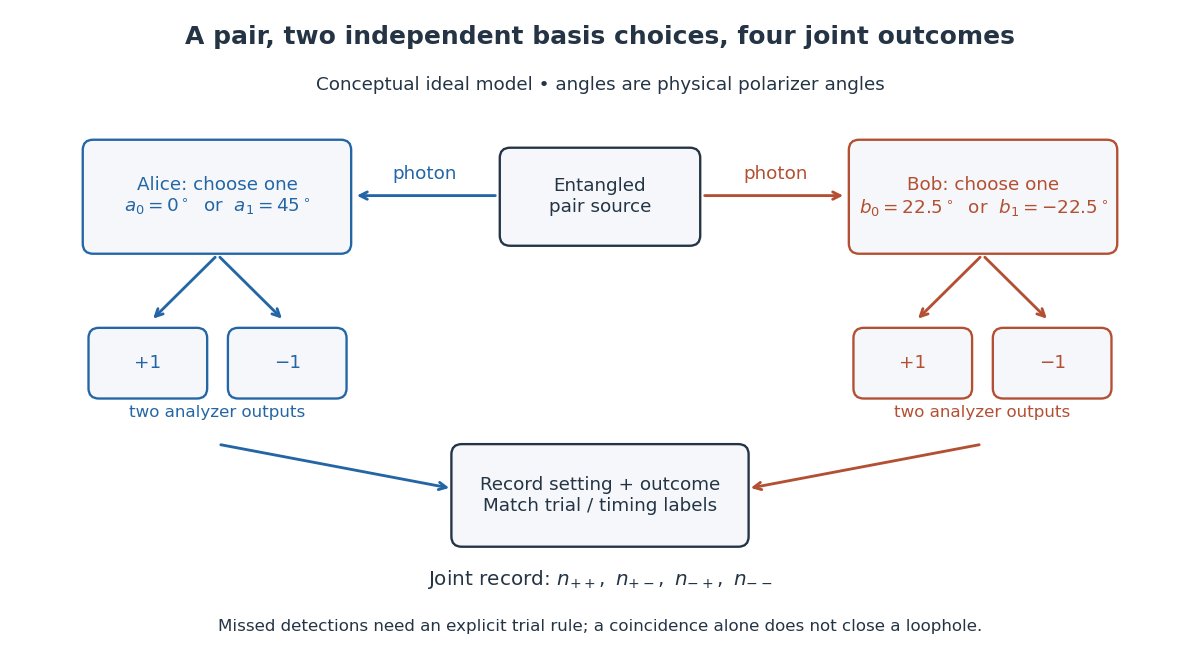
Two-setting polarization measurements and coincidence readout
. Conceptual apparatus for the ideal two-output model. The displayed angles belong to the worked CHSH example; they are not a reconstruction of a historical apparatus. Each station chooses one basis, then records either output. The coincidence record also needs a rule for missed detections. Details.
The Bell test reported by Bas Hensen and collaborators used electron spins separated by , efficient spin readout and rapid random measurement settings. Those features addressed detection and locality loopholes together. Its result tests Bell local causality with the stated experimental assumptions, rather than ruling out every possible hidden-variable theory.[ref]
Experimental loophole-free violation of a Bell inequality by Bas Hensen and others. 2015 abstract: spin separation, efficient readout and basis-choice timing
In 1972, Stuart J. Freedman and John F. Clauser excited a calcium beam from an oven with a filtered deuterium arc lamp. A calcium emission cascade supplied paired photons; an optical lens system, optical filters, removable glass-plate polarizers and cooled photomultipliers selected their linear polarizations. They compared coincidence circuit rates at relative angles and , normalized with polarizers removed. Alternating configurations controlled drift; delayed counts estimated accidental coincidences. The violation agreed with quantum mechanics, conditional on their explicit assumption that passage through a polarizer did not change a photon's detection probability. This was a static-analyzer test with a detection loophole, rather than the ideal four-output CHSH inequality statistic.[ref]
In 1982, Alain Aspect, Jean Dalibard and Gérard Roger used a calcium cascade and an acoustic standing wave in water to route each photon toward one of two fixed polarizers. Switching took about , against for light to cross between stations. Photomultiplier coincidence circuit rates, with delayed-background subtraction and polarizer-removal normalization, violated their Bell inequality. Supplementary polarizers checked each channel against Malus's law. The timing attacked the locality loophole, but the authors emphasized that switching was quasiperiodic, not random; incomplete switching and inefficient collection also limited the test. Its normalized statistic differs from the CHSH inequality convention used below.[ref]
Experimental Test of Bell's Inequalities Using Time-Varying Analyzers by Alain Aspect and others. pp. 1805-1807, Figs. 2-4; final discussion
In 1998, Jian-Wei Pan, Dik Bouwmeester, Harald Weinfurter and Anton Zeilinger created two photon pairs by two passages of a pulsed pump through a crystal using spontaneous parametric down-conversion. Interfering the inner photons at a nonpolarizing beam splitter implemented a partial Bell-basis measurement. Narrow optical filters and spatial filtering removed distinguishing information; changing the outer polarizer bases checked the conditional correlations. Fourfold detections selected the entanglement swapping events. The reported interference supported conditional quantum entanglement, but the paper reserved a statistically significant Bell inequality violation for improved visibility; it was not a demonstration closing the detection loophole.[ref]
Experimental Entanglement Swapping: Entangling Photons That Never Interacted by Jian-Wei Pan and others. pp. 3892-3894, Eq. (3), Figs. 2-3; visibility discussion
The ideal calculation makes the distinction between conditional and unconditional quantum states explicit. Start with spin singlet states , where and denote orthogonal photon polarizations. Taking the inner product with gives : expanding the four terms leaves precisely the two antisymmetric outer terms. That Bell-basis measurement outcome has probability and leaves the outer pair in a spin singlet state. Ignoring the inner outcome instead leaves the outer density matrix , a maximally mixed state. A conditional preparation flag is useful for later Bell tests only with the timing and setting conditions in setting-independent heralding preserves Bell locality.
In 2015, Marissa Giustina, Anton Zeilinger and collaborators combined spontaneous parametric down-conversion with rapid random analyzer choices and efficient transition-edge sensors. Local records included settings and detector signals; their Bell inequality used detected and undetected trials, avoiding fair sampling. Locally fixed time slots prevented coincidence-based trial selection. Calibrated optical and electrical delays checked spacelike separation of each choice from the remote readout. The violation addressed detection and locality together. Measurement independence still requires assumptions about the hidden state's origin; the experiment cannot exclude every possible common cause of source and settings.[ref]
The detection loophole arises when missed events allow the retained sample to depend on settings and hidden variables. For example, a local hidden-variable theory may retain different underlying pairs at different polarizer angles. Applying the CHSH inequality to that selected sample does not test the original setting-independent ensemble. A valid protocol specifies outcomes and trials, including failures, or justifies an appropriate fair sampling assumption. Subtracting accidental coincidences addresses background contamination; it does not by itself repair this selection problem.
For a specified Bell test statistic, fair sampling assumes that conditioning on successful detections preserves the correlations needed to represent the intended ensemble. Constant detector efficiency in an independently specified loss model can ensure this; constant observed count rates alone do not establish independence from the hidden state. The Polarization CHSH count model explicitly assumes independent losses.
The locality loophole permits a station's outcome to be influenced by the distant setting through an ordinary signal arriving before readout. Spacelike separation excludes such communication at or below the speed of light. Fast changes only help if the relevant choice and detection events have the required timing. Predictable switching also leaves open correlations with earlier settings; closing a communication channel does not prove measurement independence.
Articles by others on the same topic
There are currently no matching articles.