In vitro selection enriches a molecular sequence population by repeatedly retaining variants with a desired experimentally tested property and recovering their sequence information for further rounds. The functional test occurs outside a living organism. In directed evolution, that enrichment can be combined with sequence diversification; selection itself need not introduce a new mutation in every round.
A primary 1990 experiment by C. Tuerk and L. Gold alternated binding selection and amplification of RNA variants that interacted with bacteriophage T4 DNA polymerase. Randomizing eight nucleotide positions defined possible sequences, from which selected ligands were characterized.[ref]
Systematic evolution of ligands by exponential enrichment: RNA ligands to bacteriophage T4 DNA polymerase by C. Tuerk and L. Gold. Abstract
The experiment connects molecular recognition with sequence recovery; merely measuring total binding would not identify which variant succeeded.For protein selection, a genotype-phenotype linkage must preserve the connection between activity and recoverable information. In 1997, Richard W. Roberts and Jack W. Szostak generated covalent fusions between messenger RNA and the peptide it encoded using puromycin-bearing RNA during translation. Immunoprecipitation enriched a fusion carrying the desired epitope tag.[ref]
RNA-peptide fusions for the in vitro selection of peptides and proteins by Richard W. Roberts and Jack W. Szostak. Abstract; introductory rationale
This supplies a concrete molecular implementation underlying mRNA display, rather than requiring the recovered protein itself to be copied.An original two-class model makes the enrichment quantitative. Let the desired class have initial fraction , with retention probabilities and for desired and other molecules. If subsequent amplification is equal,For stipulated , and , one round raises the fraction to approximately 0.091. A second identical round gives approximately 0.909. These are ideal population calculations, not yields reported by either experiment.
The assumptions matter. Different amplification factors multiply the odds enrichment by an additional factor , so sequence abundance after a round does not measure binding quality alone. A finite starting sample can also lose a rare class before selection: with and 100 independent sampled molecules, the probability of missing it entirely is .
Target binding, retention on support material, sequence recovery and amplification are therefore separate experimental steps. Characterizing recovered variants with an independent binding affinity or functional assay helps establish whether enrichment captured the intended property. A large theoretical sequence space and a strongly enriched output are useful observations, but neither alone proves that every retained sequence has the desired molecular function.
Systematic evolution of ligands by exponential enrichment, abbreviated SELEX, is an in vitro selection strategy that repeatedly selects binding nucleic acid variants and amplifies their recoverable sequences. In an RNA implementation, a sequence pool is transcribed, exposed to a target, partitioned into retained and unretained material, and regenerated through reverse transcription, polymerase chain reaction and renewed transcription. A binding molecule recovered by this process can be an aptamer.
The 1990 experiment by C. Tuerk and L. Gold randomized eight positions in an RNA region associated with bacteriophage T4 DNA polymerase, defining possible sequences. Repeated binding selection and amplification recovered preferred variants.[ref]
Systematic evolution of ligands by exponential enrichment: RNA ligands to bacteriophage T4 DNA polymerase by C. Tuerk and L. Gold. Primary abstract: target, randomized region and selection/amplification cycle
Gold's firsthand retrospective connects the name and experimental design to this work.[ref]An original equilibrium model explains a practical tradeoff. With free target concentration maintained approximately constant and single-site dissociation constants , ideal binding fractions areFor stipulated nM and nM, target at 10 nM gives binding fractions about 0.909 and 0.0909: tenfold relative retention. At 1 nM they become 0.5 and approximately 0.00990: 50.5-fold relative retention. Lowering target strengthens discrimination in this model but also loses more desired molecules. This is the target-concentration tradeoff in affinity selection.
If the desired class starts at fraction , its ideal post-selection fraction is , assuming equal subsequent amplification. For , the two target concentrations above give approximately 0.00991 and 0.04812. These constructed values are not yields from the historical experiment, and the model excludes target depletion, kinetic wash losses and sequence-dependent amplification.
Enrichment therefore measures success in the whole selection protocol. Binding to a support, survival through washing or preferential amplification can change sequence abundance without improving the intended binding affinity. Independent binding measurements and appropriate control selections distinguish those mechanisms from target recognition. Iteration is powerful because it makes rare sequences recoverable, while also repeatedly applying every bias in the experimental cycle.
mRNA display is an in vitro selection method in which a peptide or protein is covalently linked to the messenger RNA encoding it. Selecting the displayed molecule can therefore retain recoverable sequence information about that same molecule: a physical genotype-phenotype linkage.
In the original experiment, synthetic messenger RNA carried puromycin at its 3′ end. During translation, this peptide acceptor enabled fusion of the message to its encoded peptide. Richard W. Roberts and Jack W. Szostak tested the linkage by selecting an encoded myc epitope tag with an antibody.[ref]
RNA-peptide fusions for the in vitro selection of peptides and proteins by Richard W. Roberts and Jack W. Szostak. Abstract; Figures 1 and 4, fusion construction and immunoprecipitation
The experimental readout went beyond observing binding. Following immunoprecipitation, reverse transcription and polymerase chain reaction recovered the encoding information. A restriction enzyme distinguished the selected myc sequence from background pool sequences, allowing before-and-after enrichment to be measured.[ref]
RNA-peptide fusions for the in vitro selection of peptides and proteins by Richard W. Roberts and Jack W. Szostak. Selective Enrichment of an RNA-Peptide Fusion and Figure 5
This tests whether selection of a molecular property can recover the associated sequence; it does not establish that every possible sequence displays equally well.An original statistical sampling calculation distinguishes nominal input size from effective displayed-library coverage. Suppose independent input molecules contain a desired sequence class with probability , and each such molecule forms a usable fusion with probability . Before any binding selection,For , and stipulated , the expected usable desired count is only one and the chance of none is approximately 36.8%. Raising the hypothetical yield to 0.10 raises the expected count to ten and reduces that probability to approximately 0.00454%. These are constructed independent-sampling examples, not fusion yields claimed for the original experiment.
Sequence-dependent translation, fusion formation, recovery and amplification can each change representation. A large input sequence pool is therefore different from a large usable displayed pool. Repeating selection and amplification can enrich retained variants, while an independent functional or binding affinity measurement tests whether the recovered sequence has the intended property.
Effective displayed-library coverage describes which molecular sequence variants actually occur as usable displayed molecules, rather than merely being allowed by a library design or present in its input material. In mRNA display, successful translation, fusion formation and recovery connect input sequences to usable genotype-phenotype linkages. Duplicates of one sequence do not replace missing sequences.
An original occupancy model has equally likely sequence variants, independent input molecules and usable-display probability for each input. A particular variant is usable with probability per input. Thereforewhere is the number of distinct represented variants. The expected usable molecule count is , which is generally larger than the expected distinct count.
For , and stipulated , the expected usable count is 3000 but the expected distinct count is only about 950.2. An average 95% represented fraction does not imply 95% probability that every variant is represented. By the union bound,A sufficient condition for that probability to be at most is . With in this example, this requires at least 990,349 input molecules under the stated model.
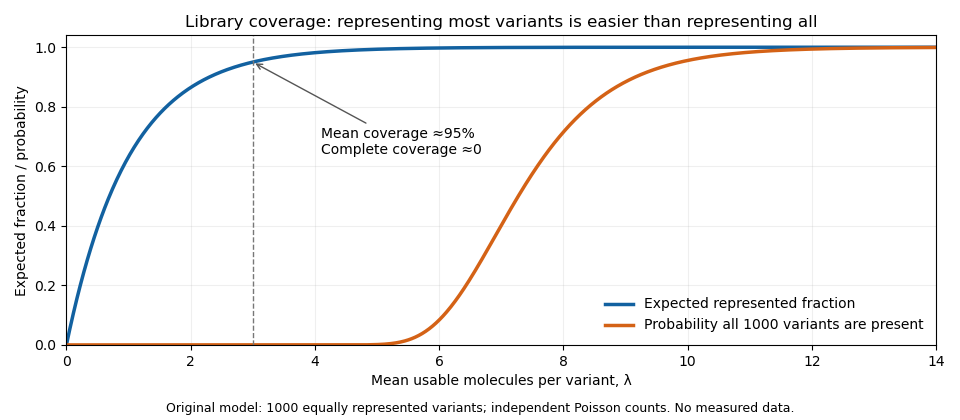
Expected represented fraction and probability of complete coverage answer different library-design questions
. Details. 
The figure uses a Poissonized displayed-library occupancy model: independently Poisson-distributed usable counts per variant with mean . The expected represented fraction is , while the probability of all variants being present is . That is an explicitly different count model, providing a convenient comparison rather than an exact fixed-input formula.
Real variants need not have equal abundance or display probability. In the original RNA-peptide fusion experiment, the selected and unselected encoding-sequence ratios were affected by preferential translation and reverse transcription.[ref]
RNA-peptide fusions for the in vitro selection of peptides and proteins by Richard W. Roberts and Jack W. Szostak. Figure 5 legend: input mixtures and biased unselected ratios
Coverage calculations therefore need assumptions about sequence representation and process losses; nominal library size alone does not validate them. Articles by others on the same topic
There are currently no matching articles.