The polymerase chain reaction amplifies a selected DNA region using repeated copying steps. Amplified material can be examined by DNA sequencing; appropriate template controls help distinguish a new rearrangement from material already present in the starting preparation.
The essential trick is to choose two PCR primers on opposite DNA strands with their extendible ends facing into the same interval. A DNA polymerase extends each PCR primer ; the resulting DNA can itself become a template. The amplicon is therefore selected by two opposed PCR primers, rather than by the DNA polymerase recognizing a named gene. This makes PCR amplification useful for inspecting one interval within a much larger genome. Here PCR means polymerase chain reaction; the statistical abbreviation PCR means principal component regression.[ref]
Polymerase Chain Reaction (PCR) by Addgene. Background Information: two primers, template-directed copying and product verification
For a deliberately tiny nucleotide sequence example, display the upper strand as . The left PCR primer is and binds the lower strand. The right PCR primer, written in its own -to- direction, is : the reverse complement of CAGC. It binds the upper strand and extends leftward in the drawing. With flanks outside this interval, the bounded amplicon contains base pairs, including both PCR primer sequences. These four-nucleotide PCR primers illustrate direction and counting only; they are not a proposed experimental design.
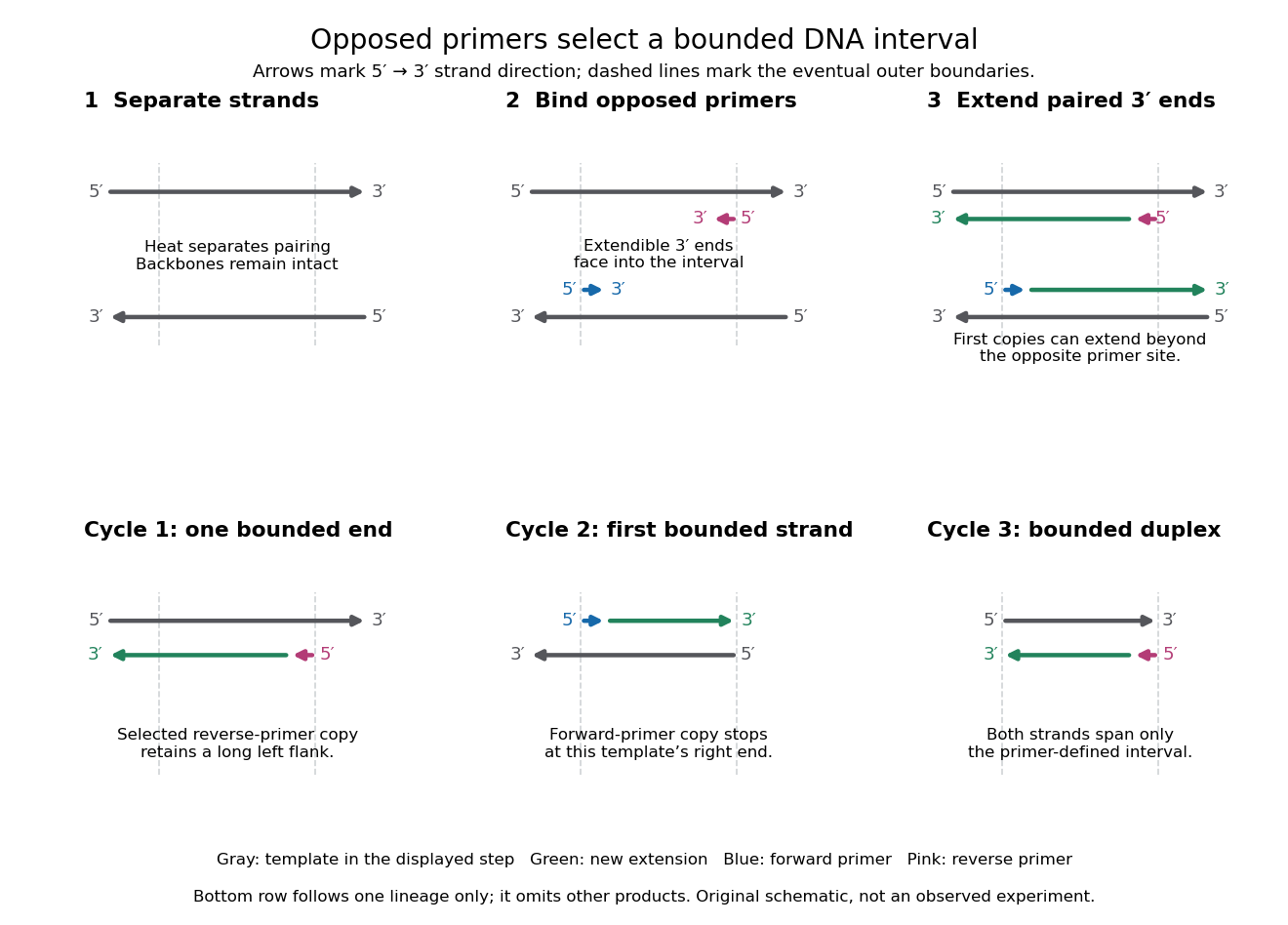
A useful way to understand the polymerase chain reaction is to separate recognition from construction. Base pairing positions a PCR primer; a DNA polymerase then joins new nucleotides onto that existing strand. The PCR primer becomes part of the copied DNA, rather than merely marking a place for an independent strand to start. A PCR thermal cycle repeatedly exposes templates, positions starting ends and permits construction. This makes DNA copying possible outside biological cells, with the chosen PCR primers specifying which interval is repeatedly accessible.
Error-prone PCR deliberately introduces sequence diversity during amplification by conditions or enzymes with reduced fidelity. The mutation burden and library composition affect how much useful sequence space can be explored.
A PCR primer is a short DNA strand that supplies a paired end for a DNA polymerase. Its nucleotide sequence determines where base pairing can initiate copying. Matching a PCR primer at one site is insufficient: both PCR primers must support opposed extension across a copyable interval for sustained selective PCR amplification.
The temperature at which a defined primer duplex is half dissociated under specified conditions. Sequence, salt and concentration matter; a simple composition rule is an approximation rather than a complete assay design.
An amplicon is a nucleic acid product of amplification. In ordinary PCR amplification without added primer tails, its boundaries eventually correspond to the outer ends of the two PCR primer binding sites. First-cycle extensions on long starting templates can run beyond the opposite site; exact-length single strands appear in cycle 2 and exact-length duplex products in cycle 3 under complete extension. This explains why the bounded product becomes dominant even though the initial extensions need not have its length.
A PCR thermal cycle separates three jobs. During PCR denaturation, heating separates the paired DNA strands without intentionally cutting their phosphodiester bonds. During PCR annealing, cooling permits base pairing between PCR primers and templates. During PCR extension, the chosen interval supports DNA polymerase synthesis from the paired ends. Each new nucleotide is supplied as a deoxynucleoside triphosphate; its incorporation lengthens the strand. The DNA polymerase is a catalyst, while these nucleotides are consumed substrates.[ref]
Principles of PCR by Thermo Fisher Scientific. Principles of PCR, accompanying description: denaturation, annealing, primer-dependent extension and dNTP incorporation
Taq polymerase withstands repeated high-temperature strand separation better than a heat-sensitive DNA polymerase. Its extension activity still depends on temperature, buffer solution and magnesium ions. Heat resistance does not mean constant activity at every stage: the separation temperature serves the DNA, whereas the extension temperature serves the copying enzyme. As one institutional example, Addgene's Basic PCR Program specifies separation, primer binding and extension. These are example settings, not universal properties of all PCR primers or DNA polymerases.[ref]
Polymerase Chain Reaction (PCR) by Addgene. Basic PCR Program, steps 1–6; Materials List: Taq buffer with magnesium chloride
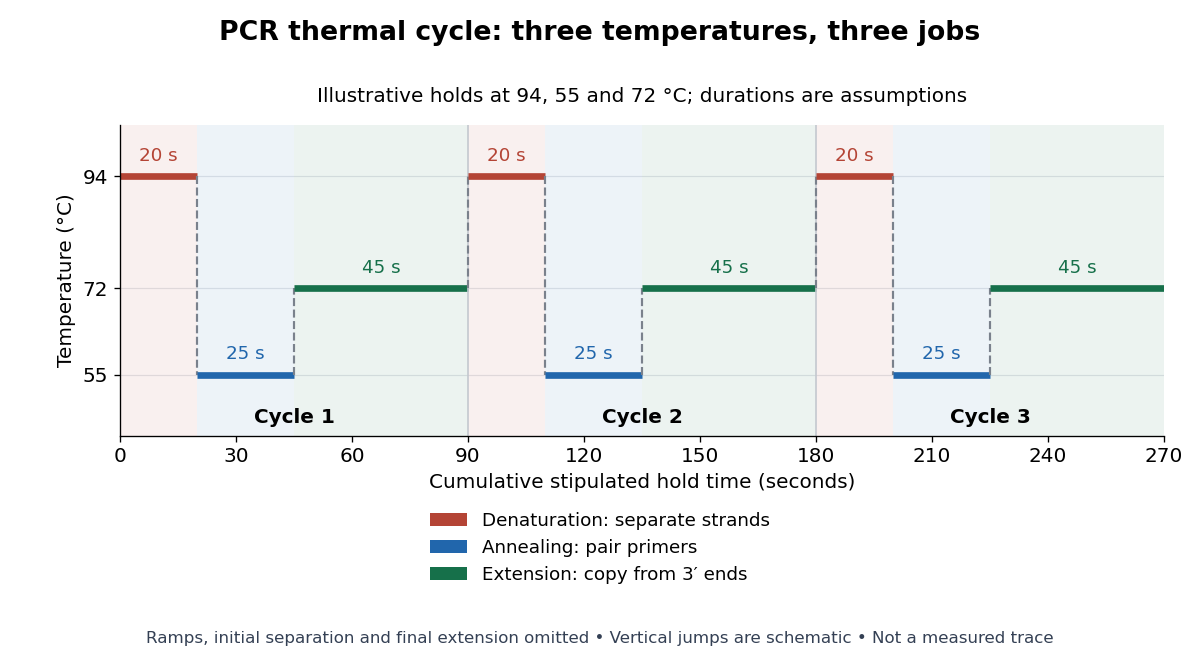
For timing arithmetic alone, those stipulated holds give per PCR thermal cycle, and three cycles give . Adding an assumed initial separation and final extension gives of holds. A real thermal cycler also takes time to move between temperatures. The schedule tells us when conditions favour PCR denaturation, PCR annealing or PCR extension; it does not measure the fraction of DNA copied.
An actual institutional protocol makes the distinction concrete. New England Biolabs specifies mixing templates and PCR primers with its OneTaq master mix in a thin-walled tube; a quick spin collects liquid at the bottom. Its preparation uses of the twice-concentrated mix and of each PCR primer stock, with water completing the volume. Tubes enter a thermal cycler preheated to ; mineral oil is specified if there is no heated lid. The program gives thirty cycles of separation, – binding and extension, with extension time scaled to product length. The binding setting must be selected for the PCR primers; the range is not a continuously swept setting.[ref]
Protocol for OneTaq 2X Master Mix with Standard Buffer by New England Biolabs. Protocol, Reaction setup steps 1–2, 25 microlitre table and Thermocycling conditions; General Guidelines, Annealing and Extension
The dilution can be checked independently: each PCR primer has final concentration , while the mix is diluted twofold. For an endpoint readout, Addgene specifies examining a product aliquot by gel electrophoresis.[ref]
Polymerase Chain Reaction (PCR) by Addgene. Procedure, Primer Design and PCR step 13: run 2 microlitres on a gel
Pair that size comparison with the existing PCR controls: a known template and a no-template tube test different explanations of success or failure. Those comparisons are an analytical addition, not controls documented in the OneTaq schedule. An expected-sized band supports production of a length-compatible amplicon; it does not establish its nucleotide sequence, ideal PCR efficiency or successful separation during every cycle. Neither protocol supplies a measured temperature or yield curve for the schematic above.PCR denaturation is the high-temperature stage that separates a DNA duplex into single-stranded templates for the next copying step. It disrupts the pairing and stacking arrangement of nucleobases; it does not require cutting the phosphodiester bonds along either strand. The distinction matters: breaking the backbone would damage the ordered nucleotide sequence that is meant to serve as a template.
For an original eight-base pair duplex, complete PCR denaturation exposes two eight-nucleotide strands. It leaves sixteen nucleotides altogether: separation has made the templates accessible without yet making more DNA. PCR extension, rather than heating alone, adds the new material. Already copied duplexes also need to separate at the beginning of subsequent cycles.
Separation is a condition-dependent process. Template composition and the buffer solution affect the required temperature and duration; heating longer is not automatically better because prolonged heating can reduce DNA polymerase activity. Incomplete separation leaves fewer accessible templates even when the PCR primers themselves are well chosen.[ref]
PCR annealing is association of PCR primers with exposed complementary DNA regions by base pairing. It supplies the paired starting ends required for PCR extension. Cooling can permit this association without itself joining new nucleotides onto the PCR primers. The two templates can also pair with one another again, so exposure after PCR denaturation is an opportunity for binding, not a guarantee of productive copying.[ref]
Principles of PCR by Thermo Fisher Scientific. Description, first and final paragraphs: binding to complementary templates precedes primer-dependent copying
In the example below, pairs with the aligned template segment . The opposite end labels show antiparallel nucleic acid strands. Pairing the right letters in the wrong directional display does not supply a correctly depicted starting end. These four-nucleotide strands are a teaching example, not a laboratory PCR primer recommendation.
The binding temperature balances enough productive pairing against unwanted binding. Its appropriate value depends on the PCR primers and reaction conditions; increasing it can improve PCR specificity but can also prevent useful binding. A predicted binding setting therefore needs experimental assessment rather than being inferred from the label PCR.[ref]
PCR Cycling Parameters—Six Key Considerations for Success by Thermo Fisher Scientific. Primer annealing optimization, paragraphs beginning In this step, Note that the calculated, and If nonspecific PCR products
PCR extension is template-directed construction of DNA from an annealed PCR primer by a DNA polymerase. Incoming deoxynucleoside triphosphates supply the new nucleotides. Each addition lengthens the growing strand at its end, so the product grows while the template is read . The direction refers to the nucleic acid backbone, not to left or right on a page.[ref]
Principles of PCR by Thermo Fisher Scientific. Description, final paragraph: extension of annealed primers by dNTP incorporation
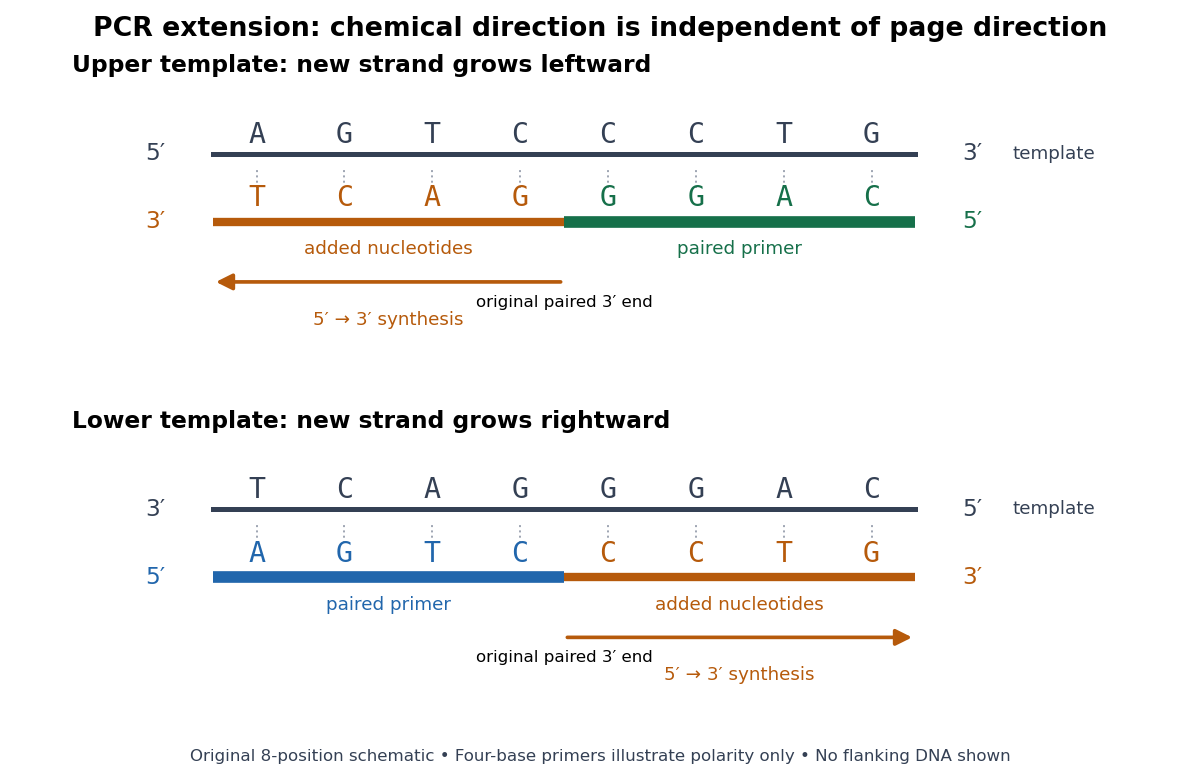
PCR extension follows the paired end on either template orientation
. Original eight-position DNA example with separated complementary templates. Dark rails are existing templates; coloured rails are new strands. The blue PCR primer grows rightward and the green PCR primer grows leftward. Orange marks the material added by DNA polymerase; both arrows point from the original paired end toward the new end. Labels at each end show that both products grow . The templates stop at the displayed boundaries for this teaching example; real starting templates can extend farther. Four-nucleotide PCR primers are deliberately too short to constitute an experimental design. Details.For a complete worked copying step, start with template and paired PCR primer . The next four template letters are GGAC, encountered in the template's -to- direction. The base pairing rule therefore selects CCTG in order, givingThe PCR primer supplies four nucleotides, and PCR extension adds four more; this copying event consumes four deoxynucleoside triphosphates. On the oppositely oriented template , the other PCR primer is . It pairs at the right and extends leftward. Reading that template from right to left encounters CTGA after the paired region, so addition of GACT gives . Both finished products are the reverse complements of their respective templates.
The direction argument is short: the PCR primer and its template are antiparallel nucleic acid strands; extension takes place at the PCR primer's end; hence forward progress along the new strand is backward progress along the template. Reflecting a drawing reverses its arrows on the page without changing either chemical direction. This is why a leftward arrow can represent synthesis.
The time needed depends on how much DNA remains to be copied and the chosen DNA polymerase, while temperature must support that enzyme's activity.[ref]
PCR Cycling Parameters—Six Key Considerations for Success by Thermo Fisher Scientific. Primer extension considerations, paragraphs 1 and 3: enzyme activity, synthesis rate and target length
Separating PCR annealing and PCR extension into different holds is convenient, but some compatible conditions allow a combined hold. The three chemical jobs therefore need not always require three distinct temperatures.[ref]Principles of PCR by Thermo Fisher Scientific. Description, paragraphs 2–3: enzyme-dependent extension temperature and two-step cycling
A thermal cycler changes the temperature of reaction tubes through a programmed sequence. A heated lid can reduce evaporation and condensation above the reaction. Instrument timing, sample temperature and nominal block temperature need not be identical.
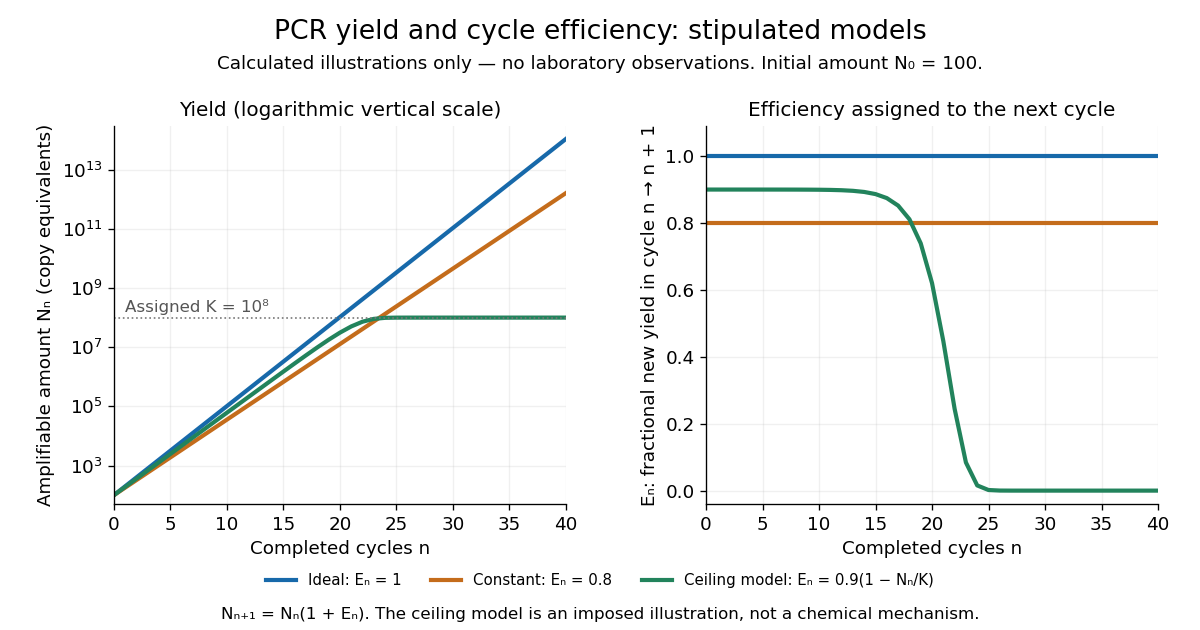
For a stipulated population of amplifiable copies, let be the amount after cycle and define PCR efficiency by the fractional new yieldHere means one additional copy per existing copy, hence ideal doubling. If every cycle has the same PCR efficiency , the exponential growth model gives . Starting with copies, twenty ideal cycles give copies; the stipulated value gives about . An efficiency of 80 percent therefore means multiplication by 1.8 each cycle, not retention of 80 percent of the final ideal yield.
In the ideal strand-counting example, all duplex-equivalent material doubles, but exact-length amplicons lag initially. Starting from one longer duplex and retaining its two original strands, cycle contains exact-length strands out of total strands. Thus their fraction is : zero after cycle 1, one quarter after cycle 2 and one half after cycle 3. This counts strands rather than assuming every strand immediately finds an exact-length partner. The generic yield model above ignores this early distinction.
A PCR plateau is the late phase in which further cycles add little product. Depletion of substrates and accumulation of reaction by-products can reduce PCR efficiency. Consequently, similar final amplicon amounts need not mean similar initial template amounts. In the stipulated green model, implies , and growth approaches the imposed ceiling. That illustrates loss of starting-amount information without claiming to identify the limiting chemical process in an actual tube.[ref]
PCR Cycling Parameters—Six Key Considerations for Success by Thermo Fisher Scientific. PCR cycle number determination and Figure 7: lowered efficiency and plateau from reaction-component depletion and by-products
PCR specificity concerns whether the accumulated amplicon comes from the intended interval. Binding temperature, PCR primer nucleotide sequences and their possible alternative binding sites matter. Too permissive binding can support competing products; excessively restrictive binding can prevent the intended product. A band of the expected length is useful evidence, but unrelated nucleotide sequences can have the same length. DNA sequencing tests identity more directly, subject to mixtures and copying errors.[ref]
How to Design a Primer by Addgene. Primer Design for PCR: specificity, paired melting temperatures and complementary primer sequences
A primer dimer is an amplification artifact in which PCR primers provide extendible partners for one another. Its accumulation consumes substrates and may produce a signal even without the intended template. It is not evidence that the intended amplicon was present.[ref]
Why do I see amplification curves in my NTC samples? by New England Biolabs. FAQ: primer structures as DNA-polymerase substrates, and carryover PCR-product contamination
PCR controls are scientific controls that separate different explanations for a readout. A no-template reaction contains the PCR primers and copying reagents but replaces the added template with water or sample buffer. Amplification there can indicate carried-over DNA or a primer dimer; a clean result does not exclude contamination confined to one sample.[ref]
How can I distinguish non-template amplification (NTC) from real products? by New England Biolabs. FAQ: target-free control reactions and differing product sizes or melt profiles
Different comparisons answer different questions. A known amplifiable template tests whether the PCR primers, DNA polymerase and thermal cycler can produce the expected amplicon. An extraction blank follows sample preparation without adding the sampled material. A separate amplifiable interval in the sample can test whether recovered DNA supports copying, although success there does not guarantee success at the target. A length standard calibrates gel electrophoresis; it is not a control for the copying reaction. These comparisons are an analytical design extension to the teaching example below, not a claim that its student protocol includes every comparison.
The DNA Learning Center's Detection of an Alu Insertion Polymorphism by PCR by DNA Learning Center, Cold Spring Harbor Laboratory supplies a concrete length-based example. It collects mouthwash biological cells, concentrates them with a microcentrifuge, heats them by Chelex extraction and transfers the DNA-containing supernatant. Its reaction combines of that preparation with primer mix and a reagent bead in a thermal cycler. Thirty cycles use , and , each for thirty seconds. An electrophoresis chamber separates products by agarose gel electrophoresis in a 2 percent gel; a UV transilluminator reveals stained DNA.[ref]
Detection of an Alu Insertion Polymorphism by PCR by DNA Learning Center, Cold Spring Harbor Laboratory. pp. 2–3, Procedures I–III: extraction, 25 microlitre reaction, cycle profile, gel and UV readout
Its PCR primers flank an insertion site at the PV92 locus. The student protocol predicts a 715-base pair product with the Alu element and a 415-base pair product without it. Two bands support a heterozygous genotype; one corresponding band supports a homozygous genotype only if amplification and detection of both alleles were adequate. These are the protocol's expected readouts, not newly collected observations.[ref]
Detection of an Alu Insertion Polymorphism by PCR by DNA Learning Center, Cold Spring Harbor Laboratory. p. 1, Introduction: primer-flanked insertion and stated 715/415 bp genotype patterns
The instructor manual describes extra bands from nonspecific priming and a small diffuse primer dimer band. A missing target band therefore cannot on its own distinguish failed extraction, inhibited copying, poor binding or lack of the target. Nor does detection of the Alu element at this one genetic locus establish a complete genome, a unique personal identity or a clinical conclusion. The PCR controls help separate these possibilities; DNA sequencing can add sequence evidence to the size comparison.[ref]
Using an Alu Insertion Polymorphism to Study Human Populations by Dolan DNA Learning Center, Cold Spring Harbor Laboratory. printed pp. 18 and 29, Results and Discussion and Amplify DNA by PCR: primer dimer and nonspecific priming
RT-PCR combines reverse transcription with PCR amplification. The RT names the RNA-to-DNA step, not real-time observation. RT-PCR can have an endpoint readout. A matched preparation omitting reverse transcriptase tests whether contaminating DNA could account for amplification; it answers a different question from a no-template reaction.[ref]
Basic Principles of RT-qPCR by Thermo Fisher Scientific. One-step vs. Two-step RT-qPCR and Controls for RT-qPCR: minus-reverse-transcription control
Real-time polymerase chain reaction monitors fluorescence during cycling. With validated specificity, calibration and PCR efficiency, that record supports estimating initial template amount; this quantitative use is called qPCR. Ordinary endpoint PCR amplification examines accumulated product afterwards. qPCR need not start from RNA, and RT-PCR need not monitor fluorescence. Combining both operations gives RT-qPCR.[ref]
Real-Time PCR (qPCR) Basics by Thermo Fisher Scientific. Real-Time PCR Basics: amplification monitoring and quantification
RT-qPCR applies qPCR after reverse transcription. Differences in RNA recovery and conversion into Complementary DNA can affect its inferred starting amount as well as differences in PCR efficiency.
The 1993 Nobel chemistry announcement credits Kary Mullis with inventing the polymerase chain reaction method and states that the technique was first presented in 1985. The reusable-product principle explains its power: each successfully copied interval can help specify the next generation. The award attribution is a historical claim; it does not imply that every improvement in DNA polymerases, thermal cyclers or PCR controls came from one person.[ref]
Press release: The 1993 Nobel Prize in Chemistry by Royal Swedish Academy of Sciences. 13 October 1993 announcement, award citation and introductory account of PCR first presented in 1985
Articles by others on the same topic

The aim of PCR is to quickly amplify a specific region of a DNA sequence — in
other words to make more copies of it.
other words to make more copies of it.
Rudimentary explanation of the basis of the method is as follows:
Single strand of DNA (single stranded DNA, ssDNA) constitutes of a backbone
chain and 4 different nitrogen bases (coded as A,T,C,G) that are attached to
the chain in a uniform way. Their arangement is the sequence or information (in
a loose sense) that a strand of DNA holds. The backbone chain has two ends that
are denoted as 5' and 3', unless stated otherwise a DNA sequence is always
expressed looking from the 5' end to the 3' end. For example:
chain and 4 different nitrogen bases (coded as A,T,C,G) that are attached to
the chain in a uniform way. Their arangement is the sequence or information (in
a loose sense) that a strand of DNA holds. The backbone chain has two ends that
are denoted as 5' and 3', unless stated otherwise a DNA sequence is always
expressed looking from the 5' end to the 3' end. For example:
The geometry and complementary electric charges of nitrogen bases allows for
stable eletrostatic attraction between A and T, and C and G, but not between A
and C or T and G. That is, the possible electrostatic bonding pairs are only AT
and CG. This fact, and other not mentioned qualities of DNA geometry allows two
strands of DNA with complementary sequences to allign themselves and form a
double stranded DNA (dsDNA) helical structure that is more stable and has lower
energy — it is a thermodynamically preffered state.
stable eletrostatic attraction between A and T, and C and G, but not between A
and C or T and G. That is, the possible electrostatic bonding pairs are only AT
and CG. This fact, and other not mentioned qualities of DNA geometry allows two
strands of DNA with complementary sequences to allign themselves and form a
double stranded DNA (dsDNA) helical structure that is more stable and has lower
energy — it is a thermodynamically preffered state.
The length of DNA sequences is expressed in nucleotides (nt) or base pairs (bp)
which is numerically equal to the lenght of the sequene expressed with letters
ATCG. The above dsDNA fragment is 39 nt or 39 bp long. Notice that strands are
anti–paralel — their ends are inverted, their sequences go in opposite
directions.
which is numerically equal to the lenght of the sequene expressed with letters
ATCG. The above dsDNA fragment is 39 nt or 39 bp long. Notice that strands are
anti–paralel — their ends are inverted, their sequences go in opposite
directions.
(1) The 1st step of PCR is denaturation: solution of your template DNA is
heated up to 98 °C, which raises the energy to the point where the
electrostatic attraction between nitrogen bases is not strong enough to
withstand the vibration of molecules, and the two strands separate.
heated up to 98 °C, which raises the energy to the point where the
electrostatic attraction between nitrogen bases is not strong enough to
withstand the vibration of molecules, and the two strands separate.
(2) The 2nd step of PCR is annealing: the temperature is lowered to 58—68 °C.
Long strands of DNA in solution are disorganized and will not be able to fully
reform the helical structure on thier whole lenght. Two short (18—25 nt) ssDNA
called primers, that are complementary to the regions flanking the sequence of
interest in the template, form a short dsDNA segment with the template. The
lenght of 18—25 nt allows for greater mobility due to small size, but enough
sequence specifity to bind only with a single place in the template. A simple
representation of the end result:
Long strands of DNA in solution are disorganized and will not be able to fully
reform the helical structure on thier whole lenght. Two short (18—25 nt) ssDNA
called primers, that are complementary to the regions flanking the sequence of
interest in the template, form a short dsDNA segment with the template. The
lenght of 18—25 nt allows for greater mobility due to small size, but enough
sequence specifity to bind only with a single place in the template. A simple
representation of the end result:
(the primer is shorter for easier representation, and there is only one strand
of the template shown, because non–monospace font makes it impossible to align
the other one properly, but the process for the other one is identical)
of the template shown, because non–monospace font makes it impossible to align
the other one properly, but the process for the other one is identical)
(3) The 3rd step of PCR is elongation: the temperature is raised to 72 °C,
which is optimal value for polymerase activity. Polymerase in an enzyme that
catalyses the synthesises of a new DNA strand. The specific kind used in PCR
synthesises does so by attaching appropriate building blocks to the 3' end of a
DNA strand using the complementary strand as a template, like this:
which is optimal value for polymerase activity. Polymerase in an enzyme that
catalyses the synthesises of a new DNA strand. The specific kind used in PCR
synthesises does so by attaching appropriate building blocks to the 3' end of a
DNA strand using the complementary strand as a template, like this:
...
The same process takes place on both DNA strands of the template molecule — a
single PCR cycle resulted in double the amount of copies of a desired sequence.
The proces is repeated (usually about 30 times) to exponentially increase the
number of copies up to copies, where is the starting
number of copies and is the number of cycles.
single PCR cycle resulted in double the amount of copies of a desired sequence.
The proces is repeated (usually about 30 times) to exponentially increase the
number of copies up to copies, where is the starting
number of copies and is the number of cycles.
—additional notes—
a) annealing temperature is fitted to the primers used, which is based on their
lenght and sequence (usually calculated by some variation of the Nearest
Neigbour method);
lenght and sequence (usually calculated by some variation of the Nearest
Neigbour method);
b) first PCRs were carried out using non-thermostable polymerases, that became
denaturated and lost their enzymatic activity after each denaturation, and had
to be manually added before each elongation. Modern PCRs use thermostable
polymerases that are able to withstand high temperatures and sustain their
enzymatic activity;
denaturated and lost their enzymatic activity after each denaturation, and had
to be manually added before each elongation. Modern PCRs use thermostable
polymerases that are able to withstand high temperatures and sustain their
enzymatic activity;

Polymerase Chain Reaction (PCR) is a widely used molecular biology technique that allows for the amplification of specific segments of DNA. Developed in 1983 by Kary Mullis, PCR enables researchers to produce millions to billions of copies of a targeted DNA sequence from a small initial sample, making it easier to study and analyze that specific region of DNA.



This is an extremely widely used technique as of 2020 and much earlier.
If allows you to amplify "any" sequence of choice (TODO length limitations) between a start and end sequences of interest which you synthesize.
If the sequence of interest is present, it gets amplified exponentially, and you end up with a bunch of DNA at the end.
You can then measure the DNA concentration based on simple light refraction methods to see if there is a lot of DNA or not in the post-processed sample.
Even Ciro Santilli had some contact with it at: Section "How to use an Oxford Nanopore MinION to extract DNA from river water and determine which bacteria live in it", see: PCR!
One common problem that happens with PCR if you don't design your primers right is: en.wikipedia.org/wiki/Primer_dimer
Sometime it fails: www.reddit.com/r/molecularbiology/comments/1kouomw/when_your_pcr_fails_again_and_you_start/and a comment:
Nothing humbles you faster than a bandless gel. One minute you’re a scientist, the next you’re just a pipette-wielding wizard casting spells that don’t work. Meanwhile, physicists are out there acting like gravity always behaves. Smash that upvote if your reagents have ever gaslit you.
PCR = Pray, Cry, Repeat