The knife clearance angle is the angle between the blade face facing the newly cut specimen surface and that surface, measured in the cutting cross-section. It describes how the knife is oriented. The knife wedge angle instead describes the angle between the two blade faces at the edge. Tilting the holder changes clearance without changing the blade's intrinsic wedge geometry.[ref]
Knife Angle in Microtomy by Charles W. Scouten. Ideal versus compromise; Figure 1 and discussion of the specimen-side bevel
Positive clearance lets the trailing blade face move clear of the cut surface. With insufficient clearance, that face can press or rub against the specimen instead of clearing it. Excessive tilt changes the cutting geometry too; simply maximizing clearance is not a general route to an undistorted section.[ref]
Knife Angle in Microtomy by Charles W. Scouten. Consequences of too shallow an angle and Consequences of too steep an angle
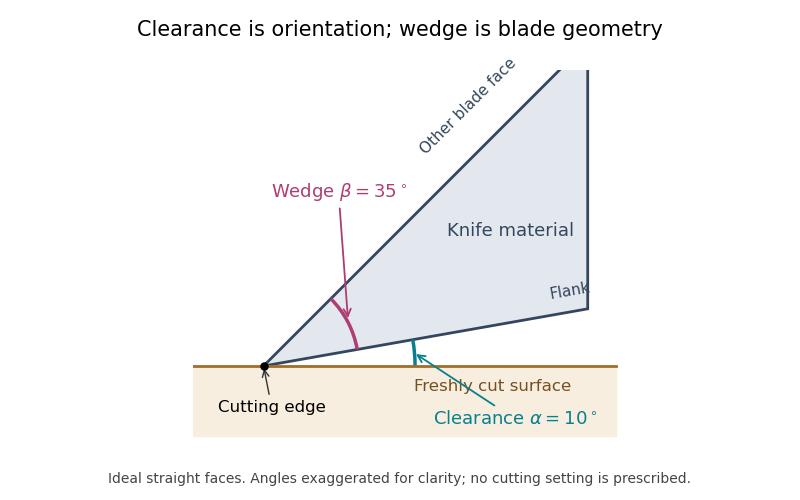

For the ideal straight faces in the diagram, let be clearance and the wedge angle. Their upper-face orientation relative to the cut surface is . With the chosen and , it is . Tilting the whole blade by gives clearance and upper-face orientation , while stays .
There is also a simple gap calculation. A point a projected distance behind the cutting edge lies above the ideal cut plane. At and , . Real bevels and specimen deflection complicate this geometry, and the holder's indicated angle must be interpreted using its manufacturer's convention. Comparing section compression and surface defects at otherwise matched conditions can test the consequences of an angle change; the angle scale alone is not a measurement of section quality.
Articles by others on the same topic
There are currently no matching articles.