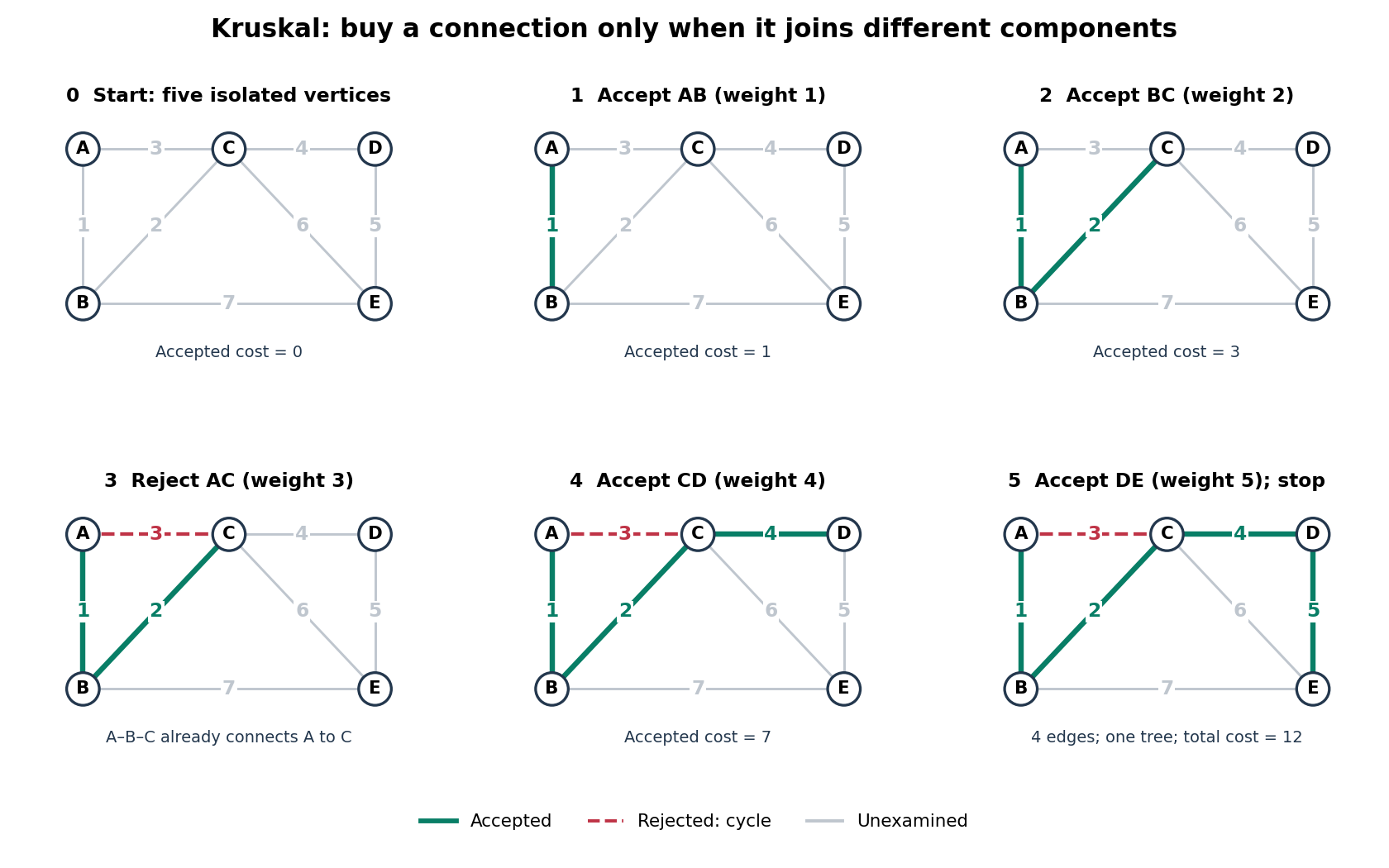
Consider this original connected graph on vertices . Its undirected edges, already in increasing weight order, areHere means the unordered pair ; the weights are dimensionless costs. Accept and , with total . Reject : its endpoints already have the graph path , so it would close the graph cycle . Accept and , reaching all five vertices with four edges. The resulting minimum spanning tree isStop here: and need not be examined. If processing continued, both would be rejected because their endpoints are already in the same connected component of a graph.

Taking the three cheapest edges instead gives a graph cycle on , leaving isolated: it is neither a forest nor a spanning tree. Even taking the four cheapest edges adds only and leaves isolated. A cheap infeasible selection cannot compete with a minimum spanning tree. For this small graph, checking all four-edge subsets gives a direct certificate: among those that are spanning trees, exactly one has minimum cost , namely . The general algorithm avoids this exhaustive search.
Articles by others on the same topic
There are currently no matching articles.