Kruskal's algorithm constructs a minimum spanning tree of a finite connected graph with undirected edges and real edge weights. Start with all vertices and no edges, a forest of isolated vertices. Sort the edges by nondecreasing weight, then accept an edge exactly when its endpoints belong to different current connected components of a graph. Otherwise reject it: the existing graph path between its endpoints would close a graph cycle. Each acceptance merges two connected components of a graph. Stop after acceptances, when the forest has become one spanning tree.
This is a greedy algorithm for economical network connection: only the next affordable connection and the current connected components of a graph matter. Unlike Prim's algorithm, which grows one reached tree, Kruskal's algorithm can grow several separate trees before joining them. The essential safeguard is avoiding a graph cycle, rather than simply buying the cheapest fixed number of edges.
Joseph Bernard Kruskal described this rule as Construction A on page 49 of his February 1956 paper, On the shortest spanning subtree of a graph and the traveling salesman problem; page 50 gives an exchange argument for distinct weights.[ref]
https://langevin.univ-tln.fr/cours/graphe/bonus/Krukskal.pdf. Joseph B. Kruskal, Jr., Proceedings of the American Mathematical Society 7(1), February 1956, pp. 48–50; inspected scan, Construction A and final exchange argument
Consider this original connected graph on vertices . Its undirected edges, already in increasing weight order, areHere means the unordered pair ; the weights are dimensionless costs. Accept and , with total . Reject : its endpoints already have the graph path , so it would close the graph cycle . Accept and , reaching all five vertices with four edges. The resulting minimum spanning tree isStop here: and need not be examined. If processing continued, both would be rejected because their endpoints are already in the same connected component of a graph.
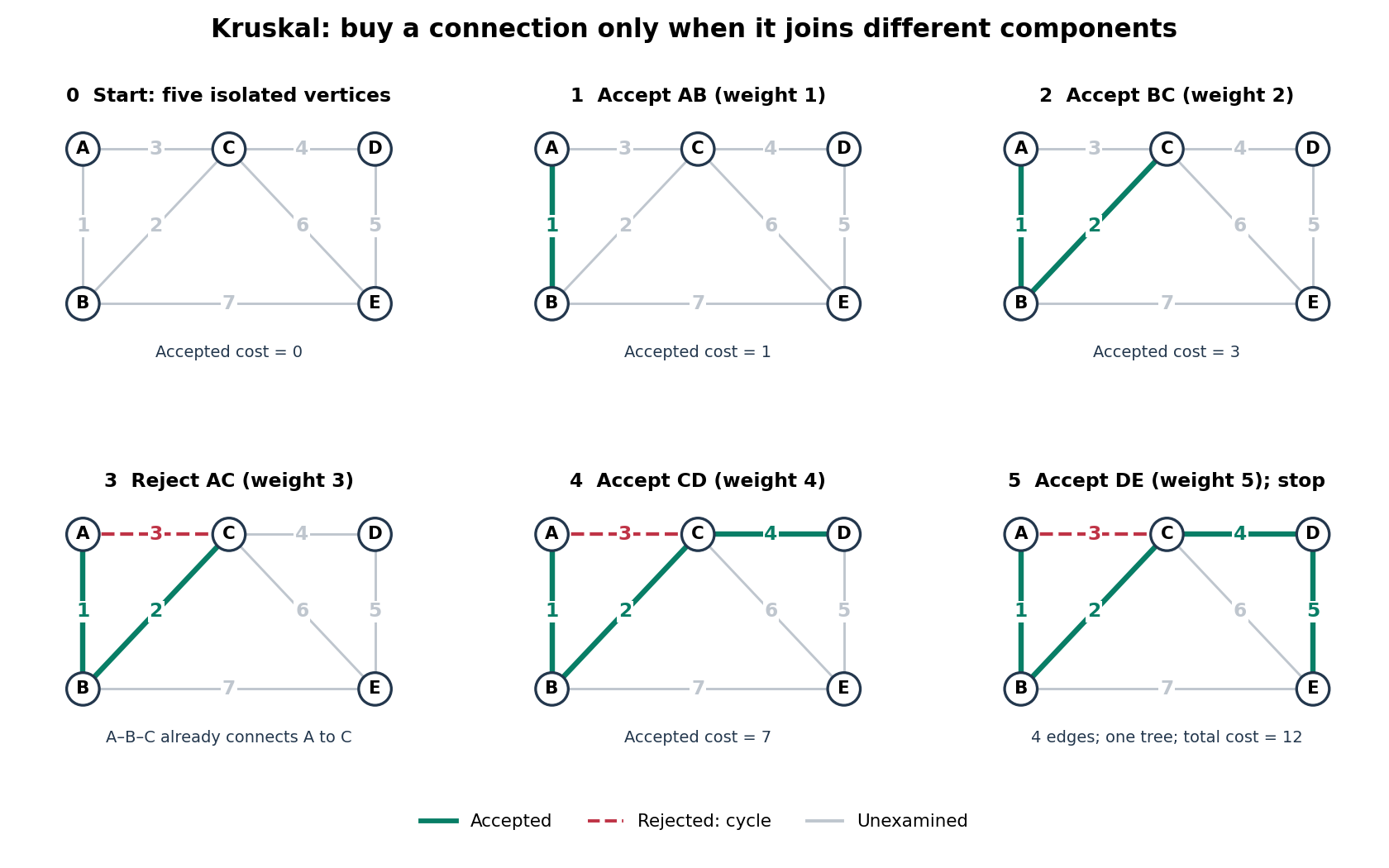
Taking the three cheapest edges instead gives a graph cycle on , leaving isolated: it is neither a forest nor a spanning tree. Even taking the four cheapest edges adds only and leaves isolated. A cheap infeasible selection cannot compete with a minimum spanning tree. For this small graph, checking all four-edge subsets gives a direct certificate: among those that are spanning trees, exactly one has minimum cost , namely . The general algorithm avoids this exhaustive search.
An edge is safe for the current accepted forest if some minimum spanning tree contains both and that edge. The loop invariant is that some minimum spanning tree contains every accepted edge. It holds initially for the empty edge set. Suppose the next accepted edge joins a current connected component of a graph to its complement. No earlier rejected edge crosses this cut of a graph: once its endpoints are in one connected component of a graph, subsequent merges never separate them. Thus is a lightest edge across that cut of a graph.
For the short exchange argument, take a minimum spanning tree containing . If is absent, adding it creates a fundamental cycle. This graph cycle contains another edge crossing the same cut of a graph. No edge of crosses the cut of a graph, so is not in . Replace by : the result is a spanning tree containing and , with no greater total weight because . It is therefore also a minimum spanning tree. This is the minimum spanning tree cut property in the form needed for tied weights.
In the example, is safe after rejecting : the current connected component of a graph has crossing edges of weights . Its cheapest connection is . The rejected is also the unique heaviest edge of the graph cycle , so the minimum spanning tree cycle property excludes it from every optimum.
Negative and zero edge weights are allowed: the comparisons and exchange argument still apply. Ties can give several minimum spanning trees, though they need not; any order among equal-weight edges remains valid. Distinct edge weights guarantee a unique minimum spanning tree. To see why, take the lightest edge belonging to exactly one of two proposed optima, say . Deleting from gives a cut of a graph; the other optimum has a graph path across it, containing an edge absent from . Hence , and replacing by improves that other optimum, a contradiction. For disconnected input, process all edges to obtain a minimum spanning forest, one minimum spanning tree per original connected component of a graph; no spanning tree of the whole graph exists.[ref]
KruskalMST.java. Robert Sedgewick and Kevin Wayne, Algorithms, 4th edition, companion KruskalMST.java, class documentation and constructor: arbitrary signed weights, ties, disconnected input and sorted processing
A disjoint-set data structure stores the current partition of a set of vertices into connected components of a graph. The operation returns a representative of the block containing . Two vertices are in the same block exactly when their representatives agree. For each candidate edge , compare and . Equal representatives mean reject; different representatives mean accept and perform , merging the two blocks. The representatives are bookkeeping choices, not preferred vertices of the minimum spanning tree.
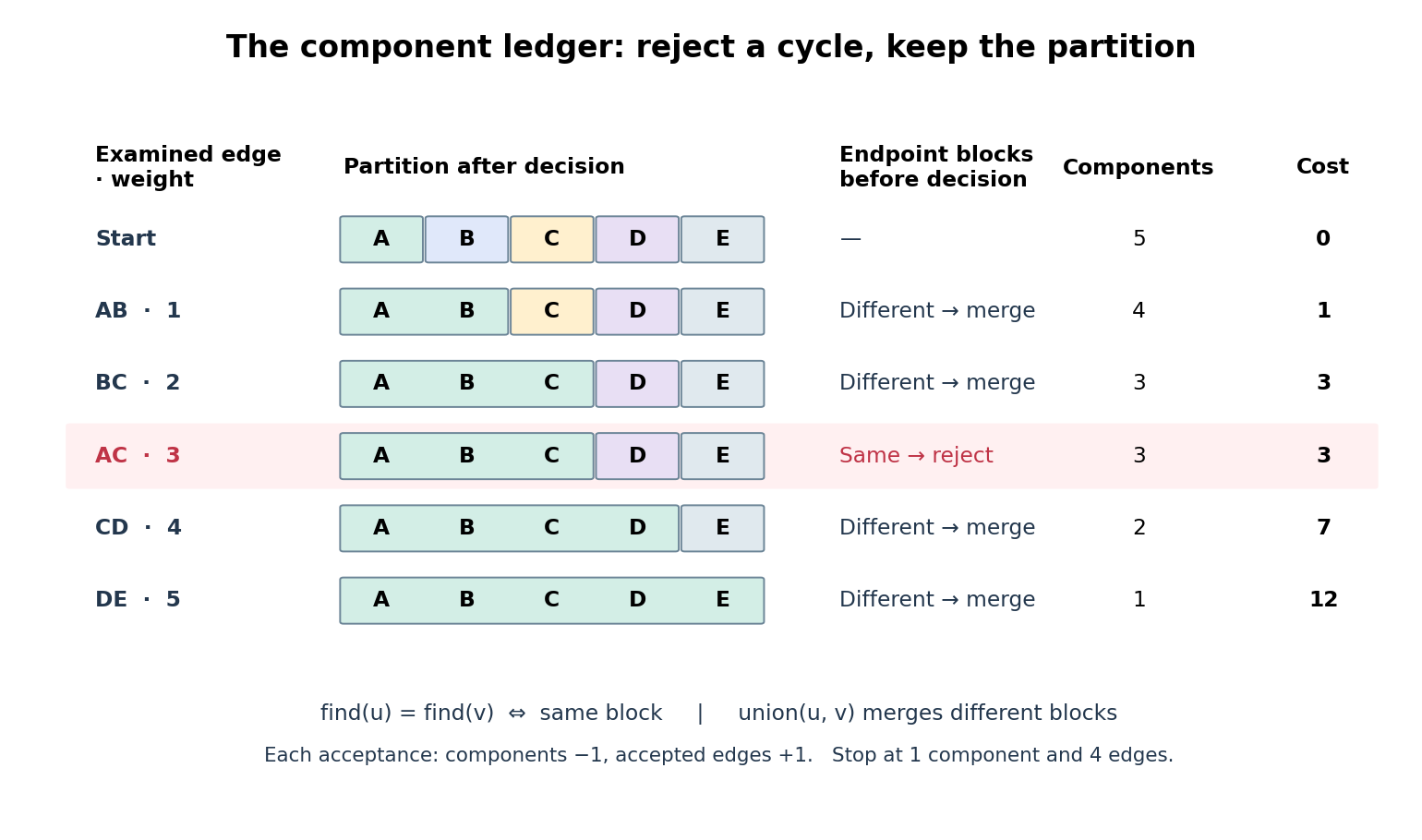
Connected components of a graph merge only when an edge is accepted
. The same example as a disjoint-set data structure ledger. Each coloured band is one block of the current partition of a set. The rejection of leaves both the partition of a set and the running cost unchanged. Bands show membership, not internal representative pointers. Details.Every acceptance reduces the connected component of a graph count by one and increases the accepted edge count by one, preserving . Thus the ledger reaches exactly when . Only ten representative queries and four merges are needed for the five examined edges, counting two queries per examination and using the already found representatives for each merge. Neither breadth-first search nor reconstruction of a graph path is needed for these connectivity queries.
For and , comparison sorting algorithm takes time for , using Big O notation. One simple disjoint-set data structure implementation stores each block as a rooted tree and attaches the smaller block's root below the larger block's root. Whenever a vertex's depth increases, its block size at least doubles, so its depth is at most . Consequently each representative query or merge takes time. Initialization plus the scan costs ; including sorting algorithm gives , hence for a connected input with . These are operation bounds, not measured timings.[ref]
WeightedQuickUnionUF.java. Robert Sedgewick and Kevin Wayne, Algorithms, 4th edition, companion WeightedQuickUnionUF.java: class documentation and union method; union by size without path compression, linear initialization and logarithmic operations
Articles by others on the same topic



Kruskal's algorithm is a method used to find the minimum spanning tree (MST) of a connected, undirected graph. A minimum spanning tree is a subset of the edges in the graph that connects all the vertices together without any cycles and with the minimum possible total edge weight.