Why does an isopycnic centrifugation band return after displacement? Choose a dilute mathematical model with outward coordinate , constant local centrifugal acceleration , fixed displaced volume , linear friction coefficient , and an imposed liquid density with . Treat the species' buoyant density as constant in this medium. The sedimentation coefficient force balance gives the ordinary differential equationIts exponential function solution is . The sign of the velocity reverses across , proving stable equilibrium when lies inside the liquid. Changing changes the approach time , while depends on buoyant density and the imposed density gradient. A real centrifuge rotor has radially varying centrifugal acceleration; the constant- approximation describes a short radial interval. Here the density gradient is held fixed, rather than modeling its formation.
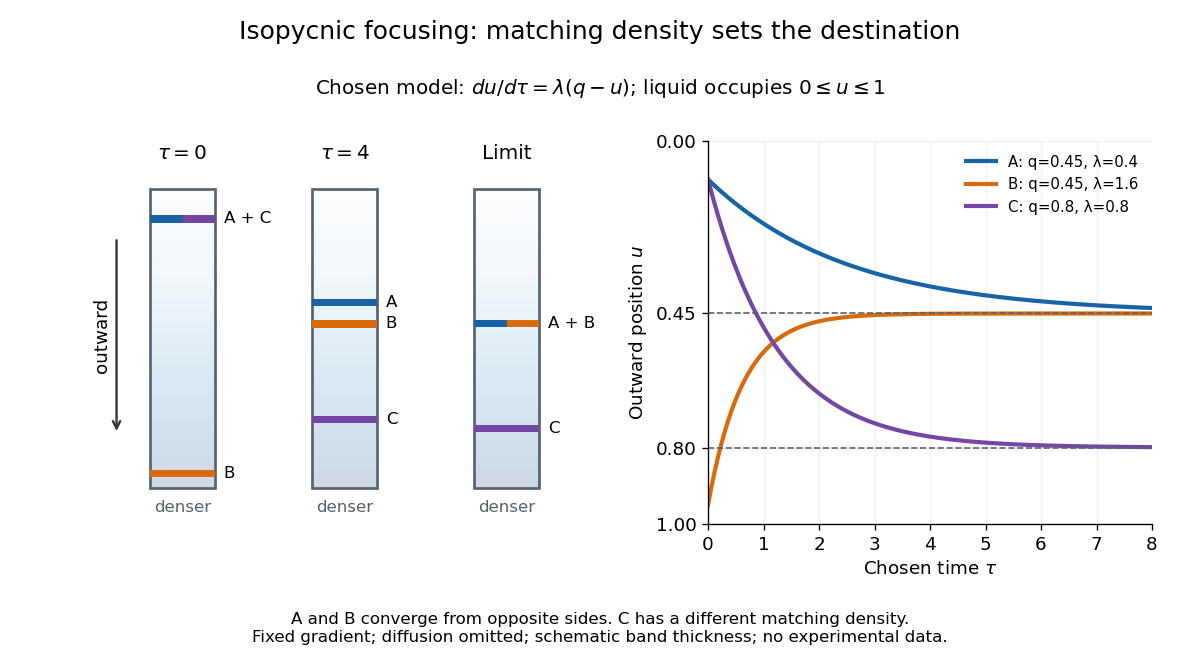
For an original dimensionless example, let and , where is column length and a chosen time scale. Write and , so . Species A and B have the same but different friction-dependent rates: and . A moves outward and B inward, both toward . Species C has and approaches a separate band at . At , their positions are approximately , and : a finite-time photograph would still show A short of its limiting position.

An equilibrium band has finite width because diffusion opposes focusing. In the same local model, let be concentration and let the constant diffusion coefficient be . Combining the restoring drift with Fick's laws, zero net flux requiresDividing by and integrating proves the Gaussian function profile, whose standard deviation is . This local result assumes that the band is narrow relative to its distance from the boundaries and that , and the density gradient vary negligibly across it. Equal buoyant densities therefore imply coincident centers in this model, not identical widths. A band outside the available density range has no such interior restoring point.
Articles by others on the same topic
There are currently no matching articles.