Consider an M/M/1 queue with an exogenous Poisson process of arrivals of rate , one server, unlimited waiting space, first come first served service, and independent and identically distributed service times with an exponential distribution of rate , independent of arrivals. There is no blocking or abandonment, so offered rate and admitted queue throughput coincide: . The memoryless property makes the queue population a birth-death process. For , the stationary distribution of an M-M-1 queue isThis is a geometric distribution on the nonnegative integers. Its mean, together with Little's law, givesHere count the whole system, and count only waiting. These distinctions and formulas are derived in MIT 2.854, M/M/1 Queue notes, pages 1-2.
Take customers per hour and customers per hour. The mean service time is hour, or 12 minutes, and the server utilization is . Computing each quantity explicitly,Thus Little's law checks both boundaries: and . The mean number in service is , rather than one, because the server is idle 20 percent of the time. By PASTA, an arriving customer sees four customers already in the system on average. Under first come first served, the memoryless property gives mean residual service time for the customer in service; clearing those four customers takes hour on average, independently confirming the mean queueing delay.
Holding per hour fixed, increasing arrivals from to per hour raises server utilization from to , but doubles mean customer sojourn time from one to two hours. At per hour, server utilization is , , hours, , and hours. Both mean population and mean duration diverge as approaches from below. The formula describes an explosive congestion penalty near capacity even though all arrivals still eventually receive service at every fixed subcritical rate. At or above capacity there is no stationary distribution for this unlimited M/M/1 queue, so these finite stationary formulas no longer apply.
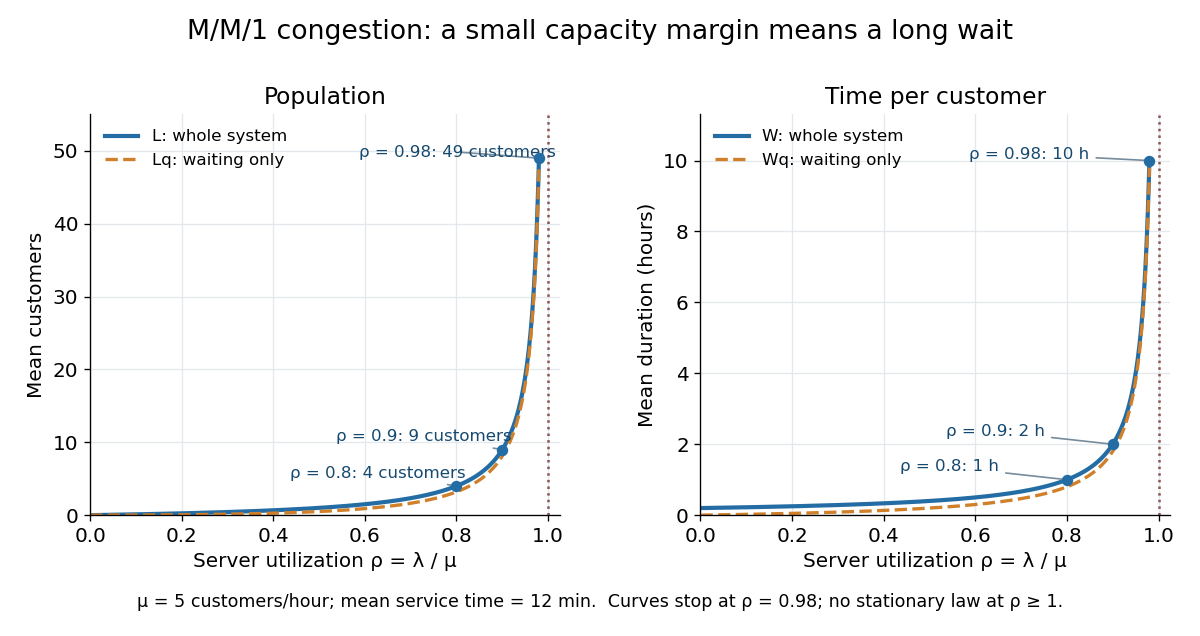

The inverse dependence of mean customer sojourn time on spare capacity, , makes server utilization a poor standalone measure of service quality. Adding capacity at a nearly saturated M/M/1 queue can sharply reduce queueing delay. Stanley B. Gershwin develops this capacity interpretation in Markov Processes and Queues, MIT 2.854, 2016, slides 71-72.
Articles by others on the same topic
There are currently no matching articles.