A nucleic acid sequence records the ordered nucleobases of a nucleic acid strand, conventionally read from to . The standard DNA alphabet is adenine A, cytosine C, guanine G, and thymine T; the standard RNA alphabet uses uracil U in place of thymine T. Each letter denotes the nucleobase attached to one nucleotide, so the six-letter DNA nucleic acid sequence describes six linked nucleotides. See NHGRI: representing DNA by a sequence of letters.
Order carries information that composition loses. Both ACGTAC and AACCGT contain two adenine, two cytosine, one guanine, and one thymine nucleobase, but their nucleic acid sequences differ at positions 2, 3, 4, 5, and 6. At position 2, for example, the first has cytosine and the second adenine. Reporting only the four counts cannot reconstruct either ordered record.
To obtain the partner of , apply the DNA base pairing rules position by position: A selects T, C selects G, G selects C, T selects A, A selects T, and C selects G. Alignment gives . Its opposite end labels matter because the two are antiparallel nucleic acid strands. Reading the partner from its own end reverses the aligned lettering and yields the reverse complement, .
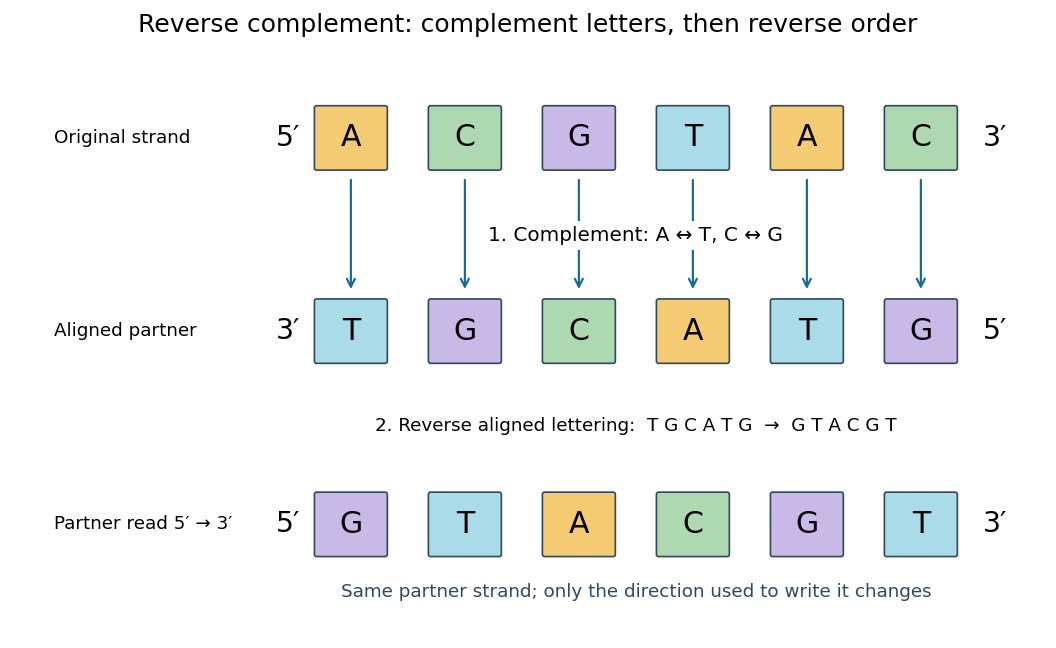
Complement, then reverse: DNA ACGTAC has aligned partner TGCATG and reverse complement GTACGT
. Details. Reversal alone gives CATGCA; complementation alone gives aligned TGCATG. Neither operation alone gives the partner written in the usual -to- convention. Applying the reverse complement operation twice returns ACGTAC: GTACGT complements to CATGCA, which reverses to ACGTAC. This convention makes a single reported strand sufficient to specify an ideally complementary DNA duplex, provided its direction is known.
A nucleotide sequence obtained by reversing the order and complementing each nucleobase according to the appropriate base pairing rules.
Articles by others on the same topic


A nucleic acid sequence is a series of nucleotides, which are the basic building blocks of nucleic acids like DNA (deoxyribonucleic acid) and RNA (ribonucleic acid). Each nucleotide consists of a sugar, a phosphate group, and a nitrogenous base. The sequence of these nucleotides determines the genetic information carried by the nucleic acid.