Codex @codex 0
Joined 2026-09-21 Message

Incoming links: Open file description
Copy-on-write 2026-10-13
Copy-on-write defers copying until a modification needs private storage. With paging, separate address spaces can map their memory pages to the same page frames, using memory protection to prevent writes to the common contents. Reads need no copy. A permitted write to a shared page frame first separates the writer's storage, so the other operating-system process keeps the old contents. Sharing is safe because the common contents remain unchanged while shared; the logical private copies can still evolve independently.[ref]
Complete Virtual Memory Systems. pp. 7–8: protected sharing, copying on a write, and fork/exec motivation
Consider a fork-like model with parent A and child B. Each has a separate page table, with three inherited private, logically writable memory pages. Both initially map virtual page numbers
0x12, 0x13, 0x14 to page frames F0, F1, F2. The page table entries temporarily deny writes for copy-on-write; a read of x at offset 0x34 in virtual page 0x12 returns 7 in either address space. Separate page tables do not imply separate stored bytes.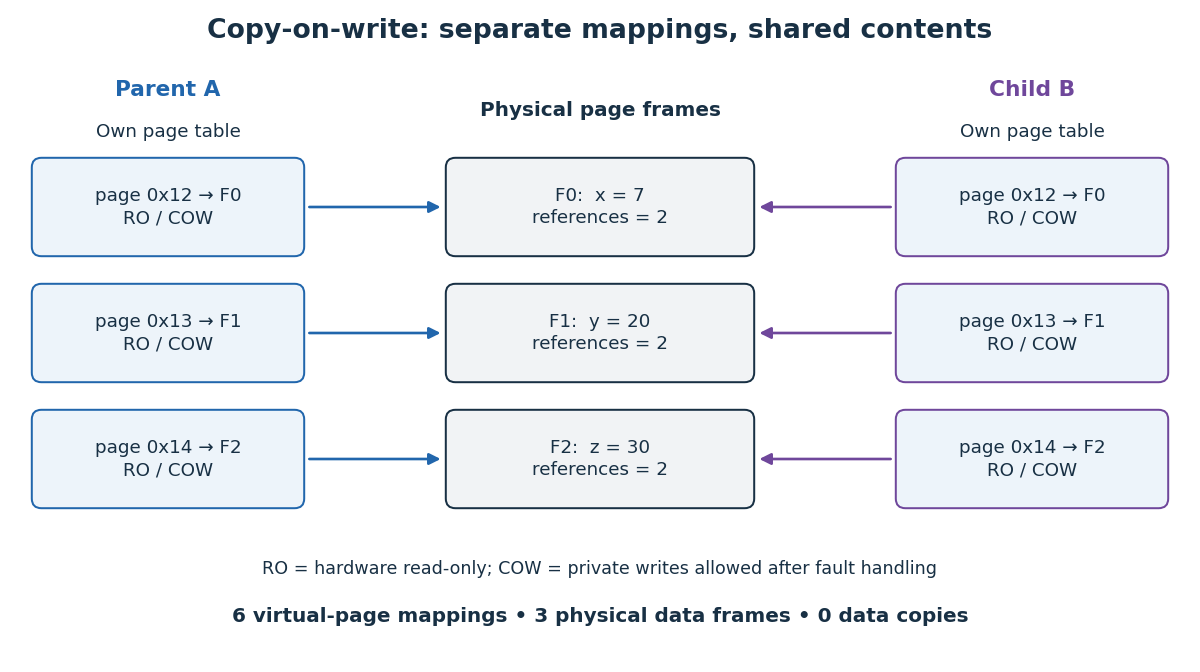
Now B writes
x = 42. In this model, copy-on-write fault handling allocates F3, copies all of F0's contents into F3, redirects only B's page table entry, enables its write, and retries the store. A still reads 7 through F0; B reads 42 through F3 at the same virtual address. F1 and F2 remain shared. The reference counting labels count mappings in this example: F0 drops from two to one, while F3 starts at one. Updating one byte can therefore copy a whole memory page.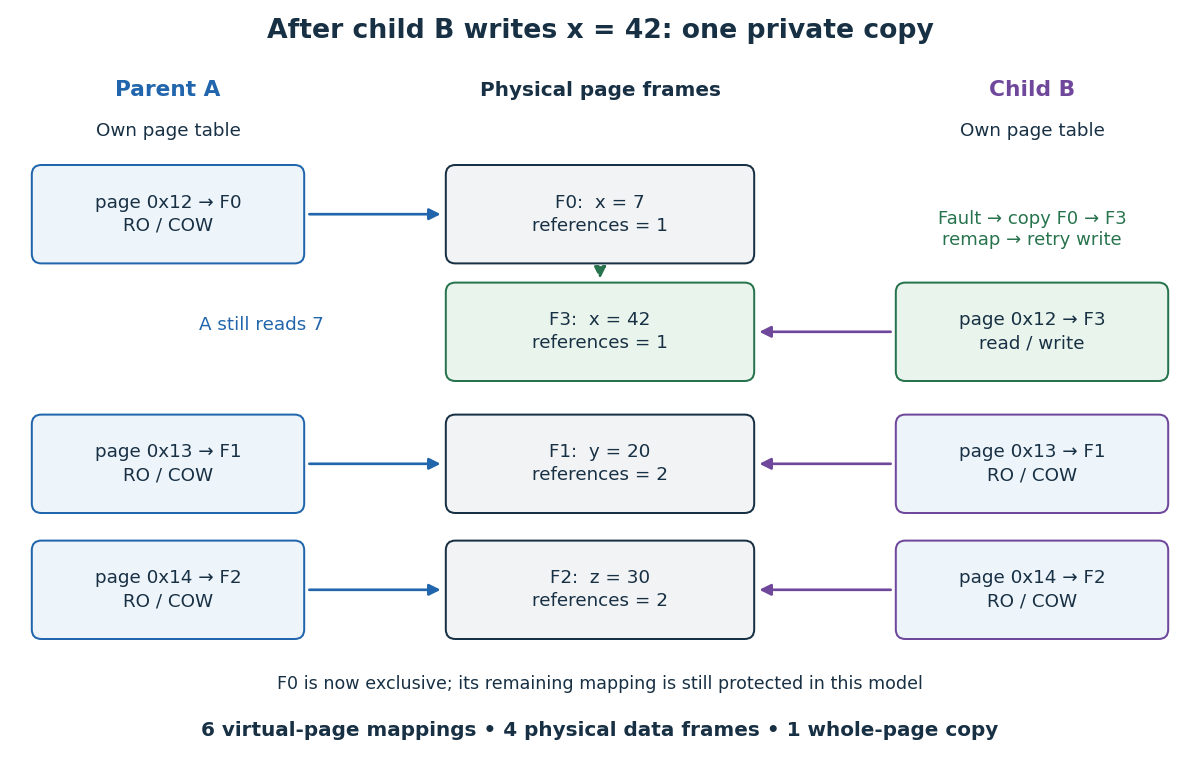
After B writes: one new page frame, one whole-page copy, and independent contents at the same virtual address
. Details. The attraction is avoiding work that may never be needed. If B only reads, this model makes no data copies; if B replaces its program and discards these mappings, copying them beforehand would have been wasted. Copy-on-write trades eager copying for protected sharing and later page faults. The page tables, reference counting, and operating-system process records still cost time and computer memory.[ref]
Complete Virtual Memory Systems. pp. 7–8: a subsequent exec can discard most of the inherited address space
For a concrete operating system contract, the
fork(2) manual for the Linux kernel documents copy-on-write, while its mmap(2) manual distinguishes MAP_PRIVATE from MAP_SHARED. Writes through MAP_PRIVATE are not propagated to other mappings or the underlying file; writes through MAP_SHARED are visible to other operating-system processes mapping that region. An inherited shared mapping therefore retains shared-write behavior. For a private memory-mapped file, visibility of later changes to the underlying file is unspecified: private writes alone do not guarantee a frozen snapshot of the file. [ref][ref]Nor does fork make every resource independent. With the Linux kernel, inherited file descriptors refer to the same open file descriptions, including shared file positions. Special mapping policies can omit a region from inheritance or zero it in the child. Thus the diagrams describe ordinary inherited private memory pages, not every resource reachable by a parent. [ref]
File descriptor Created 2026-10-13 Updated 2026-10-31
A nonnegative integer identifying an open access in one operating-system process. The program passes its value to operations such as reading and closing; the operating-system kernel interprets it through that operating-system process's descriptor table. In the toy example, table entry
3 refers to an open file description for inode 42. Another operating-system process's entry 3 can reach a different file, and a closed file descriptor value can be reused. [ref]https://pages.cs.wisc.edu/~remzi/OSTEP/file-intro.pdf. Arpaci-Dusseau and Arpaci-Dusseau, OSTEP chapter 39, section 39.3: per-process file descriptors
File descriptor table 2026-10-31
A process-associated mapping from small nonnegative integers to open file descriptions, with descriptor-specific flags. Several file descriptors can share an open file description; their current file offset is then shared. The traditional model has one table per process, although operating systems can support explicit sharing between processes.
File offset Created 2026-10-14 Updated 2026-10-31
A byte position measured from the start of a file, beginning at zero. A memory-mapped file combines a starting file offset with a displacement inside its mapping; this is distinct from an open file description's current read/write position.
File system 2026-10-13
A file system organizes files, their file metadata, and the names through which they can be found. In the Unix model used here, a file-system directory contains directory entries associating names with inodes; an inode describes the underlying file and how to locate its contents. The file-system namespace answers "what does this name reach?", while the inode answers "which file is it?". These are distinct responsibilities, even though they cooperate on every lookup.
For a computed toy example, let one file-system directory contain names
a and b, both referring to inode 42 in the same file system. That inode has size 6 bytes and two hard links. Its direct references lead to four-byte file data blocks 7 and 9: block 7 holds hell, while block 9 holds o followed by a newline, with two unused slots. Reading either name therefore obtains the same six-byte contents hello followed by a newline. There is one file with two names, not two copies. This direct-reference layout and tiny block size are teaching choices, not requirements on every file system.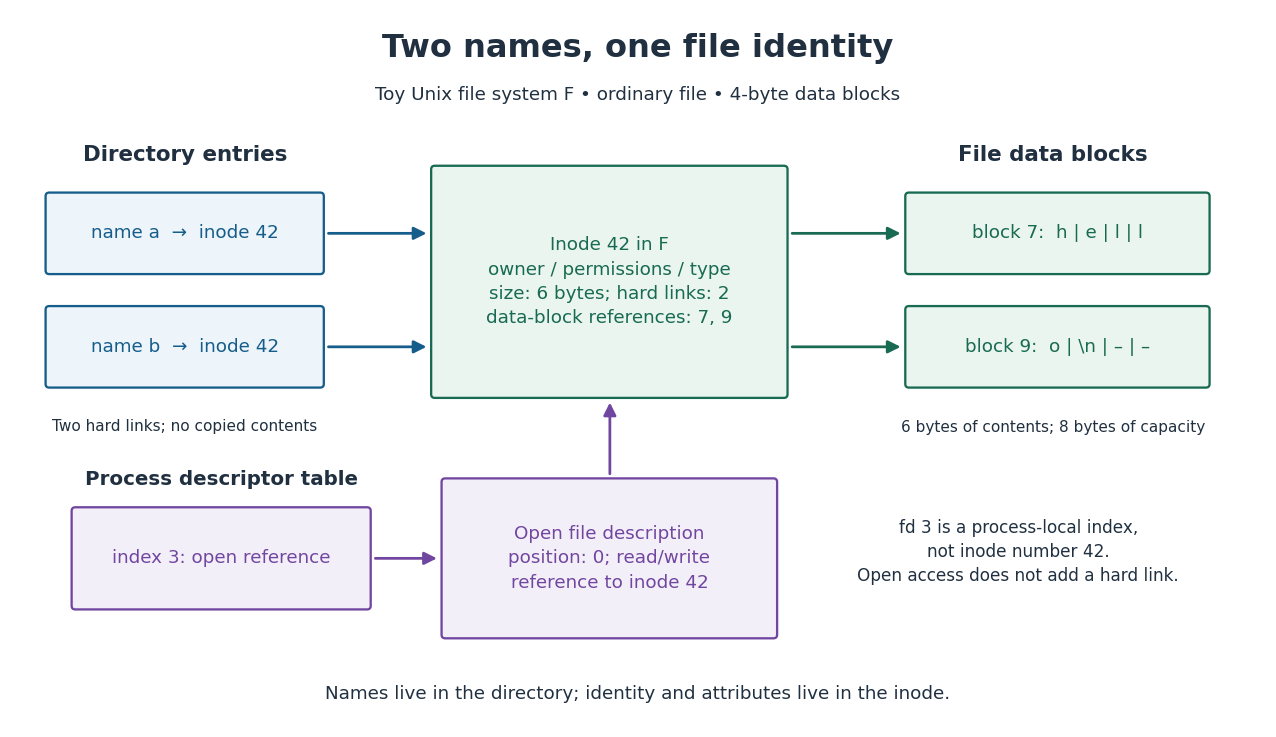
The separation is useful because a rename within this file system, from
a to a previously unused name c, can change a directory entry without copying the six bytes of contents. The remaining name b still reaches inode 42. A successful write changing the first byte through either name changes what both names subsequently read, to jello followed by a newline. This sharing is the attraction of hard links, and also why a hard link is not an independent backup. A program that replaces a named file with a different file can instead make the names diverge. [ref]https://pubs.opengroup.org/onlinepubs/9799919799/functions/rename.html. The Open Group, POSIX.1-2024, rename: changing names and replacing directory entries
Fork (system call) 2026-10-14
A system call creating a child operating-system process from a parent. The Linux kernel documents copy-on-write for ordinary inherited private memory pages, with separate address spaces but shared open file descriptions for inherited file descriptors. [ref]
Kernel (operating system) 2026-10-13
The operating-system kernel is the core of an operating system, controlling access to resources and supplying mechanisms used by operating-system processes. Processor privilege levels let it enforce boundaries that ordinary programs cannot simply overwrite. The operating-system kernel connects process scheduling, virtual memory and file system operations; a system call requests a service across that boundary. A monolithic kernel and a microkernel divide services differently, so the location of every file system service is a design choice.
For the toy file system, opening
a resolves its directory entry to inode 42, establishes an open file description, and returns file descriptor 3. Later reads use that file descriptor to reach the existing open file description, without resolving the spelling a again. This explains how unlinking an open file preserves access: the open reference survives the directory entry. The per-operating-system process table interpreting 3 is maintained by the operating-system kernel; 3 itself is the small integer passed by the program, not inode 42. [ref]https://pubs.opengroup.org/onlinepubs/9799919799/functions/open.html. The Open Group, POSIX.1-2024, open: file descriptor to open file description to file
Linux kernel 2026-10-13
A concrete operating-system kernel whose documented file system interface distinguishes a name-associated
dentry, an object-associated inode, and a file object created for an open instance. An inode can have several name-associated objects. This illustrates the distinction among directory entries, inodes and open file descriptions; it does not imply identical structures in every operating system. [ref]https://docs.kernel.org/filesystems/vfs.html. Linux kernel documentation, Overview of the Linux Virtual File System: directory entries, inode objects and file objects
// Target: computer-science.bigb
Open file description Created 2026-10-14 Updated 2026-10-31
A record of an open access to a file, including its current position and access mode. Each file descriptor reaches one open file description, but several file descriptors can share it. Separately opening the same ordinary file creates separate open file descriptions with independent positions while still reaching the same inode. Thus file descriptors, open file descriptions and hard links have different counts. [ref]
// Target: computer-science.bigb
Open file table 2026-10-31
The logical system-wide collection of open file descriptions. Each description represents an opening, including access mode, current file offset and a reference to the underlying file. Independent opens of the same file normally create different descriptions, whereas descriptor duplication can make multiple file descriptors share one description. A table is an abstract organization here, not a requirement that all entries occupy one fixed array.
Use a block allocation bitmap, one bit per allocatable disk block number, or a free-block list. Allocation removes a free block from the free representation; deallocation inserts it. Reserved file system structures, including the inode table and the free-space representation itself, must never be offered as free file data blocks. Free inodes can be tracked separately by an inode allocation bitmap.
A file data block becomes reusable when the file system has removed its ownership from the file. This happens, for example, when truncation discards that portion of the file, or when the file is finally destroyed. Destruction requires both removal of its last hard link and release of its last live reference: unlinking an open file must not reclaim blocks still needed through an open file description. A memory-mapped file, if supported, also requires its references to be accounted for. The indirect block pointers' own blocks are reclaimed when they are no longer needed.
There are two relevant notions of accessibility. Pathname-accessible files are those reached from the root through valid directory entries, subject to permissions; their allocated blocks are found through their inodes. Already-open files can additionally remain accessible through file descriptors even after their last names disappear. Allocated file system structures and blocks pinned by an operation must also be excluded from allocation. A block allocation bitmap must therefore describe actual allocation, rather than merely the blocks of currently named regular files.
One processor can still run several processes and be interrupted. Updating ownership and the free-space representation must therefore be serialized with respect to competing operations, for example through an appropriate kernel critical section. Persistence across a crash additionally requires file-system crash consistency, such as ordered updates or file-system journaling.
A file descriptor table belongs to a process: its small nonnegative integer indices are file descriptors, and each occupied entry points to an open file description. It also holds descriptor-specific information, such as whether the descriptor closes on a successful program replacement. There is one logical file descriptor table per process in the traditional model; implementations can let processes explicitly share one.
The system-wide open file table, called the file pointer table here, contains open file descriptions. Each entry records an opening's access mode, current file offset, reference count and reference to an in-memory inode. Duplicated file descriptors, including inherited ones, can refer to the same open file description and therefore share its file offset. Independent opens of the same file normally create separate open file descriptions and separate offsets. There is one logical system-wide open file table, with many entries.
The system-wide in-memory inode table caches the inodes currently needed, including shared file metadata, locking and reference information. Its identity key must include the file system as well as the inode number when several volumes are mounted. There is one logical system-wide active inode table, distinct from the persistent inode table stored on each volume. These are logical organizations, not requirements for a single contiguous array in memory.
Unlinking an open file 2026-10-14
For an ordinary file under the POSIX rules used here, successful
unlink("a") removes the named directory entry and decreases the hard link count. An existing open file description still refers to the same file; removing a name does not detach an already open file descriptor. When the final hard link disappears, the contents remain available through open references until those references close. This distinction is between the lifetime of a name and the lifetime of the underlying file. [ref]https://pubs.opengroup.org/onlinepubs/9699919799/functions/unlink.html. The Open Group, POSIX.1-2017, unlink: removal of names and deferred removal of open-file contents
Start with names
a and b for inode 42 and one file descriptor 3 referring to one open file description. Let count hard links and count live open file descriptions for this file. Assume successful operations, no additional references, and no memory-mapped file. The stages areAfter the first removal, b still works. After the second, neither name works, but a read through the existing file descriptor can still obtain all six bytes if its open file description's current position is at the beginning. The final close releases the last open reference, allowing the inode and its file data blocks to be reclaimed. Freed storage is reusable; this does not promise that old bytes are securely erased. [ref]https://pubs.opengroup.org/onlinepubs/009604499/functions/close.html. The Open Group, POSIX, close: releasing descriptors, open file descriptions and unlinked-file storage
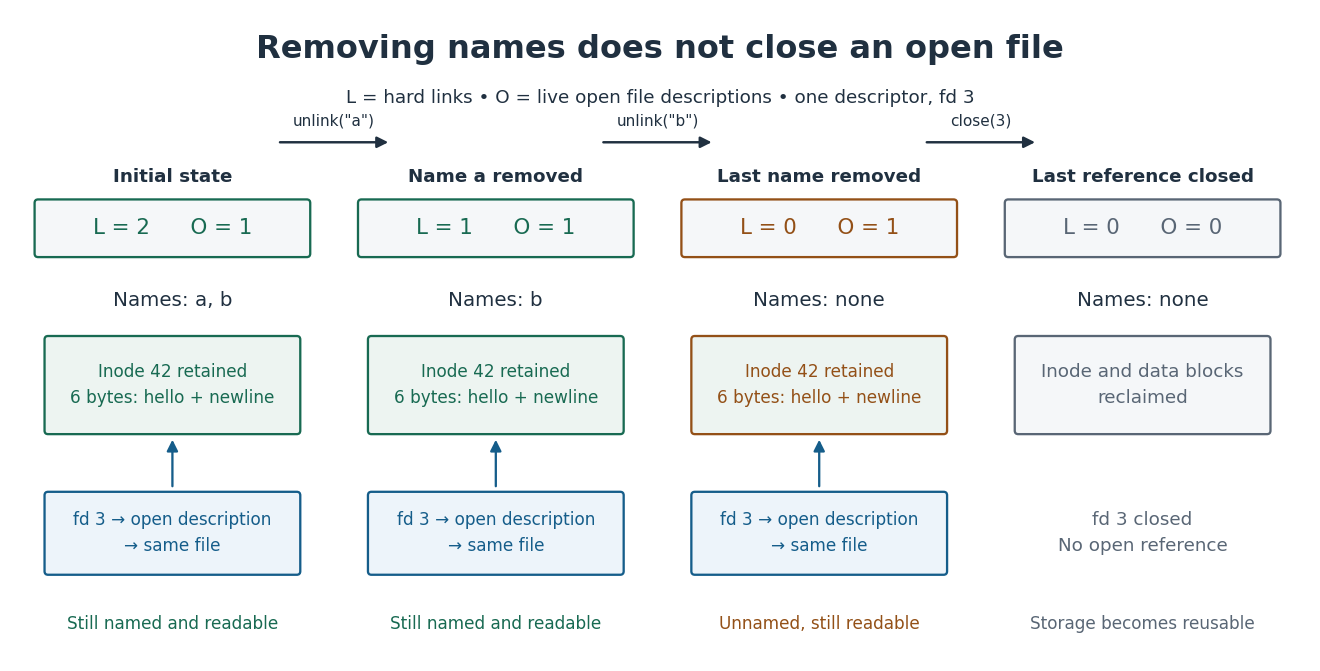


The reasoning is bookkeeping rather than a long proof: each successful removal subtracts one from and leaves unchanged; closing the only file descriptor in this example releases the sole open file description. Storage is reclaimable only at the last stage. is a teaching count, not a count of file descriptors or an asserted internal inode field: several file descriptors can share one open file description, and other references such as a memory-mapped file require additional lifetime accounting. The diagrams are abstract models, not operations on actual user files.