Paging divides an address space into fixed-size memory pages and main computer memory into equally sized page frames. Here assume byte addressing, one memory page size bytes, and an unsigned virtual address . Its virtual page number and offset areThe brackets denote the floor function, and gives the remainder in Euclidean division. If the page table maps to physical frame number and permits the access, the physical address isThe low bits are unchanged; the other bits select the memory page or page frame. A bit shift and bit mask can extract these fields. [ref]
https://pages.cs.wisc.edu/~remzi/OSTEP/vm-paging.pdf. Arpaci-Dusseau and Arpaci-Dusseau, OSTEP chapter 18: Paging, Introduction, sections 18.1–18.2
For a 16-bit virtual address and bytes, take in hexadecimal. Then and . A mapping to givesThus the eight high bits choose a mapping; the eight low bits choose the same position in the resulting page frame. The 256-byte size is for illustration, not a claim about an actual architecture's supported memory page sizes.
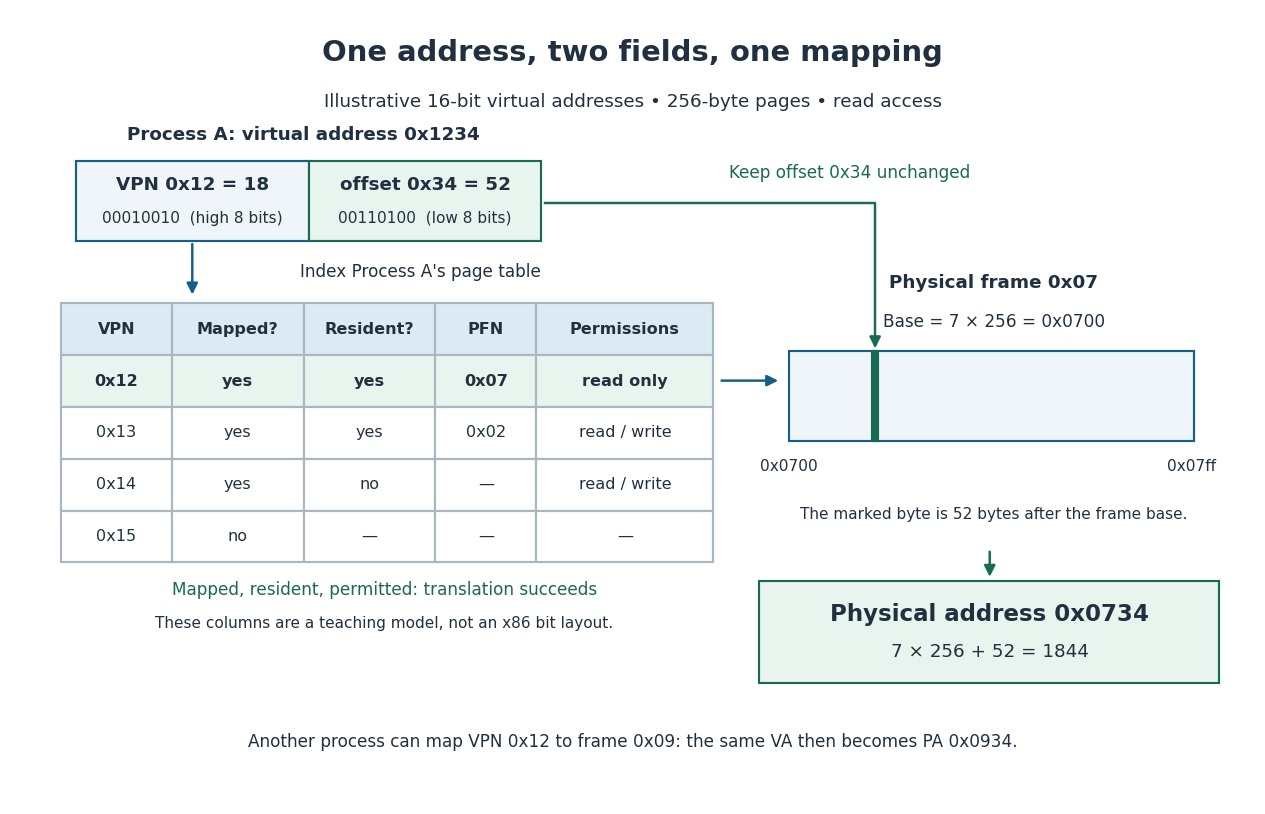
Translating 0x1234 through an illustrative page table, with a separate offset and access check
. Details. 
The useful freedom is that adjacent memory pages can occupy unrelated page frames. In the diagram, virtual pages
0x12 and 0x13 occupy page frames 0x07 and 0x02; virtual addresses 0x12ff and 0x1300 are consecutive, but translate to physical addresses 0x07ff and 0x0200. Uniform units simplify placement and page replacement, at the cost of page table storage and unused bytes within partly filled memory pages. For example, placing 300 bytes in exclusive 256-byte page frames requires two page frames, leaving bytes unused. Articles by others on the same topic
There are currently no matching articles.