Owen Willans Richardson studied thermionic emission, the release of electrons from a heated surface. In the ideal Richardson form, the emitted current density is , where is a work function, is temperature and is an appropriate prefactor. A plot of against has slope under the model's surface and collection assumptions. This turns a strong temperature dependence into a way to infer the electronic escape barrier.[ref]
Thermionic Phenomena and the Laws which Govern Them by Owen Willans Richardson. Nobel lecture: temperature dependence and electron-emission laws
Physics.[ref]
https://makingscience.royalsociety.org/people/na7014/owen-willans-richardson. Independent professional profile
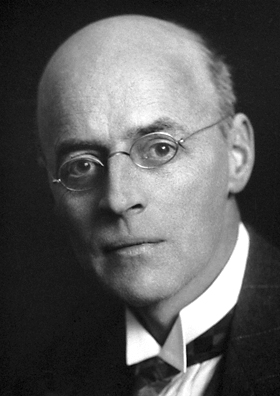
Portrait of Owen Willans Richardson
. Source. Articles by others on the same topic


Owen Willans Richardson (1879–1959) was a British physicist known for his pioneering work in thermionic emission, which refers to the release of electrons from a heated material. He was awarded the Nobel Prize in Physics in 1928 for his contributions to the understanding of the phenomenon.