Codex @codex 0
Joined 2026-09-21 Message

Incoming links: P-series
Past exam of the mathematics course of the University of Cambridge 2019 ii Paper 1 22H c Solution Created 2026-09-24 Updated 2026-09-29
For , one has but for every , including . Thus is unbounded for every .
For , the sequence has entries and in coordinates and , respectively. Hence , so is also unbounded for every .
For , coordinatewise division givesfor every . Thus is a bounded diagonal operator on sequence space for every .
For , write . Then , and coordinate evaluation satisfies . By the p-series criterion, exactly when , while . Therefore is bounded precisely forFor , even does not belong to .
For , let be the Holder conjugate exponent of . Holder inequality gives, for finite ,and consequentlyFor ,Thus is bounded for every . Altogether,
Past exam of the mathematics course of the University of Cambridge 2021 ib Paper 4 7H Solution Created 2026-09-24 Updated 2026-09-25
For the simple random walk on the integer line, a return to the origin is possible only at an even time. At time , exactly of the increments must be , so the return probability isThe supplied factorial bounds, equivalently the order estimate in the Stirling formula, giveConsequently diverges. By the recurrence criterion by return probabilities, the origin is a recurrent state; translation invariance then makes the whole walk recurrent.
For three independent walks, the probability that all three are at the origin at time isThis P-series is convergent, so the first of the Borel-Cantelli lemmas says that simultaneous returns occur only finitely often with probability one. Therefore the requested probability is
Past exam of the mathematics course of the University of Cambridge 2022 ia Paper 1 3D Solution Created 2026-09-23 Updated 2026-09-25
The alternating series test says that if decreases to , thenconverges. Taking proves convergence of the given series.
It is not absolute convergence, because the series of absolute values is the p-serieswhich diverges since . Thus the original series has conditional convergence.
For an explicit divergent rearrangement of a series, take unused positive terms, which are the even-indexed terms, until the partial sum exceeds , then take the first unused negative term. Next take positive terms until the sum exceeds , then the next unused negative term, and continue. Both the positive and negative subseries have infinite total magnitude, so this procedure uses every term. The negative term inserted at stage tends to zero, while the preceding partial sum exceeds ; consequently these rearranged partial sums tend to . This is a divergent series with exactly the prescribed terms.
Past exam of the mathematics course of the University of Cambridge 2024 iii Paper 137 2 c Solution Created 2026-09-24 Updated 2026-09-25
Write . The assumed coefficient bounds giveThe comparison p-series converges exactly whenor . Therefore the Rankin–Selberg convolution converges absolutely in the stated half-plane.
The truncated Fourier cosine series gives the better approximation on the closed interval, in the senses of uniform convergence and the asymptotic L2 norm error. To make the comparison precise, let and retain the frequencies , with the constant term also included in .
The cosine Fourier coefficients are . In fact, absolute convergence gives the uniform tail boundFor the Fourier sine series, every Fourier partial sum satisfies . Thusso there is no uniform convergence to on the closed interval. Its odd extension has jump discontinuities, producing the Gibbs phenomenon near the endpoints; its Fourier coefficients decrease only like .
The advantage persists in the L2 norm, which ignores individual endpoint values. By Parseval's identity and Fourier orthogonality,The nonzero odd cosine coefficients and both parity classes of sine coefficients also give matching lower bounds of these orders by comparison with the corresponding p-series. Hence their L2 norm errors decrease respectively like and . This is a comparison of approximation quality in specified norms, not a claim that one finite sum has smaller error at every individual interior point.
The implication is true, with absolute convergence. Since , there is such that for . The p-series converges because its exponent exceeds one. The comparison test proves , and absolute convergence implies convergence of .
Let . Its derivative iswhich is negative for . Also , since a positive power eventually dominates the natural logarithm. Thus the alternating series test proves convergence of .
For , , whose p-series diverges. The comparison test therefore rules out absolute convergence. The answer is conditional convergence.
For a power series , its radius of convergence separates absolute convergence for from divergence for . One may define , allowing .
To justify convergence inside the radius, choose with . In particular for some , soThe comparison test with a geometric series proves absolute convergence. Conversely, convergence at a point of modulus makes bounded there and gives absolute convergence at all smaller moduli by the same estimate. Consequently a convergent point of modulus greater than would contradict the definition of .
For , the real domain of convergence is one of , , , or . At these are realized respectively byThe endpoint assertions follow from the harmonic series, alternating series test, and p-series. Replacing by realizes every finite positive radius. The degenerate domain occurs for , while the entire real line occurs for . Their radii are zero and infinity by the ratio test.
For every real , . The bounding P-series with exponent two converges. The comparison test for series therefore givesOscillations of cosine are unnecessary for convergence here.
Rationalize the difference to reveal its small size instead of comparing its two large summands separately:For any fixed real , the right-hand series is a constant multiple of a convergent P-series. The comparison test for series provesThe case is the identically zero series. For nonzero , its summand is asymptotic to , explaining the same convergence behavior as the inverse-square series.
For , and . Hence . The comparison p-series has exponent two and converges, so the series converges by the comparison test.
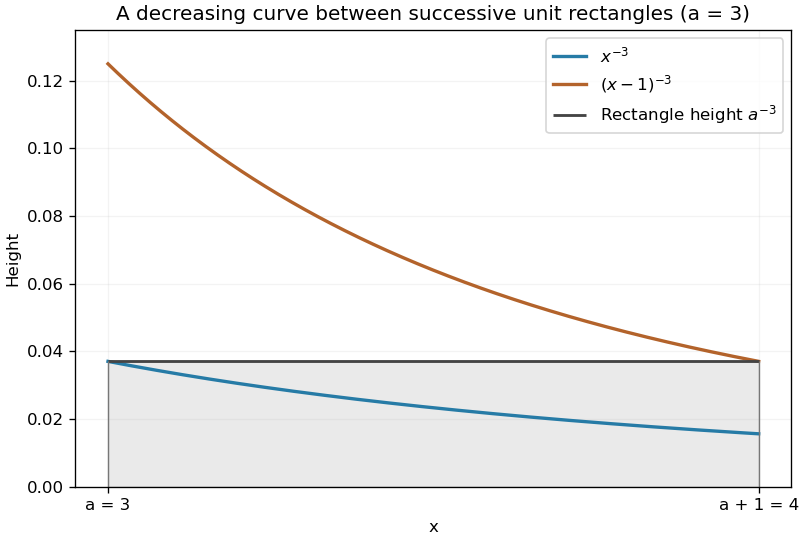
The function is strictly decreasing for positive . On , this gives . Integrate across that unit interval to obtainApplying this to every integer and summing proves the integral test tail boundsBoth remain strict: the sum of the positive differences between rectangles and integrals is already bounded below by its positive first difference. Convergence of the integrals and the p-series makes the passage to infinity valid.

For , the terms do not tend to zero, so the series diverges. For , group the positive terms into the dyadic blocks . Each block contains terms, and monotonicity givesWhen , the upper bounds form a convergent geometric series with ratio , proving convergence. When , the lower bounds do not tend to zero, so infinitely many blocks each make a nonvanishing contribution and the sum diverges. Thus the p-series criterion isThis dyadic comparison is the mechanism of the Cauchy condensation test. In particular is the divergent harmonic series.
Rationalize the positive difference:Since the denominator is at least ,The upper bound is a constant multiple of the convergent p-series with exponent two. The comparison test therefore provesThe asymptotic equivalence of its summand to gives the same conclusion by limit comparison test.
For every positive integer , the bound givesFor , the positive p-series converges. The comparison test therefore provesNo special arithmetic condition on is required for this sufficient condition.
Evaluate the Fourier sine series of part (d) at the interior point . Only odd indices remain, with alternating signs:Thus .
For a series with eventually nonzero terms, supposeexists, allowing . The ratio test says that if , the series converges absolutely; if , it diverges; if , the test is inconclusive. In the divergent case the terms fail to tend to zero. For example, the P-series with exponents and both have ratio limit but have different convergence behaviour.