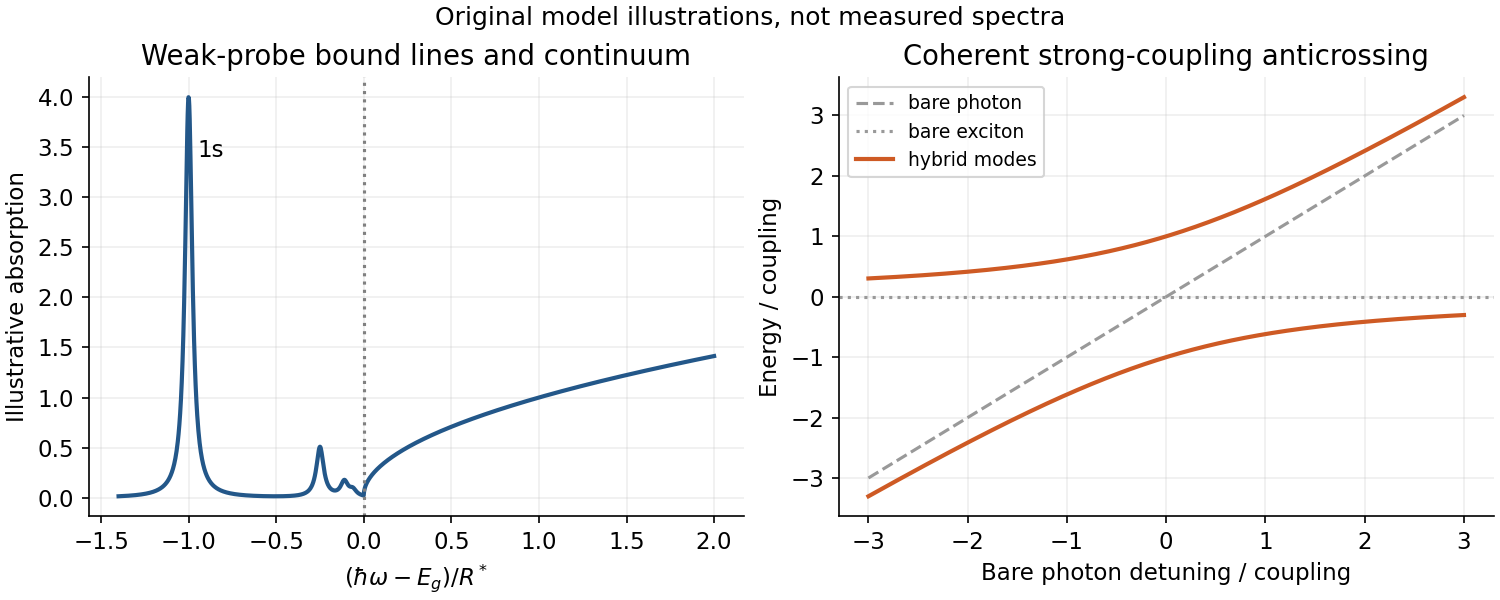
In weak-probe optical absorption, Fermi's golden rule creates an electron-hole pair, with negligible population depletion. Negligible photon momentum makes a direct band gap transition nearly vertical in crystal momentum:For allowed transitions between three-dimensional parabolic bands, the joint density of states yields above the gap. Selection rules and polarization enter the dipole matrix element. An indirect band gap needs an additional phonon to conserve crystal momentum, with phonon absorption/emission weights and shifted thresholds.
Electron-hole attraction produces Wannier excitons below the continuum, approximately , with bright -state oscillator strength decreasing as . It also enhances the continuum edge. Screening, disorder and phonons broaden these features; heavy/light valence bands can create distinct series. This linear-response picture includes Coulomb binding but excludes a resolved coherent photon–exciton anticrossing: that would require a strong light–matter coupling treatment. “Weak coupling” here is distinguished from neglecting the electron-hole interaction altogether.

In mixed-valence manganites, mobile electrons hop between sites whose localized core spins are coupled to them by strong Hund's coupling. Projecting onto local spin-aligned states gives the double-exchange mechanismAlignment maximizes the hopping bandwidth and lowers carrier kinetic energy, favouring ferromagnetism. This involves real charge transfer, unlike insulating superexchange. Heating disorders core spins and reduces coherent transport; a magnetic field aligns spins, increasing mobility and reducing resistivity. The large negative response near the magnetic transition is colossal magnetoresistance.
Double exchange supplies the conduction–magnetism link, but its simplest spin-only model is insufficient for the full resistivity change. Lattice distortions, Jahn-Teller effect and carrier localization can amplify the effect; materials need not obey a universal resistivity-versus-magnetization law.[ref]
Interaction between the d-Shells in the Transition Metals. II. Ferromagnetic Compounds of Manganese with Perovskite Structure by Clarence Zener. Double exchange and magnetic conduction
[ref]An exciton is an electron-hole bound state and behaves approximately as a boson when the gas is dilute compared with the inverse exciton volume. A condensation experiment needs a long enough lifetime for cooling, high phase-space density and evidence of spontaneous coherence; excessive density causes ionization or a Mott transition instead.
Bulk Cu₂O offers long-lived excitons, but heating, losses and Auger recombination complicate interpretation. Spectral narrowing or anomalous transport alone is insufficient: early claims required reinterpretation. Coupled quantum wells separate electron and hole layers, increasing lifetime and enabling cold indirect-exciton gases, though disorder, trapping and nonequilibrium flow must be distinguished from condensation.[ref]
Bose-Einstein Condensation of Excitons in Cu2O: Progress Over Thirty Years by David Snoke and G. M. Kavoulakis. 2012 preprint: experimental history, losses and reinterpreted signatures
In a semiconductor microcavity, coherent strong coupling mixes an exciton with a light cavity photon to form polaritons with very small effective mass. Nonresonant pumping supplies particles without imposing the condensate's phase. The 2006 CdTe experiment reported a threshold, strong low-momentum occupation, increased temporal coherence and long-range spatial coherence. These combined signatures support an exciton-polariton condensate; a threshold or bright emission alone does not distinguish it from photon lasing. Check that strong coupling persists above threshold. Finite lifetime and pumping make this an open, driven system, so thermalization must be demonstrated rather than inferred merely from the word condensate.[ref]
Bose-Einstein condensation of exciton polaritons by J. Kasprzak and others. 2006: occupation, coherence and polarization measurements
Articles by others on the same topic
There are currently no matching articles.