A normal Fermi liquid is an interacting fermion phase continuously connected to a Fermi gas without broken symmetry. Its Landau quasiparticles are dressed particle/hole excitations near the Fermi surface, with the same conserved quantum numbers, finite quasiparticle residue and a decay width small compared with their excitation energy. Their reference dispersion already includes zero-temperature interaction renormalization; “bare quasiparticle” here does not mean a free atom.[ref]
The Theory of a Fermi Liquid by Lev Davidovich Landau. Low-energy quasiparticles and effective dispersion
The rate assumes , , regular scattering amplitudes and density of states, equilibrium Fermi-Dirac distributions, and two-body collisions conserving energy and momentum. Pauli exclusion principle restricts the available phase space. It describes a regular three-dimensional normal liquid, not a one-dimensional interacting electron liquid. On the surface, ; at and , it is proportional to . Hence excitations become increasingly sharp. The quoted asymmetric occupation factor is for particle out-scattering: a hole decay or full spectral width also needs the complementary in-scattering process; it does not imply exponentially stable deep holes.
Symmetry cancels the quadratic functional's factor one-half, giving the thermal Landau quasiparticle energy shiftHere , and the derivative is with respect to an occupation, not particle density. Replacing the homogeneous momentum sum by an energy integral defines a smooth angularly averaged kernel . With ,Fixed density gives ; fixed chemical potential instead has . Thus in either case, provided the kernels are smooth and no instability intervenes. This is the Sommerfeld expansion; singular spectra require separate treatment.[ref]
The leading entropy is therefore that of quasiparticles with their zero-temperature effective mass: here is the total, spin-summed density of states. The plotted low-temperature slopes require the enhanced masses at molar volume and at , rather than the bare-mass predictions. At fixed molar particle number, . Agreement is restricted to the low-temperature limit: the measured curves depart markedly from a fixed-mass ideal-gas extrapolation at higher temperature. This supports long-lived quasiparticles with smooth low-energy parameters, but heat capacity alone does not measure their lifetime or prove adiabatic continuity.
A GaAs–AlGaAs semiconductor heterostructure confines electrons normal to the interface in a semiconductor quantum well. Remote modulation doping supplies a high-mobility two-dimensional electron gas. Negative split gates deplete it laterally, leaving a narrow quantum point contact with discrete transverse subbands and continuous longitudinal momentum. A single occupied subband requires transverse excitation gaps larger than thermal and applied-bias energies.
Take and count one spin-resolved channel. In a length , right-moving states have density ; each contributes charge current . ThusThe second expression is the right reservoir's left-moving contribution expressed in the same left-to-right conventional-current sign. Since ,The limit needs and ballistic transport. Velocity cancels the one-dimensional state density. Two degenerate spin channels give , not an extra factor hidden in the quoted single-channel result.
For elastic phase-coherent scattering, expand each incident flux-normalized mode in outgoing lead modes. Its transmitted fraction is ; sum over all open outgoing and occupied incident . Linearizing the reservoir occupations gives the Landauer formulaThe source's denotes this amplitude matrix, not temperature or a probability matrix. Flux normalization is essential: ordinary wave-amplitude ratios need a velocity factor. Reservoirs equilibrate, contacts supply incoming Fermi distributions, and inelastic processes within the channel are neglected. Spin is included among channel labels. At , only transmissions at contribute; perfect channels each add one quantum. This is a two-terminal conductance including contact resistance, even with no internal backscattering.
Trace I has steps near integer as less-negative gate voltage opens successive spin-degenerate subbands. At the printed parallel field , Zeeman splitting separates the two spin thresholds, allowing approximately half-sized steps in the plotted units; the onset also shifts. Thermal broadening, imperfect transmission and unresolved thresholds round the plateaux. A parallel field primarily resolves spin in the ideal thin-interface model; finite layer thickness can also shift subband energies. The plot alone does not determine a unique effective factor or microscopic disorder model.
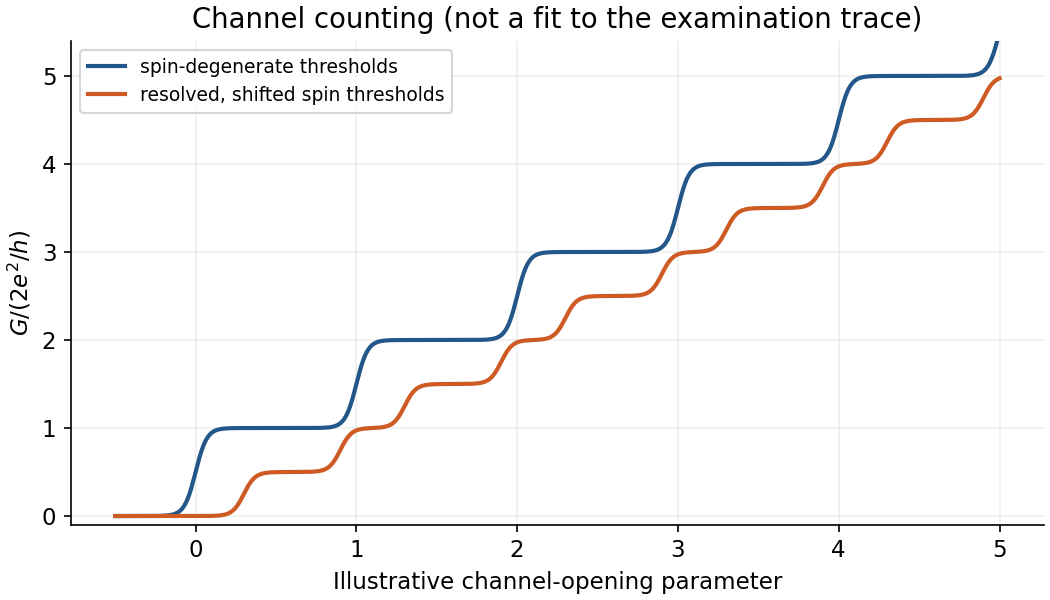
Illustrative spin-resolved channel thresholds produce full or half-sized conductance steps
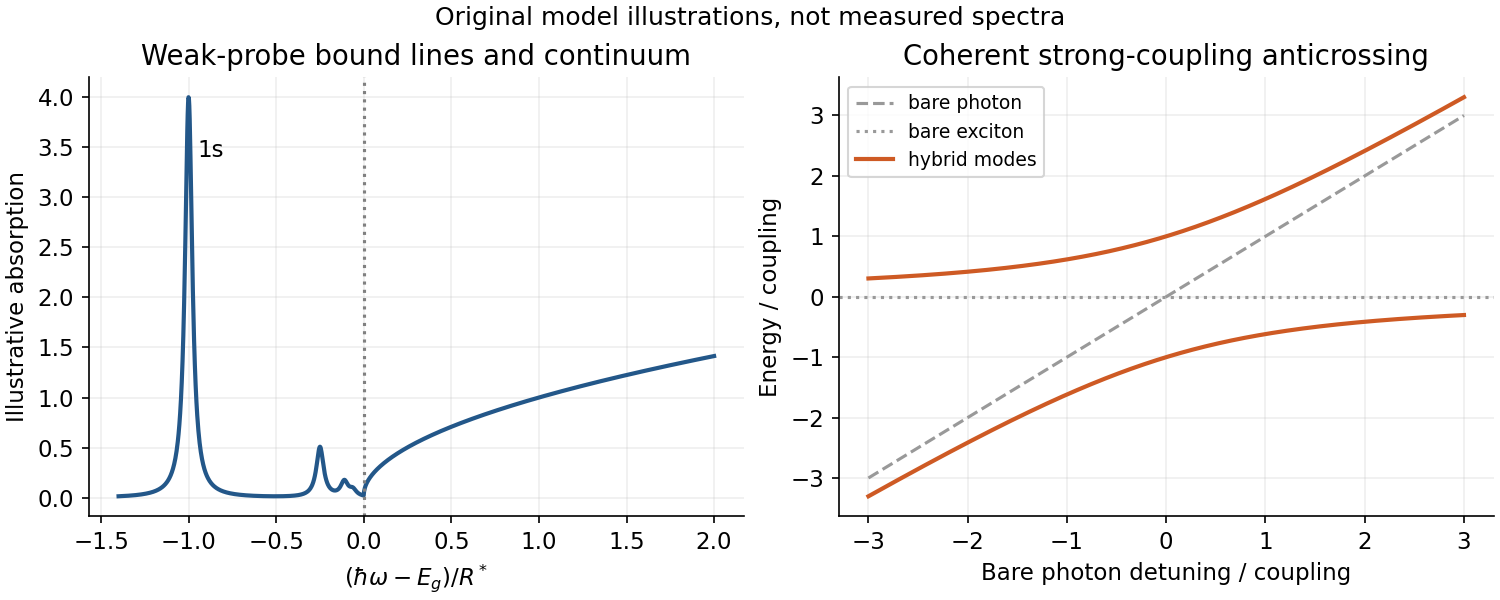
. Source. Details. In weak-probe optical absorption, Fermi's golden rule creates an electron-hole pair, with negligible population depletion. Negligible photon momentum makes a direct band gap transition nearly vertical in crystal momentum:For allowed transitions between three-dimensional parabolic bands, the joint density of states yields above the gap. Selection rules and polarization enter the dipole matrix element. An indirect band gap needs an additional phonon to conserve crystal momentum, with phonon absorption/emission weights and shifted thresholds.
Electron-hole attraction produces Wannier excitons below the continuum, approximately , with bright -state oscillator strength decreasing as . It also enhances the continuum edge. Screening, disorder and phonons broaden these features; heavy/light valence bands can create distinct series. This linear-response picture includes Coulomb binding but excludes a resolved coherent photon–exciton anticrossing: that would require a strong light–matter coupling treatment. “Weak coupling” here is distinguished from neglecting the electron-hole interaction altogether.


In mixed-valence manganites, mobile electrons hop between sites whose localized core spins are coupled to them by strong Hund's coupling. Projecting onto local spin-aligned states gives the double-exchange mechanismAlignment maximizes the hopping bandwidth and lowers carrier kinetic energy, favouring ferromagnetism. This involves real charge transfer, unlike insulating superexchange. Heating disorders core spins and reduces coherent transport; a magnetic field aligns spins, increasing mobility and reducing resistivity. The large negative response near the magnetic transition is colossal magnetoresistance.
Double exchange supplies the conduction–magnetism link, but its simplest spin-only model is insufficient for the full resistivity change. Lattice distortions, Jahn-Teller effect and carrier localization can amplify the effect; materials need not obey a universal resistivity-versus-magnetization law.[ref]
Interaction between the d-Shells in the Transition Metals. II. Ferromagnetic Compounds of Manganese with Perovskite Structure by Clarence Zener. Double exchange and magnetic conduction
[ref]An exciton is an electron-hole bound state and behaves approximately as a boson when the gas is dilute compared with the inverse exciton volume. A condensation experiment needs a long enough lifetime for cooling, high phase-space density and evidence of spontaneous coherence; excessive density causes ionization or a Mott transition instead.
Bulk Cu₂O offers long-lived excitons, but heating, losses and Auger recombination complicate interpretation. Spectral narrowing or anomalous transport alone is insufficient: early claims required reinterpretation. Coupled quantum wells separate electron and hole layers, increasing lifetime and enabling cold indirect-exciton gases, though disorder, trapping and nonequilibrium flow must be distinguished from condensation.[ref]
Bose-Einstein Condensation of Excitons in Cu2O: Progress Over Thirty Years by David Snoke and G. M. Kavoulakis. 2012 preprint: experimental history, losses and reinterpreted signatures
In a semiconductor microcavity, coherent strong coupling mixes an exciton with a light cavity photon to form polaritons with very small effective mass. Nonresonant pumping supplies particles without imposing the condensate's phase. The 2006 CdTe experiment reported a threshold, strong low-momentum occupation, increased temporal coherence and long-range spatial coherence. These combined signatures support an exciton-polariton condensate; a threshold or bright emission alone does not distinguish it from photon lasing. Check that strong coupling persists above threshold. Finite lifetime and pumping make this an open, driven system, so thermalization must be demonstrated rather than inferred merely from the word condensate.[ref]
Bose-Einstein condensation of exciton polaritons by J. Kasprzak and others. 2006: occupation, coherence and polarization measurements
Articles by others on the same topic
There are currently no matching articles.