Choose on the Dirac field, in the fundamental representation of SU(2), and . Define the gauge field strength and the Adjoint representation gauge covariant derivative byThe required gauge-fixed Yang-Mills Lagrangian in a covariant gauge, including the matter term, isHere and are independent Grassmann fields in the Adjoint representation: the Faddeev-Popov ghost fields and antighost fields. Under an infinitesimal gauge transformation, ; hence the Lorenz gauge function varies by . Its Faddeev-Popov determinant is represented by the ghost term, with an irrelevant field-independent determinant sign absorbed into normalization. Integration by parts gives , explicitly showing the ghost-gluon vertex.
There is no scalar vacuum expectation value here, so R-xi gauge reduces to the linear covariant gauge displayed above, with no Goldstone boson term. At the Feynman gauge gauge boson propagator is . With Fourier convention and all three boson four-momenta incoming, this choice gives exactly the source's three-boson Feynman rule, and the matter interaction vertex is . The sign of has been explicitly chosen here; the QED convention in question 2 instead has vertex .
There are three tree-level Feynman diagrams: two ordered fermion-exchange diagrams and one s-channel gauge boson exchange diagram. Write the outgoing labels as and .
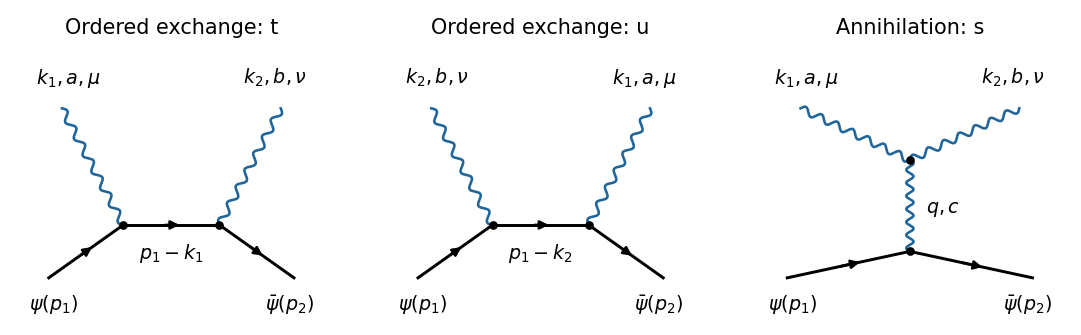
Original tree-level Feynman diagrams for fermion and antifermion annihilation into two non-Abelian gauge bosons: two ordered exchanges and the three-boson annihilation channel
. Details. 
Following the fermion flow from to , the first diagram emits boson 1 and then boson 2; its internal four-momentum is and its ordered colour factor is . The second emits boson 2 and then boson 1, giving and . The third annihilates into one virtual gauge boson of four-momentum and uses the three-boson interaction vertex. There is no two-fermion two-boson contact interaction vertex for the minimally coupled Dirac field, and no tree ghost contribution with these external states.
Use the Feynman rules and Feynman gauge convention from part a. Put , , , the Mandelstam variables, and define the three-boson tensor with incoming four-momenta :The contributions, with external Dirac spinors included and both external gauge boson propagators amputated, areFor example, contains . In the annihilation channel, the current vertex, propagator, and three-boson vertex give , so division by the defining overall gives . These relative signs are essential for the cancellation in part d. The antisymmetric colour factor makes the last expression symmetric under simultaneously exchanging and , as required for identical outgoing gauge bosons. The on shell external Dirac spinors obey , .
For the outgoing massless gauge bosons, take . Work away from internal poles, with the Feynman i-epsilon prescription understood. The Dirac equations and four-momentum conservation giveMultiplying by the neighboring Dirac propagator numerator cancels its denominator. The two fermion-exchange diagrams therefore yield the matrix commutatorThe annihilation vector current obeys . Direct contraction of the three-boson tensor givesThusThe terms proportional to cancel, leaving the non-Abelian Ward identity for fermion annihilationThe open-index tensor is generally nonzero: neither nor is constrained to vanish. For a concrete nonzero configuration, take centre-of-momentum frame kinematics , , , , . Standard Dirac spinors with two-component spin labels for and for give the spinor current and its contraction with is . Choosing both colour spinors and multiplies this by , still nonzero. This explicitly rules out an unconditional tensor identity .
For a physical polarization vector , however, , and thereforeThis is the required decoupling of a pure-gauge polarization vector on leg 2 when the other leg is physical. Interchanging the legs gives the corresponding identity for leg 1. The role of the three-boson diagram is explicit: it cancels the noncommuting colour-current term left by the two fermion exchanges.
The non-Abelian counterpart of the photon Ward identity is a Slavnov-Taylor identity, derived from BRST symmetry. A scattering amplitude with all other external states physical vanishes when one external massless gauge boson polarization vector is replaced by its four-momentum. An amputated tensor with the remaining indices open need not be transverse: part d gives its explicit nonzero longitudinal remainder.
Consequently, amplitudes involving several unphysical covariant polarization vectors need not vanish. For example, contracting the result of part d with a timelike vector gives , nonzero in the explicit configuration there for . Even with other states physical, the pure-gauge vector is the relevant null combination; separate timelike and spatial longitudinal basis vectors are not themselves pure gauge, and their separate amplitudes need not be zero.
These auxiliary components do not define separately observable positive probabilities. Physical states are classes in BRST cohomology, and the S-matrix preserves that physical state space in this anomaly-free vectorlike gauge spectrum. There is no physical transition from a physical state to a nonphysical state. The incorrect stronger statement would be that every covariant component called “unphysical” has a zero matrix element.
For loop Feynman diagrams or unitarity cuts, summing covariant gauge indices with propagates those auxiliary components. In a Non-Abelian gauge theory, their cancellation requires the interacting Faddeev-Popov ghost fields as well as the gauge boson diagrams. Ghost contributions carry their Grassmann field loop signs and restore the Slavnov-Taylor identities and physical unitarity. One may instead use a formulation with only physical propagating polarization vectors, but one cannot simply discard the ghost diagrams while retaining the Feynman gauge rules from part a.
Articles by others on the same topic
There are currently no matching articles.