Source PDF: mmathphys.physics.ox.ac.uk/sites/g/files/vzsiac2991/files/mmathphys/documents/media/aqft_for_particle_physics_2024.pdf
Solutions to all seventeen lettered parts. Use natural units, the Minkowski metric , Feynman slash notation , and the Feynman i-epsilon prescription in internal propagators. Define the scattering amplitude by . The gauge covariant derivative convention in question 3 is specified there to match the printed three-boson Feynman rule.
For a Dirac field, the path integral is a Berezin integral over independent Grassmann fields and :The vacuum boundary conditions and the Feynman i-epsilon prescription are understood; fixes the vacuum normalization. This is the vacuum generating functional without sources, rather than a finite-temperature partition function.
The Dirac adjoint transforms as . For constant , . Both the kinetic term and the Dirac mass term therefore retain their values. This proves the global phase symmetry, whose group is the unitary group .
For the local variation , , the terms proportional to cancel and the differentiated phase givesThus, for a compactly supported , integration by parts givesThis Dirac current is the Noether current in the convention . Using the convention with a plus sign reverses the Noether current and the conserved charge together. There is one independent global symmetry in field theory, with four spacetime components of its Noether current. The associated conserved charge is , with vacuum subtraction when required.
An operator equation in a path integral means that insertion of into every time-ordered correlation function vanishes when is separated from the other insertion points. At coincident points, Ward identity contact terms can remain; an operator equation does not assert that these distributions vanish.
Let be a product of local insertions. Make the local phase change of integration variables from part b. The functional measure has unit functional Jacobian: the opposite phases of and cancel in a vector-symmetry-preserving regularization in quantum field theory. There is no vector gauge anomaly. Invariance under a change of integration variables givesIf and , comparison of the coefficients of the arbitrary yields the Ward-Takahashi identityConsequently is an operator equation at separated points. This is stronger than just . For example, has , , so its two Ward identity contact terms are ; dropping them would give a false identity. Equivalently, the Dirac equation and the adjoint Dirac equation give , with the same coincident-point qualification in time-ordered correlation functions.
Couple a nondynamical background gauge field to the Dirac current, choosing a plus sign for the source term:There is no integration over . The gauge covariant derivative is , so the simultaneous transformations areThe kinetic term changes by and the source term changes by . The action is therefore invariant, exactly for finite as well as infinitesimally. Changing integration variables and using the invariant functional measure from part c proves the background gauge invariance of a current generating functional:The allowed transformations preserve the vacuum boundary conditions. Its infinitesimal version is . Because is only a source, this statement needs no gauge fixing or photon kinetic term. The absence of a vector gauge anomaly is essential to the change-of-variables argument.
Collect the two Dirac fields into , with a common nonzero mass . ThenAmong complex-linear rotations of the Dirac fields, the internal symmetry of a classical field theory is , , with . Unitarity preserves the kinetic term, and the mass matrix commutes with every . This unitary flavour symmetry of degenerate Dirac fields has group , where the quotient avoids counting the common central element twice.
Choose the four Hermitian matrices , for , with the Pauli matrices. Promoting the four parameters to functions gives . The four Noether currents are thereforeTheir divergences vanish by the equal-mass Dirac equations. The singlet is half the total Dirac current; the other three currents rotate the two species.
Free-theory qualification. If “global internal symmetry” allows mixing the Dirac fields with charge-conjugate fields, the completely free theory written here has a larger enhanced internal symmetry of free Dirac fields. Write using four Majorana fermions. Up to a total derivative,The full orthogonal group acts on the four real species; its connected part is . Its six Noether currents can be chosen as for , up to the common sign convention. The antisymmetry of this Majorana fermion vector bilinear makes these the six independent rotations. A concrete rotation outside the stated complex-linear is , : it preserves the displayed Lagrangian density while mixing with their charge-conjugate fields. The usual answer specifies the subgroup preserving the chosen common fermion number.
In the Weyl representation of the gamma matrices, write each Dirac field as , where and have opposite chirality. With the Weyl sigma matrices and ,The Dirac mass term couples the two Weyl fields. Under , , its first term acquires , so a common nonzero mass requires . At zero mass there is no such constraint:This is the chiral flavour symmetry of massless Dirac fields. Its eight Noether currents are and . The sum is the vector current, and is the axial current, for each flavour generator. This statement concerns the free theory in flat spacetime; an interacting theory can have a chiral anomaly.
For completeness, allowing the extra transformations described in part e gives four left-handed Weyl fields, , where is the left-handed charge-conjugate field of . After integration by parts their kinetic term is , whose maximal linear unitary group is . The symmetric mass matrix for equal Dirac masses iswith the antisymmetric spinor contraction implicit. A unitary change of basis makes ; preserving both the kinetic term and requires , hence real . Thus the unrestricted free-theory enhancement is at zero mass and at equal nonzero mass; the familiar and diagonal are their common-fermion number-preserving subgroups.
The two one-loop Feynman diagrams are fermion loops with three photon interaction vertices. Fix vertex 1; the two cyclic orders are and . A cyclic rotation does not produce another Feynman diagram. Keeping all three external labels in the same positions, these two orders can be represented by the same triangle with opposite fermion flow, as in the first two panels.
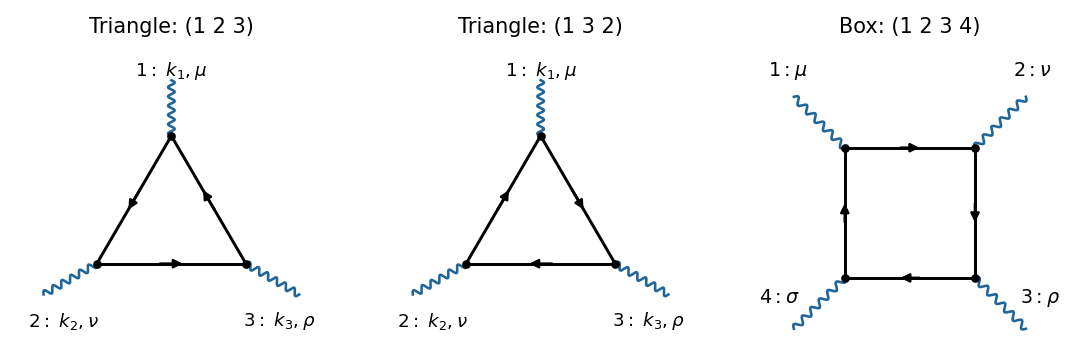
Original Feynman diagrams for the two orientations of the three-photon fermion loop and a representative four-photon box diagram
. Details. 
The photons are labelled , , , with all four-momenta incoming and . The amputation of external propagators removes the three external photon propagators, leaving their Lorentz indices open. There are no other connected one-loop Feynman diagrams with only three external photons in QED.
Put for the Dirac propagator, and for a translation-invariant dimensional regularization of the loop momentum integral. The two oriented scattering amplitudes areThe common minus sign is the closed fermion loop sign. There is no additional symmetry factor for either labelled orientation. Each expression is a trace over spinor indices; all external photon propagators are amputated. If , the common factor is , so, for example, .
Use the source's charge-conjugation matrix convention . It impliesA trace equals the trace of its matrix transpose, which reverses the order of all factors. Inserting the displayed identities givesThere is one minus sign from each of the three photon interaction vertices, and none from the transformed Dirac propagators. In the last line, change loop momentum to . Since , its three Dirac propagators become , , , exactly those of the reversed orientation. HenceThis is Furry's theorem. The regularization in quantum field theory matters: the individual Feynman integrals are superficially divergent, so an unregulated shift of a divergent integral is not a proof. A common dimensional regularization preserves charge conjugation and the vector Ward identity, making the change of variables legitimate. No chirality matrix occurs, so the axial triangle anomaly is not involved.
For an -vertex fermion loop, reversing the fermion flow reverses the ordered product inside its trace. The same charge-conjugation matrix calculation transforms every Dirac propagator by and contributes for each vector photon interaction vertex. Relabel the loop momentum so that the external labels are fixed. The reversed Feynman diagram therefore obeysFor odd , the cyclic orders pair into opposite orientations and cancel. For , the single photon tadpole maps into itself with a minus sign and is zero. The common closed fermion loop sign is present on both sides and does not supply the factor . This proves Furry's theorem for all the requested one-loop Feynman diagrams. The charge conjugation argument also gives vanishing odd-photon correlation functions to all orders in vacuum QED, provided no charge conjugation symmetry breaking background or charged external state is introduced.
The third panel of the figure in part a is a representative four-photon box diagram. Fix the external photon labelled 1 and orient the fermion loop. The six inequivalent cyclic orders of the labelled interaction vertices areThey are obtained by permuting labels on the displayed box, keeping label 1 fixed. Equivalently there are three undirected boxes, each with two opposite fermion flows. The reversal pairs areFor four photon interaction vertices, the sign in part d is positive, so the members of each pair add. They can be represented by three box diagrams multiplied by two. There is no tree photon self-coupling in QED, and therefore no triangle or bubble with a photon self-vertex to add at this loop order. This is the one-loop light-by-light scattering contribution, of order .
At large loop momentum, each Dirac propagator scales as . One four-dimensional loop and four internal Dirac propagators therefore give the superficial degree of divergenceThus a possible ultraviolet divergence in the sum is logarithmic. By locality its divergent coefficient is a degree-zero polynomial in the external four-momenta, namely a constant Lorentz tensor,The photon Ward identities apply to the complete sum for arbitrary external four-momenta, including off shell ones: , and likewise for the other legs. A constant tensor with for every must be zero. Hence andEquivalently, a logarithmic divergence would require a local dimension-four counterterm, forbidden by Abelian gauge invariance. A gauge-invariant four-photon local operator starts with four gauge field strengths, for example , of mass dimension eight; it cannot be this power counting divergence. Individual boxes need not be finite; their forbidden divergent parts cancel in the sum. There are no divergent proper loop subgraphs at this loop order. With the massive Dirac field in the source, there is also no soft or collinear infrared divergence at generic external kinematics. The argument establishes ultraviolet finiteness, and does not claim the absence of physical threshold singularities.
Choose on the Dirac field, in the fundamental representation of SU(2), and . Define the gauge field strength and the Adjoint representation gauge covariant derivative byThe required gauge-fixed Yang-Mills Lagrangian in a covariant gauge, including the matter term, isHere and are independent Grassmann fields in the Adjoint representation: the Faddeev-Popov ghost fields and antighost fields. Under an infinitesimal gauge transformation, ; hence the Lorenz gauge function varies by . Its Faddeev-Popov determinant is represented by the ghost term, with an irrelevant field-independent determinant sign absorbed into normalization. Integration by parts gives , explicitly showing the ghost-gluon vertex.
There is no scalar vacuum expectation value here, so R-xi gauge reduces to the linear covariant gauge displayed above, with no Goldstone boson term. At the Feynman gauge gauge boson propagator is . With Fourier convention and all three boson four-momenta incoming, this choice gives exactly the source's three-boson Feynman rule, and the matter interaction vertex is . The sign of has been explicitly chosen here; the QED convention in question 2 instead has vertex .
There are three tree-level Feynman diagrams: two ordered fermion-exchange diagrams and one s-channel gauge boson exchange diagram. Write the outgoing labels as and .
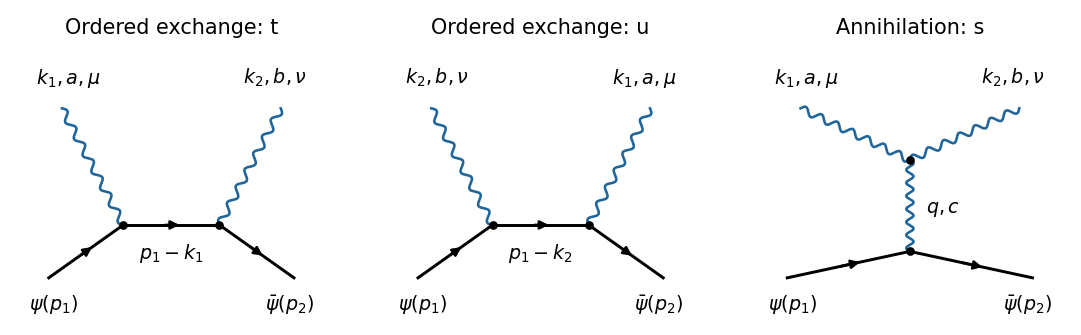
Original tree-level Feynman diagrams for fermion and antifermion annihilation into two non-Abelian gauge bosons: two ordered exchanges and the three-boson annihilation channel
. Details. 
Following the fermion flow from to , the first diagram emits boson 1 and then boson 2; its internal four-momentum is and its ordered colour factor is . The second emits boson 2 and then boson 1, giving and . The third annihilates into one virtual gauge boson of four-momentum and uses the three-boson interaction vertex. There is no two-fermion two-boson contact interaction vertex for the minimally coupled Dirac field, and no tree ghost contribution with these external states.
Use the Feynman rules and Feynman gauge convention from part a. Put , , , the Mandelstam variables, and define the three-boson tensor with incoming four-momenta :The contributions, with external Dirac spinors included and both external gauge boson propagators amputated, areFor example, contains . In the annihilation channel, the current vertex, propagator, and three-boson vertex give , so division by the defining overall gives . These relative signs are essential for the cancellation in part d. The antisymmetric colour factor makes the last expression symmetric under simultaneously exchanging and , as required for identical outgoing gauge bosons. The on shell external Dirac spinors obey , .
For the outgoing massless gauge bosons, take . Work away from internal poles, with the Feynman i-epsilon prescription understood. The Dirac equations and four-momentum conservation giveMultiplying by the neighboring Dirac propagator numerator cancels its denominator. The two fermion-exchange diagrams therefore yield the matrix commutatorThe annihilation vector current obeys . Direct contraction of the three-boson tensor givesThusThe terms proportional to cancel, leaving the non-Abelian Ward identity for fermion annihilationThe open-index tensor is generally nonzero: neither nor is constrained to vanish. For a concrete nonzero configuration, take centre-of-momentum frame kinematics , , , , . Standard Dirac spinors with two-component spin labels for and for give the spinor current and its contraction with is . Choosing both colour spinors and multiplies this by , still nonzero. This explicitly rules out an unconditional tensor identity .
For a physical polarization vector , however, , and thereforeThis is the required decoupling of a pure-gauge polarization vector on leg 2 when the other leg is physical. Interchanging the legs gives the corresponding identity for leg 1. The role of the three-boson diagram is explicit: it cancels the noncommuting colour-current term left by the two fermion exchanges.
The non-Abelian counterpart of the photon Ward identity is a Slavnov-Taylor identity, derived from BRST symmetry. A scattering amplitude with all other external states physical vanishes when one external massless gauge boson polarization vector is replaced by its four-momentum. An amputated tensor with the remaining indices open need not be transverse: part d gives its explicit nonzero longitudinal remainder.
Consequently, amplitudes involving several unphysical covariant polarization vectors need not vanish. For example, contracting the result of part d with a timelike vector gives , nonzero in the explicit configuration there for . Even with other states physical, the pure-gauge vector is the relevant null combination; separate timelike and spatial longitudinal basis vectors are not themselves pure gauge, and their separate amplitudes need not be zero.
These auxiliary components do not define separately observable positive probabilities. Physical states are classes in BRST cohomology, and the S-matrix preserves that physical state space in this anomaly-free vectorlike gauge spectrum. There is no physical transition from a physical state to a nonphysical state. The incorrect stronger statement would be that every covariant component called “unphysical” has a zero matrix element.
For loop Feynman diagrams or unitarity cuts, summing covariant gauge indices with propagates those auxiliary components. In a Non-Abelian gauge theory, their cancellation requires the interacting Faddeev-Popov ghost fields as well as the gauge boson diagrams. Ghost contributions carry their Grassmann field loop signs and restore the Slavnov-Taylor identities and physical unitarity. One may instead use a formulation with only physical propagating polarization vectors, but one cannot simply discard the ghost diagrams while retaining the Feynman gauge rules from part a.
Articles by others on the same topic
There are currently no matching articles.