For a nonzero principal part the discriminant classifies the equation: it is hyperbolic for , parabolic for , and elliptic for . These are the three definitions requested by the inline roman labels.
In the hyperbolic case the characteristic equation gives two distinct real tangent directions. Locally, with suitably smooth coefficients, solve the corresponding characteristic ordinary differential equations to obtain two independent families of curves. Label their level sets and . Their gradients satisfyand the coordinate Jacobian is nonzero. The chain rule therefore eliminates and . The remaining mixed coefficient is nonzero: otherwise the invertible coordinate change would send the nondegenerate principal quadratic form to zero. Divide by this coefficient and absorb all first-order terms into , giving . This canonical reduction is local; a global chart is not automatic.
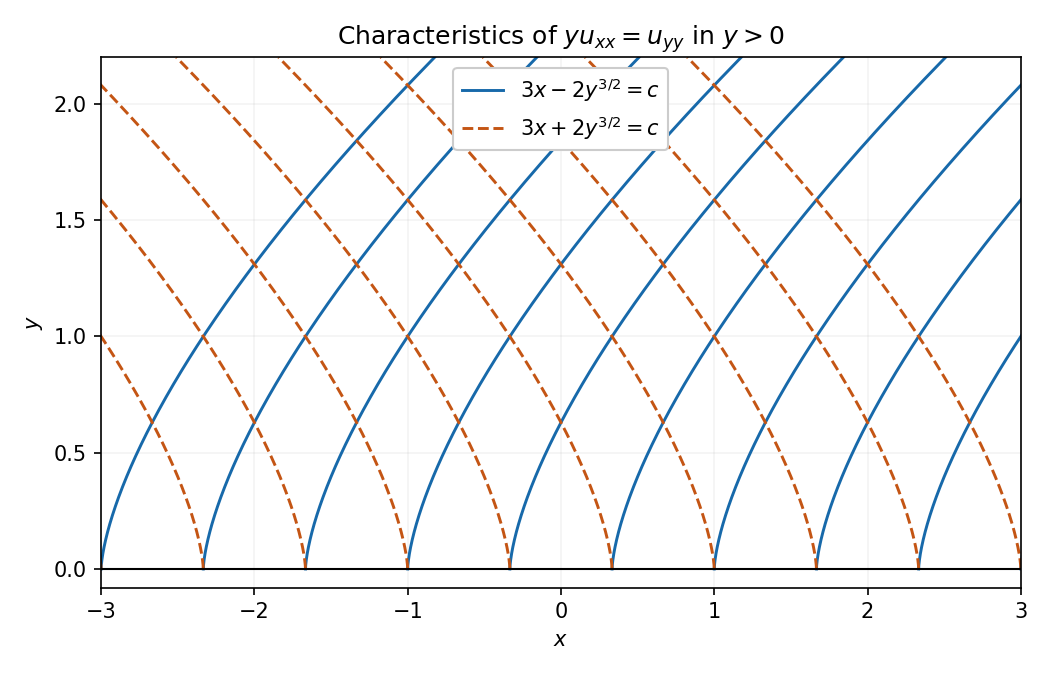
For the specific equation , so it is hyperbolic exactly on , elliptic for , and degenerate parabolic on . For and , the Jacobian is . Direct differentiation givesSince , the canonical form isThe characteristic families are and , with slopes . They are distinct for and meet the degeneracy line with coincident vertical tangent directions.

Articles by others on the same topic
There are currently no matching articles.