Differentiating the Rodrigues identity gives and . Induct with the proposed finite sum. The coefficient at in this recurrence is the contribution from minus the derivative contribution with previous index :Using a common denominator, this equals . At an endpoint omit terms whose factorial indices would be negative; the same formula then covers the sole remaining term. ThusThe initial value and recurrence identify these polynomials with the given Rodrigues definition.
Substitute the finite formula and write . Under the allowed rearrangements,Hence , with the normalization of the physicists' Hermite polynomials used in the source.
Complete the square to obtain, initially for real ,Compare coefficients of on the two sides. The left coefficient is , and the right is zero unless , in which case it is . The polynomials are real on the real line, so these are the complex inner products of the . ThusPolynomial times Gaussian decay also directly shows each lies in .
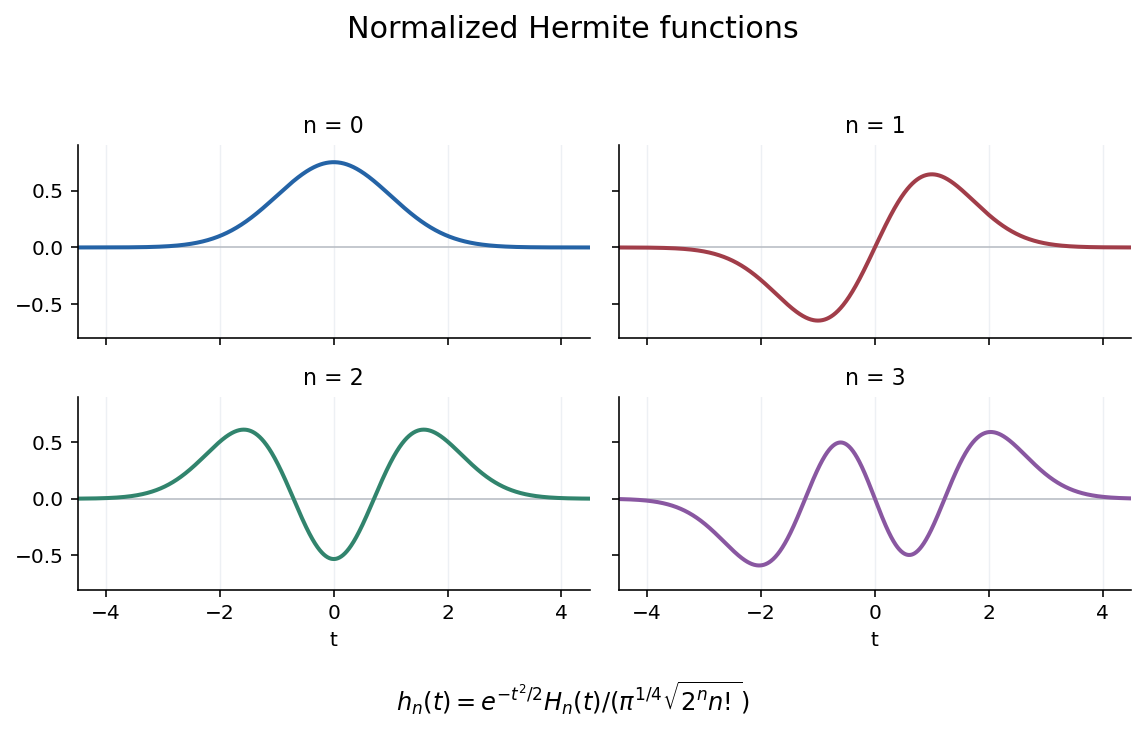
Normalized Hermite functions for orders zero through three
. Details. 
Articles by others on the same topic
There are currently no matching articles.