A norm on a complex vector space is a map that vanishes only at zero, satisfies , and obeys the triangle inequality. The space is Banach when every Cauchy sequence in the resulting metric converges in .
If is Banach and , the estimate shows that its partial sums are Cauchy, hence converge. Conversely let every such series converge and take a Cauchy sequence . Choose a subsequence with . The series consisting of followed by these successive differences is absolutely summable in norm, so converges by hypothesis; its partial sums are exactly this subsequence. A Cauchy sequence with a convergent subsequence converges to the same limit, proving the absolute-series criterion for completeness.
On the absolutely summable sequence space , coordinatewise addition and scalar multiplication preserve membership, and summing the scalar triangle inequality verifies its norm axioms. To prove completeness using the criterion, let with . For each the sum converges absolutely, and the permitted interchange of nonnegative double sums givesThus . MoreoverEvery absolutely norm-summable series therefore converges in , proving is a Banach space.
The continuous dual space consists of all bounded complex-linear functionals , with pointwise vector operations and norm . This is finite by boundedness. The scalar norm identity and triangle inequality follow under the supremum; if the norm is zero, scaling every nonzero vector into the unit ball shows that vanishes. Hence is a normed complex vector space.
For the dual of the convergent sequence space, take . The displayed formula is a bounded linear functional, since the series is absolutely convergent andIt is linear in , so . For equality fix , choose for of modulus at most one so that , and make all later terms equal a constant of modulus at most one with . The choices for a zero coefficient can be arbitrary. This sequence lies in the unit ball of and converges to . The reverse triangle inequality givesLetting proves , including injectivity.
For surjectivity let . By the permitted description of , there is with on . Every decomposes as plus . ConsequentlyTake and . This is an sequence and , proving the stated isometric linear isomorphism onto . No complex conjugation is inserted, since these are complex-linear dual functionals.
The complex Hahn-Banach theorem extends every bounded complex-linear functional on a subspace to the whole normed space with exactly the same norm. Let and define on The representation is unique. The distance inequality gives . Taking with proves the reverse norm bound. Extend by the Hahn-Banach theorem to ; then , , and . The labels (a)-(c) specify these simultaneous properties of this one functional.
Let . Every functional vanishing on vanishes on by linearity and continuity, so . If , the separation just proved gives a bounded functional zero on and nonzero at . It belongs to and excludes from its preannihilator. ThereforeFor the dual-side counterexample take , , and . It is norm closed, since a uniform limit of sequences tending to zero still tends to zero. Every coordinate unit vector belongs to , so the only annihilated by every element of has all coordinates zero. Thus andThe dual-side double annihilator corresponds to weak-star closure, which need not equal norm closure.
The spectrum of a bounded operator consists of for which has no bounded two-sided inverse. The point spectrum consists of eigenvalues, so . The approximate point spectrum consists of admitting unit vectors with ; equivalently is not bounded below.
If is invertible, its inverse bounds it below and its Banach-space adjoint is invertible. Thus neither alternative on the right of the claimed union occurs. Conversely suppose belongs to neither term and write . There is with , so is injective and has closed range: convergence of makes Cauchy, and completeness supplies a preimage of its limit. Also . The allowed annihilator identity makes the range dense, hence equal to . Its inverse has norm at most . This proves the spectrum decomposition through the Banach-space adjoint:For the right shift on , , so the allowed norm bound puts its spectrum in the closed unit disc. Under the linear pairing with , its Banach-space adjoint is the left shift . For each the bounded nonzero sequence is an eigenvector of with eigenvalue . The union identity gives the reverse inclusion. Hence . This Banach-space adjoint uses the complex-linear dual, so its eigenvalue is itself.
Expand both squared norms using sesquilinearity and conjugate symmetry. Their mixed terms appear with opposite signs and cancel. Hencethe parallelogram identity.
Put and . Then and the parallelogram identity, applied to and to and subtracted, givesTaking shows . Replacing in the identity by now givesThe proposed complex pairing is . Applying these same identities with and proves both asserted midpoint and additivity equalities for .
Repeated additivity gives for every positive integer . Since is the sum of copies of , . Combining these provesThe case also holds by additivity at zero.
Additivity applied to gives . Multiplication by preserves the norm, soFor example the first follows by multiplying by inside each norm. ConsequentlyThis proves the two required identities, with the convention of linearity in the first argument.
For a fixed second argument the norm formula makes continuous in its first argument. Rational homogeneity therefore extends to real homogeneity by rational approximation; additivity and then give full complex linearity in that argument.
The real pairing is symmetric, and . Hence , giving conjugate linearity in the second argument. Finally and , because . Thereforewhich is positive for . This proves is a complex inner product inducing exactly the original norm. The assumed Banach completeness makes the resulting inner product space Hilbert. This is the Jordan-von Neumann theorem.
Differentiating the Rodrigues identity gives and . Induct with the proposed finite sum. The coefficient at in this recurrence is the contribution from minus the derivative contribution with previous index :Using a common denominator, this equals . At an endpoint omit terms whose factorial indices would be negative; the same formula then covers the sole remaining term. ThusThe initial value and recurrence identify these polynomials with the given Rodrigues definition.
Substitute the finite formula and write . Under the allowed rearrangements,Hence , with the normalization of the physicists' Hermite polynomials used in the source.
Complete the square to obtain, initially for real ,Compare coefficients of on the two sides. The left coefficient is , and the right is zero unless , in which case it is . The polynomials are real on the real line, so these are the complex inner products of the . ThusPolynomial times Gaussian decay also directly shows each lies in .
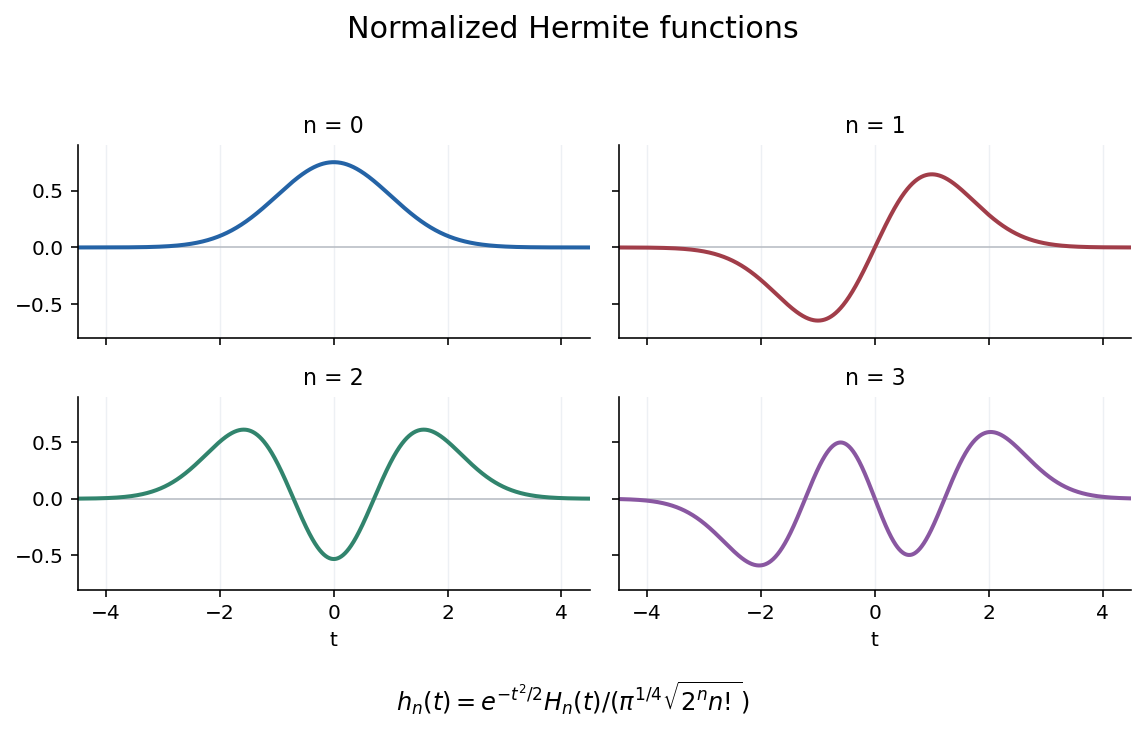
Normalized Hermite functions for orders zero through three
. Details. 
The classical Fourier partial sums areHere , and functions are extended periodically. One version of the Dini test for Fourier series states that if one-sided limits at exist andthen . A step function on a finite interval is constant on each side of any given point for sufficiently small distance, so its displayed numerator is zero there. Dini test for Fourier series gives exactly the asserted midpoint of the two one-sided values, including at jumps.
Let on . It is the orthogonal projection onto the span of the displayed trigonometric functions through frequency , hence . For a step-function approximation ,The convergence on a dense set under a uniform operator bound, here applied using the allowed convergence for and density of step functions, proves in . Consequently the union of these finite trigonometric spans is dense, which is precisely completeness of the orthonormal system. It also proves Parseval's equality by passing to the limit in the Pythagorean projection identity.
For , oddness gives , direct integration gives , and two integrations by parts give . ThusDini test for Fourier series justifies this pointwise on the interval, or absolute coefficient summability gives its continuous extension after the identification. At zero it yields . Parseval givesTherefore .
Anti-self-adjoint means . Unitary means , so . For a unitary operator , and the space is nonzero. Thus .
The series for the exponential converges absolutely in the Banach algebra , since . The adjoint is norm continuous and conjugate linear, and its action on these real scalar coefficients gives . The absolutely convergent Cauchy product givesbecause its degree- coefficient for is . If , these identities prove is unitary.
If is invertible, zero is outside the spectrum of . For the factorizationshows that the left side is invertible exactly when the final factor is. HenceFor unitary , both and have norm one. The norm bound on each spectrum gives and , forcing to lie on the unit circle.
The converse fails: on with its usual inner product takeIts spectrum is , but , so it is not unitary.
Articles by others on the same topic
There are currently no matching articles.