We use two-isogeny descent, stating the arithmetic results involved. Fordefine the two-torsion square-class homomorphism by , , and otherwise. Its kernel is the image of the dual two-isogeny formula; the analogous map has kernel the image of the forward two-isogeny formula. The two-isogeny rank formula isThe images have signed squarefree representatives supported on primes dividing and , respectively. This prime-support bound in two-isogeny descent follows by valuation comparison: if a prime does not divide , the valuations of at that prime must be even, whether positive or negative. A candidate squarefree class is represented precisely when its quartic covering in a two-isogeny descenthas the corresponding rational solution, apart from the separately included identity and two-torsion cases; clearing denominators permits coprime integers .
Here , soOn the possible classes are . They all occur: the identity gives one, gives , and gives . Since the image is a group, their product also gives five. Thus its image has order four.
On , the quadratic factor is strictly positive for real . Every nonzero rational -coordinate is therefore positive. The prime-support bound in two-isogeny descent restricts its image to . The identity gives one and gives , that is class five.
Class three is impossible. Its quartic covering in a two-isogeny descent would requireModulo three this is , so three divides and at least one of . They cannot both be divisible. If and , the right side has valuation exactly one, from . If and , it again has valuation exactly one, from . Either case contradicts its being a square. Class fifteen is then impossible too, since multiplying it by the known image class five would give class three.
Hence the second image is exactly , of order two. The rank formula givesThis proves the rank-one elliptic curve with coefficients five and minus five calculation, including the local obstruction that removes the spurious extra descent classes.
For with , the factor is strictly positive on the real line. Thus every nonzero rational -coordinate is positive. In the two-isogeny descent map, prime support restricts its square class to or . Both are realized by the identity and , although only the upper bound is needed:The two-isogenous curve is . Its two-torsion square-class homomorphism has signed squarefree representatives supported on the primes dividing . For odd these are amongHence the second image has at most eight elements. At the list reduces to , so the bound by eight remains valid. The two-isogeny rank formula therefore givesIn fact the same simple count yields when . The positivity restriction on the first descent image is essential for the stated bound of two for all primes.
Use the two-isogeny formula formula with and . Its companion isBoth curves are nonsingular because . With , chooseEach map extends across its exceptional affine points, and . On , the first coordinate of the dual can also be written .
Let and solve . The first coordinate gives . Since , the equation of then givesThe second coordinate selects the signs. The two rational preimages are exactlySubstituting into the dual formula checks that both map to . Their coordinates are nonexceptional under the assumptions, and the degree-two map has no further preimages.
The two-torsion square-class homomorphism has kernel , and on these two points it is their nonzero -coordinate modulo squares. Thus is in the image of exactly when is a rational square, and is in that image exactly when is a rational square.
If , then is one of the two preimages, because . Conversely, if , applying the dual shows . ThereforeFinally, if an integer equals in lowest terms, then forces . Thus rational squareness of these integer parameters is exactly integer squareness, andThis is the two-isogeny halving criterion for the alpha family.
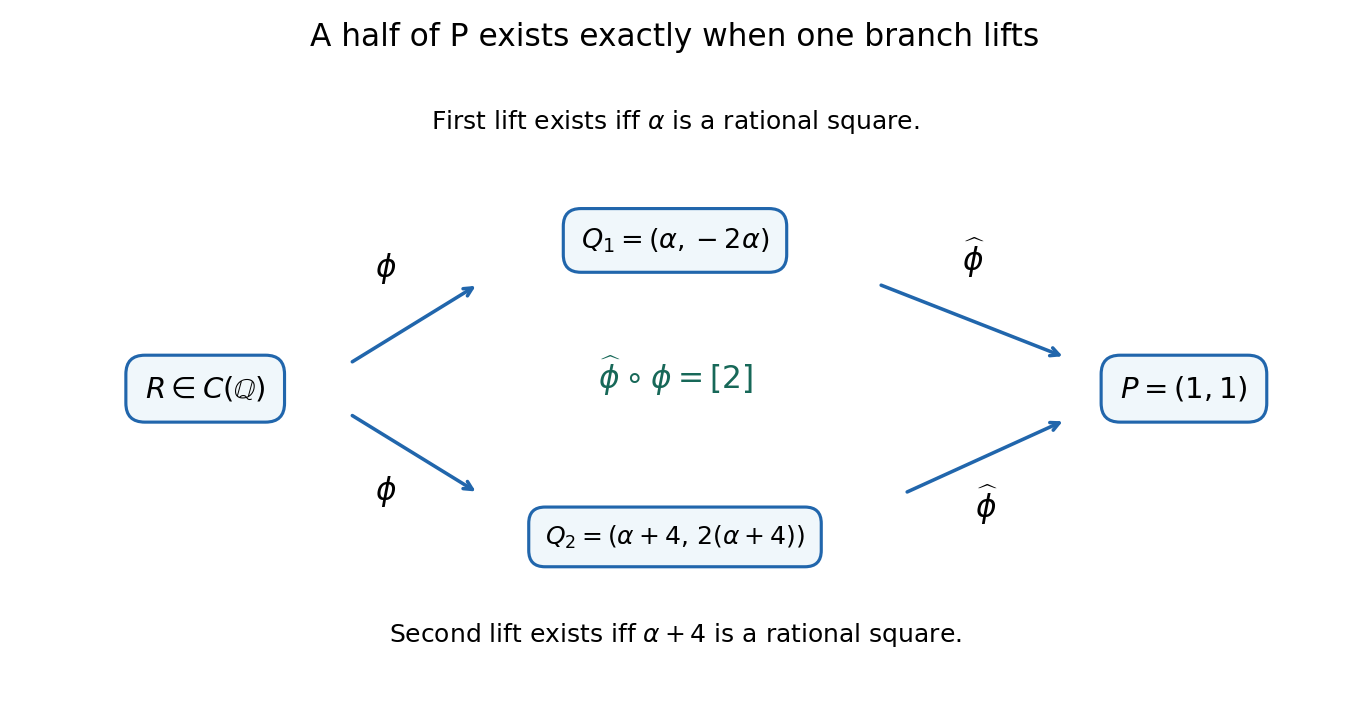
Halving the point is equivalent to lifting either of its two dual-isogeny preimages
. Details. 
Articles by others on the same topic
There are currently no matching articles.