Source: Mathematics release, bundle
Part C 2007 11.pdf, pages 365–371. The combined Mathematics and Mathematics and Philosophy Part C paper was sat on 5 June 2010, 2.30–5.30pm.Bounded exact-paper availability checks found no matching answer advertisement. The general even-year policy establishes coverage back to at least 2016 and does not itself establish this 2010 paper. Both sections and all printed targets are covered below; the unlettered theorem requests in Questions 4 and 5 are included alongside their displayed subdivisions.
For , interchange a finite sum and an integral:This proves the Abel's summation formula, including the term at .
Apply it with , . Writing givesThe last two terms are , proving the first expansion. For the refinement let . It has mean zero on each unit interval, so its primitive is bounded and periodic. Integration by parts givesThus for integer , where ,For the zeta representation, integrating each defining integral by parts yieldsSumming from to and substituting into the definition of givesSince ,This is uniform on compact subsets of , so the series is holomorphic there and limits at are legitimate after subtracting the pole. Expanding givesThe final tail is , and the harmonic expansion sends the remaining difference to . Therefore
Use the convention in the definition of a multiplicative arithmetic function. For a finite set of primes, multiplying the absolutely convergent local series gives the Dirichlet sum over integers supported on those primes, by unique prime factorization. If all primes up to are included, any missing integer is larger than , so the difference from the full series is bounded by , which tends to zero. This proves the Euler product in its absolute-convergence half-plane.
For coprime , every divisor of is uniquely a product of a divisor of and a divisor of . Hence . The squared modulus is also multiplicative when .
At a prime put and , so . Summing by the two divisor exponents givesFor example, expand the square as and sum from to obtain this rational expression. It remains valid for . Absolute convergence for follows from and convergence of . Multiplying the factors therefore provesSuppose now that . Necessarily , since is a pole. Complex conjugation gives a zero also at . In the numerator, the double pole at is canceled by those two zeros in the shifted factors. At , the possible simple pole of a shifted factor is canceled by the double zero of . Thus on the only possible remaining poles come from zeros of . Since the Euler product excludes zeros for , these possible poles lie in . In particular is regular for .
The assumed nonnegative-series principle now makes its Dirichlet series converge and equal there. Its first coefficient is one and all coefficients are nonnegative, so for real . But as , the numerator remains finite while , forcing . This contradiction provesAt the real point the statement is understood as a pole rather than a finite nonzero value. The pole-location argument did not assume the zero-free boundary before proving it.
The vertical integral is absolutely convergent because the denominator is quadratic in the imaginary part. If , move its line to the right: no poles are crossed, and the integral on is , tending to zero. If , move left across the simple poles at . Their residues are and , and the far-left integral tends to zero. Horizontal segments vanish by their decay for a fixed pair of vertical lines. At , dominated convergence on the original line gives the limiting value zero. Hence the kernel is below one and at or above one.
On a line , absolute convergence permits interchanging the totient Dirichlet series and this integral. The th term is times the kernel at , giving exactly for . ThusWe may take and shift to . The denominator has no zeros in this strip; the only pole crossed is , where has residue one. Its residue in the integrand isOn the new line, the supplied estimates bound the integrand by for , an integrable function. The compact portion is bounded as well. The same estimates, uniformly across the strip, make the horizontal integrals tend to zero. ConsequentlyFor the Tauberian step let . It is nondecreasing because the summands are nonnegative, and . For fixed ,After division by and passage to lower and upper limits, the asymptotic for gives bounds and . Letting squeezes them together. ThereforeThis uses monotonicity of the summatory function; differentiating an asymptotic formula without such control would not justify the conclusion.
The integer gives , whose 2-adic norm is . For the 5-adic condition, if then is a unit, while if its valuation is exactly one. Neither case has norm below . The Newton construction for the remaining requests follows.
Let and . At any step before reaching a root, setAssuming inductively that and , this givesAll derivatives of a polynomial over are integral on , so . Hence , and the ultrametric inequality keeps in . If a root is reached, retain that value for subsequent terms, and the asserted weak step inequality still holds.
Taylor expansion of about has integral coefficients, soIn a Non-Archimedean absolute value, adding an error of norm strictly smaller than cannot change a quantity of norm . ThereforeThis simultaneously verifies the derivative assumption used at the next step of part (i).
The constant and linear Taylor terms cancel in the Newton step, leavingThus residuals strictly decrease whenever the current residual is nonzero, and the steps tend to zero doubly exponentially. By the ultrametric inequality, the distance between any two sufficiently late iterates is bounded by the largest intervening step. The sequence is Cauchy and converges in the complete valuation ring to . Continuity gives , andThe literal infinite chain of strict inequalities needs the root-hit exception: if , or a later iterate is already a root, it cannot keep strictly decreasing below zero. The construction is eventually constant in that case; all existence and distance conclusions remain valid.
For the equality case, suppose with . The first Newton step has norm . Write the Taylor coefficient of as . Its norm is strictly below one by hypothesis; all higher coefficients have norm at most one. HenceThe derivative changes by , of norm strictly below , so it still has norm . The strict Hensel argument applies from this first iterate onward, and the root remains within distance of . If characteristic two is admitted, interpret the displayed half-second-derivative as the second Taylor coefficient ; this is the division-free form of the required hypothesis.
For the final local equation put . Its values modulo nine are , so the sum of two such values is confined to . Conversely choose initial pairs for these five classes asrespectively. Fix the second coordinate and apply the equality-case Hensel result to at the first coordinate . Its residual is divisible by nine, has 3-adic norm , and has norm below one for every . The strict or equality case therefore supplies a root in . Thusis the necessary and sufficient condition.
We first prove all three general torsion assertions before treating the lettered cases. If a finite point has , the cubic term dominates the integral lower terms, so , for an integer . Its parameter then lies in , with norm at most . The integral Weierstrass model defines its formal group at infinity over : using gives , an integral power series starting in degree three.
The supplied torsion estimate excludes a nonzero torsion parameter for , since , and the lower bound increases for higher -powers. For it excludes orders with , because their bound is strictly above . The remaining possibility is order two, which would imply the finite point equals its negative and hence . A nonintegral cannot solve the monic cubic with integral coefficients, so this is impossible too. Thus every finite torsion point has integral , and the equation then forces integral .
For good reduction the reduction map is a group homomorphism whose kernel is this formal group at infinity. Its torsion-free kernel proves injectivity on torsion, giving a subgroup of the finite reduced group. Applying local integrality to a rational torsion point at every prime gives .
If , the double of a rational torsion point is finite and integral. The doubling formulatherefore implies . Also . Evaluating the supplied polynomial identity at the integral now givesThis establishes the needed Nagell–Lutz theorem conclusions without assuming them in the lettered applications.
Nonsingularity with forces . TakeIt lies on the curve. Its tangent slope is , so the doubling formula gives . If were torsion, would be torsion as well, contradicting the integrality just proved. Therefore has infinite order.
The curve has good reduction at , since is nonzero modulo three. Its reduced points are the point at infinity, two points above , and one above , so there are four in total. Injectivity of torsion reduction bounds the rational torsion order by four. The known four points exhaust it:
Modulo five the curve is , with good reduction because . It has one point above each of and no others, plus infinity, so its group has order four. Rational torsion therefore has order dividing four.
A nonzero rational point of order two would have and integral , so would give an integer root of . But modulo two this polynomial is , which is one at both residues. Thus there is no rational 2-torsion. Every nontrivial finite group of order dividing four contains an element of order two, so
Complete the square-class map at the identity by ; at the finite point its value is the class of . For another rational point writeThese denominator powers follow because a negative valuation of forces the leading cubic term to dominate, so that valuation is even and the valuation of is three halves of it. The equation givesIf a prime divides , it does not divide the second factor, since . Thus is even. All denominator valuations are even too. Every image class therefore has a representative which is a signed squarefree divisor of , proving that is finite.
Use the standard 2-isogeny with kernel and dual isogeny satisfying , . Away from the exceptional points one may takeApplying the analogous isogeny to gives a curve with coefficients ; scaling its coordinates by gives the dual map back to . The analogous descent map on has kernel and finite image. The sequenceis exact at the last two terms. Its outside groups are finite, identified with the two finite descent images, so is finite.
For , the rational 2-torsion is , of order four. The first descent image is exactly : these classes occur on the 2-torsion, and the divisor-support bound permits no others. The isogenous curve is . Its real points have , so the second image lies in the four positive classes .
Here the kernel of the dual is contained in , since . Thus the displayed map is injective, and exactness givesThe allowed rank formula makes the left side , soNow consider the quartic relation. Normalize a nontrivial integer solution so that does not divide both , by dividing them by and by whenever necessary. If , reduction modulo gives , with modulo , making a quadratic residue. If , then and ; write , , divide by , and reduce to get modulo . Again is a square. ThereforeIf the class occurred in , write the corresponding coordinate as . The curve equation then givesHere are nonzero coprime integers and is rational. Since is an integer, its reduced denominator must be one, so is an integer too. For this contradicts the quartic obstruction. Hence class is absent. A subgroup of omitting has order at most two, so and .
For , direct substitution verifies the nonintegral pointA rational torsion point would have integral coordinates by the preceding theorem, so this point has infinite order. Thus , and together with the upper bound,
absolute convergence depends only on , since . Let be the set of real for which converges. Comparison with a convergent member shows that is upward closed. The hypotheses give a member of and a real number outside , so its infimum is finite. If , some lies below , giving convergence by comparison; if , convergence would contradict the definition of the infimum. Thus is the abscissa of absolute convergence of a Dirichlet series. This argument leaves convergence on the boundary open.
Partition according to . Writing identifies the part indexed by with the integers coprime to . There are of them. Counting the entire partition proves the totient divisor-sum identity
We use the multiplication theorem for absolutely convergent Dirichlet series: their product is the Dirichlet series of the Dirichlet convolution of their coefficients. absolute convergence justifies rearrangement of the double sum. Here , so its series converges absolutely for , andThe Euler product implies for . Division gives
We finally use the simple pole of the Riemann zeta function at one, of residue one, and . The quotient therefore tends to as real . If converged, its nonnegative terms would dominate the series at every real , giving a uniform finite bound and a contradiction. Thus the series diverges at two; comparison then excludes absolute convergence at every . Combined with the convergence already proved, the abscissa is exactly two. This is the totient Dirichlet series and its absolute convergence boundary.
summation by parts, with , gives for an integer The boundary term tends to zero when because is bounded. In the original region of absolute convergence this provesFor a compact subset of , choose below all its real parts and bound there. The integral tail is bounded by a constant times , uniformly on that compact set. Its truncated integrals are holomorphic function in , so locally uniform convergence proves a analytic continuation throughout . This is holomorphy of a Dirichlet series from bounded partial sums.
The Euler product, valid for , isExpand the logarithms of these absolutely convergent Euler products. Writing , the logarithm of the product in the desired inequality isFor odd , is or . In the first case the numerator is the given nonnegative trigonometric polynomial. In the second replace by , which changes the sign of and leaves unchanged. At the numerator is . Every summand is nonnegative. Exponentiation provesThis is the three-four-one inequality for Euler products applied to the real character modulo four.
Suppose and . Holomorphy gives as . The only pole of the Riemann zeta function is at one, so remains bounded, while . The displayed product is then , contradicting its lower bound. Hence for .
At the last zeta factor also has a pole, so that contradiction no longer follows from the inequality. Instead evaluate the convergent alternating series:For rigor, integrate the finite geometric identity for ; the remainder has absolute integral at most and tends to zero. summation by parts above identifies this value with the analytic continuation at one.
Write ; the source's rectangle notation is interpreted as the intended height restriction . We use the standard facts that has no zeros on , has a simple pole at one, and is meromorphic with no other pole. The function is holomorphic function and nonzero on the compact set , including its removable value one at . It remains nonzero in a neighborhood of this compact set. Together with nonvanishing to its right this gives some such that the whole closed rectangle , contains no zeta zero. The pole at one is harmless: extends holomorphically there with value zero.
The linearly smoothed Perron kernel, for and , isFor shift the contour left across the simple poles at zero and minus one, whose residues are and . For shift right, crossing no pole. At the integral is zero, also obtained by direct integration of . The quadratic denominator gives absolute integrability on the original vertical line.
For use the absolutely convergent Dirichlet series . Interchanging the sum and the contour integral is justified by and the integrable denominator. The term for is times the kernel at , hence when and zero otherwise. Consequently
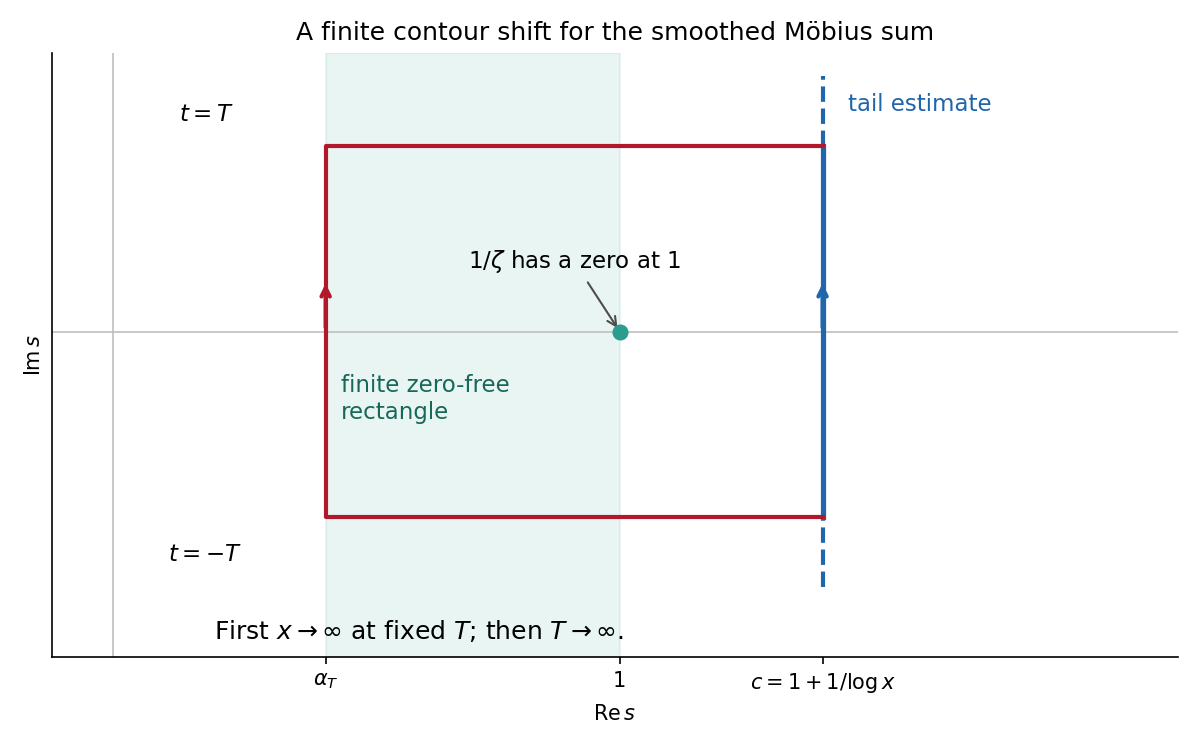
Here is a contour argument that needs only the stated bound, with no unproved uniform estimate left of one. Take , , and first hold fixed. On the two tails , the given bound and giveShift the remaining segment to . The integrand is holomorphic function inside the rectangle: the zero of at one cancels the apparent zeta pole, and lie outside. On the fixed left side its integral is . On the two horizontal sides, is bounded by some finite constant depending on . Therefore their integrals are bounded byIt follows thatNow let ; the integrable tail tends to zero. ThusThe order of limits matters: first for each fixed rectangle, then . This is linearly smoothed Möbius cancellation from finite zero-free rectangles.

Work with the smooth projective cubic, including its points at infinity. For two points , draw their chord, using the tangent when they coincide, and let be its third intersection counted with intersection multiplicity. Draw the line through and , again using the tangent if necessary, and let be its third intersection. Define . When is a flex, this is the familiar reflection of the first third-intersection point across the Weierstrass involution. The two-line construction also works when the chosen identity is not a flex.
To prove associativity without assuming it in the geometry, use divisor class. A nonsingular plane cubic has genus one. By the Riemann-Roch theorem, every divisor class of degree one contains exactly one effective divisor on an algebraic curve of degree one: for such a divisor on an algebraic curve ,and , so . Thus , and the nonzero section is unique up to scalar. Over , a degree-one effective divisor on an algebraic curve defined over is a -rational point. This also proves uniqueness of that point. In particular the mapis injective and identifies these points with the corresponding degree-zero Picard group of a curve: to recover the point from a class, add and take its unique effective representative. This is the elliptic curve group law from Riemann-Roch.
Let denote the divisor class cut out by a line. The two lines in the chord-and-tangent group law giveTheir difference gives , henceAddition of divisor class is associative. Therefore both and map to . Injectivity of proves the chord-and-tangent group law is associative. The same argument gives identity , commutativity and inverses, and covers tangencies through the use of intersection multiplicities. All constructions are defined over .
The three suggested values areThere is an obstruction at : every integer residue satisfies , whereas is not a square modulo three. Reduction of a solution in the p-adic integers would give an impossible solution modulo three.
At , take . The odd 2-adic unit in a ring is congruent to one modulo eight, so it is a square in . We use the standard 2-adic square criterion that an odd unit in a ring is a square exactly when it is one modulo eight. Its sufficiency follows by successively adjusting an odd square root modulo by to obtain the next required square congruence. Thus has a 2-adic integer solution.
For other than , the discriminant of isso this model has good reduction of an elliptic curve. Hasse's theorem on elliptic curves givesSince there is just one point at infinity, there is an affine point. Smoothness means that at least one partial derivative of is a unit in a ring modulo , so Hensel's lemma lifts the affine point to . The last exceptional odd prime is also soluble: at , has square roots , which are simple roots of modulo , and lift by Hensel's lemma.
For small-prime checks the suggested values also give at and at , where respectively and . ThereforeThe same prime list holds if one only asks for a solution modulo , but the lifting above establishes the asserted p-adic integer solutions. This is local solubility of the cubic x cubed minus x minus one.
In the elliptic curve method, addition is attempted modulo the composite number. A denominator that is not a unit in a ring supplies a factor through its greatest common divisor with that number.
First double using the elliptic-curve addition formula. Its tangent slope isThese calculations are valid modulo since the only initial denominator is two, which is invertible. Thus , equivalently modulo .
To form , the chord slope would requireThe denominator hasIt cannot be inverted, and thirteen is the requested proper factor. The failure has a geometric explanation: modulo thirteen, , so is the point at infinity. Modulo seventeen that chord denominator remains nonzero. The differing behavior at the two primes is exactly what the elliptic curve method detects.
Choose the blocksIf , then , so in . By the ultrametric inequality, for ,The partial sums are Cauchy sequence, and completeness of proves convergence of .
In the real series of p-adic absolute values, the block contains equal terms of size . Its sum is , independently of . Infinitely many such positive block sums force divergence. This exhibits p-adic convergence without summable absolute values: the criterion is that the terms tend to zero, rather than real absolute summability.
A differential is invariant under formal translation ifas an identity of formal power series. Setting gives . Consequently every invariant differential of a formal group law, if it exists, must have the form . In particular there can be only one with constant coefficient one.
Existence follows directly from associativity. Differentiatewith respect to at zero, obtainingEvery displayed is a unit in a ring, soThis is precisely invariance of . ThusNormalization means its constant coefficient is one. This proves both existence and uniqueness over an arbitrary commutative ring, without division by any integer.
Let . The pullback through the formal group homomorphism isThe identity and the chain rule show that this pullback is invariant under : translation by before becomes translation by afterward. By part (i) it is a scalar multiple of . Its coefficient at zero is , so
Apply this to the multiplication-by- endomorphism . Since the linear coefficient of is , repeated addition gives . If with , the pullback formula givesbecause is a unit in a ring. Write . Then for every . If , choose integers with . It follows thatChoose with for those not divisible by , and defineCoefficient comparison now provesNo cancellation of was used, so this prime-multiplication coefficient splitting for formal groups remains valid when is a zero divisor in .
The discriminant of is , so five and seven are primes of good reduction of an elliptic curve. Count solutions over their residue fields.
Modulo five the values of for are . They yield affine points, respectively, and the point at infinity gives .
Modulo seven the values for are . Only the three values four are nonzero squares, giving six affine points and .
For a rational elliptic curve at an odd prime of good reduction of an elliptic curve, the kernel of reduction on has no torsion element: it is the formal group on , whose formal logarithm embeds it in the additive group . Thus the entire torsion subgroup injects into each of the two finite reduction groups. Its order divides both six and seven, hence is one:Equivalently one may use prime-to-residue-characteristic injection at both primes; it gives the same coprime bound. This is a two-prime bound on rational elliptic torsion.
Since neither nor is a square, both cubics have exactly one rational root, zero. Thus each torsion point of an elliptic curve group has exactly one nonidentity 2-torsion, namely .
Neither curve has a rational point of order four. Indeed on the duplication formula givesIf , then is neither the identity nor a 2-torsion, so the denominator is nonzero and . Thus must be a rational square; an integer that is a rational square is an integer square. Applying this with or contradicts the hypotheses.
If , both curves have good reduction of an elliptic curve at three and exactly four points over . To see this, there, so the equation is . For the right side runs through all residues, and for it is always zero; either way there are three affine points. Injection of torsion point of an elliptic curve at this odd good prime bounds each torsion element order by four. An order-four torsion subgroup with just one nonzero 2-torsion would contain an order-four point, which was excluded. Therefore in this case both torsion subgroups equal .
The remaining case is . The literal hypothesis then ensures , so both curves have good reduction of an elliptic curve at five. Direct square counting givesFor example the square residues are ; substituting gives this table, including the point at infinity. The pair has residues or in some order. In either pair at least one reduction group has order two or four. The same injection and absence of order-four points then force that curve's torsion point of an elliptic curve to have order two. ThusThis torsion alternative for opposite quartic-twist coefficients uses only ; it does not strengthen the source hypothesis to coprimality with fifteen.
We use two-isogeny descent, stating the arithmetic results involved. Fordefine the two-torsion square-class homomorphism by , , and otherwise. Its kernel is the image of the dual two-isogeny formula; the analogous map has kernel the image of the forward two-isogeny formula. The two-isogeny rank formula isThe images have signed squarefree representatives supported on primes dividing and , respectively. This prime-support bound in two-isogeny descent follows by valuation comparison: if a prime does not divide , the valuations of at that prime must be even, whether positive or negative. A candidate squarefree class is represented precisely when its quartic covering in a two-isogeny descenthas the corresponding rational solution, apart from the separately included identity and two-torsion cases; clearing denominators permits coprime integers .
Here , soOn the possible classes are . They all occur: the identity gives one, gives , and gives . Since the image is a group, their product also gives five. Thus its image has order four.
On , the quadratic factor is strictly positive for real . Every nonzero rational -coordinate is therefore positive. The prime-support bound in two-isogeny descent restricts its image to . The identity gives one and gives , that is class five.
Class three is impossible. Its quartic covering in a two-isogeny descent would requireModulo three this is , so three divides and at least one of . They cannot both be divisible. If and , the right side has valuation exactly one, from . If and , it again has valuation exactly one, from . Either case contradicts its being a square. Class fifteen is then impossible too, since multiplying it by the known image class five would give class three.
Hence the second image is exactly , of order two. The rank formula givesThis proves the rank-one elliptic curve with coefficients five and minus five calculation, including the local obstruction that removes the spurious extra descent classes.
For with , the factor is strictly positive on the real line. Thus every nonzero rational -coordinate is positive. In the two-isogeny descent map, prime support restricts its square class to or . Both are realized by the identity and , although only the upper bound is needed:The two-isogenous curve is . Its two-torsion square-class homomorphism has signed squarefree representatives supported on the primes dividing . For odd these are amongHence the second image has at most eight elements. At the list reduces to , so the bound by eight remains valid. The two-isogeny rank formula therefore givesIn fact the same simple count yields when . The positivity restriction on the first descent image is essential for the stated bound of two for all primes.
Use the two-isogeny formula formula with and . Its companion isBoth curves are nonsingular because . With , chooseEach map extends across its exceptional affine points, and . On , the first coordinate of the dual can also be written .
Let and solve . The first coordinate gives . Since , the equation of then givesThe second coordinate selects the signs. The two rational preimages are exactlySubstituting into the dual formula checks that both map to . Their coordinates are nonexceptional under the assumptions, and the degree-two map has no further preimages.
The two-torsion square-class homomorphism has kernel , and on these two points it is their nonzero -coordinate modulo squares. Thus is in the image of exactly when is a rational square, and is in that image exactly when is a rational square.
If , then is one of the two preimages, because . Conversely, if , applying the dual shows . ThereforeFinally, if an integer equals in lowest terms, then forces . Thus rational squareness of these integer parameters is exactly integer squareness, andThis is the two-isogeny halving criterion for the alpha family.
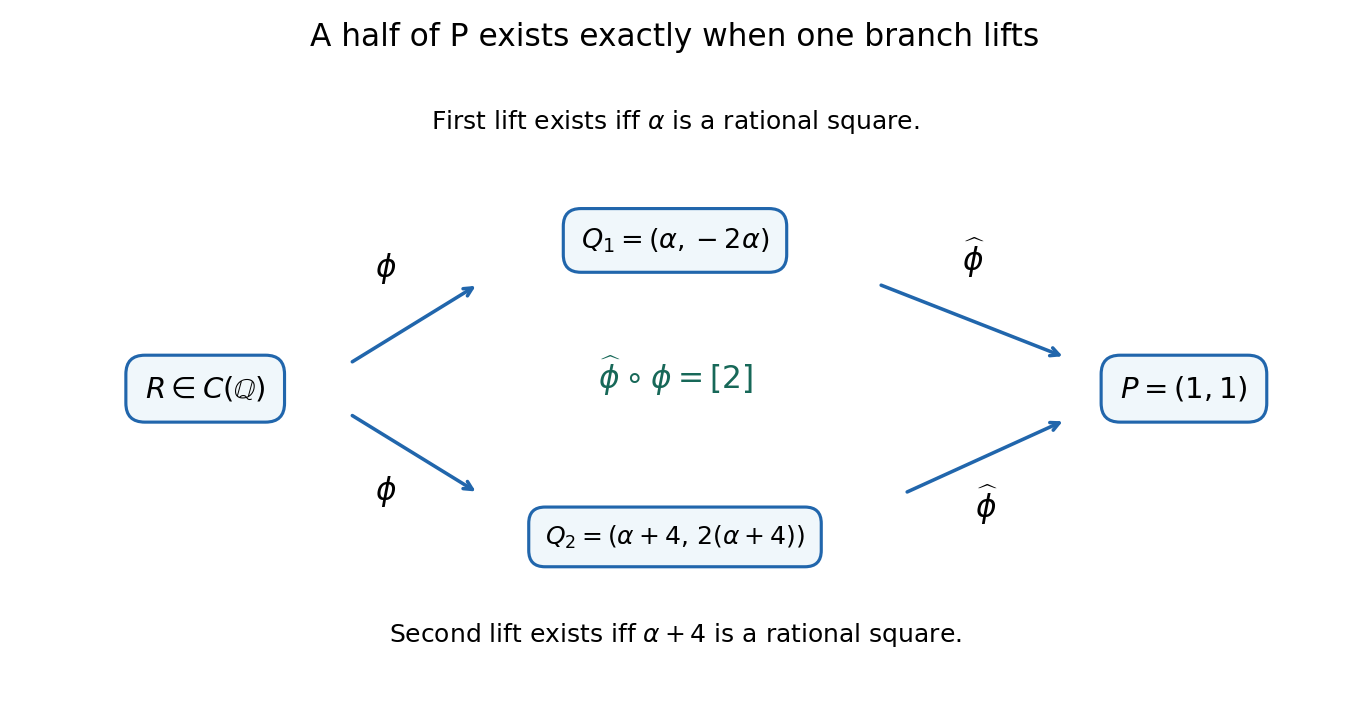
Halving the point is equivalent to lifting either of its two dual-isogeny preimages
. Details. 
Source: Mathematics release, bundle
Part C 2007 11.pdf, pages 178–184. The seven-page paper is shared by Mathematics, Mathematics & Philosophy and Mathematics & Statistics Part C, dated 31 May 2008.Bounded exact-paper checks found no matching advertisement of worked answers. Both printed halves and every question part are covered; complete editable source statements remain in the private archive.
A multiplicative arithmetic function has and satisfies whenever are coprime. For a prime power , the divisors are exactly , so there are . Multiplicativity therefore givesFix . If , then for every integer . There are only finitely many primes below the threshold. For each such prime the sequence tends to zero, so its supremum is finite and at least one. ThusThe product is over a fixed finite set, independent of , proving .
For an integer , monotonicity of gives ; the same bound for real follows by taking its integer part. ConsequentlyHence the requested bound holds with , including .
For , the Euler product theorem isThe local series converge absolutely, and the product is absolutely convergent in the sense that the sum over primes of the absolute deviations of the local factors from one is finite. Indeed this sum is bounded by . To prove the identity, expand the product over primes at most . Absolute convergence permits all those local expansions, and multiplicativity identifies the coefficients with for integers whose prime factors are at most . Every omitted integer exceeds , so the difference from the full Dirichlet series is bounded by its absolute tail beyond , which tends to zero. The same tail bound on a closed right half-plane inside proves local uniform convergence. With signed coefficients a local factor can be zero; the identity does not require claiming every such general Euler product is nonzero.
For , multiplicativity gives local coefficients . With ,The divisor bound from (1), applied with a sufficiently small exponent, proves absolute convergence when ; divergence at one follows from . Multiplying the local identities therefore givesFor , the inequality gives . Sum those nonnegative terms and enlarge to the whole infinite series to get the required comparison.
For real , integral comparison gives , while . Hence uniformly in that interval. Choosing for makes and . Thus
Each finite-interval integral is entire in : the integrand is and its complex derivatives may be integrated on the compact interval. On a compact subset of , choose with . Then . The Weierstrass uniform-convergence theorem gives convergence and holomorphy of throughout that half-plane.
Integration by parts givesFor , sum absolutely and use the integral over to obtain . Rearranging gives the first requested identity.
On , the magnitude of is at most . On a compact subset of , its integrals are bounded by a convergent constant multiple of for some . Thus is holomorphic there. The prefactor is entire, leaving only the explicit simple pole at one in , with residue one.
Differentiate and integrate. Its endpoint values both vanish, givingAt the last quotient has its continuous value . For , telescoping over gives . Substitution into yieldsThis supplies the analytic continuation to apart from the pole. Evaluating its holomorphic expression at zero makes the series term vanish and gives .
For , logarithmic differentiation of the absolutely convergent Euler product gives , where and it is zero otherwise. On the line , this series is absolutely bounded by , and is integrable in the vertical variable. Hence absolute convergence justifies interchanging sum and contour integral. The given first Mellin kernel, with , contributes if and zero otherwise. ThusSplitting off gives the desired decomposition with for . There is a range misprint in the second supplied kernel: for its integral is zero, not . The globally correct value is . For it is exactly the expression used here, so the subsequent large- argument is unchanged.
For a continuously differentiable with the given decay, both and are integrable and at either end. Integration by parts on finite intervals and passage to the limit gives, for ,Its absolute value is at most , proving the estimate.
We also need uniform control of on bounded as . Here is the three-four-one zero-free-region argument supplying it. For , the Euler product and implyIf vanished for a nonzero real , holomorphy from (3) would make the left side , since remains bounded, a contradiction. Thus there are no zeros on that line, and there are none to its right by the Euler product. After removal of the singularity at one, and are bounded on the compact rectangle , .
For , put . The supplied estimates give anduniformly in . Since , it follows that and , both . Also . Together with the compact bound this proves both required decay bounds with constants independent of .
Parametrizing the contour, the remainder in the decomposition is times the oscillatory integral just bounded. Choose for , so . Hence the remainder is . Finally , and is absorbed, proving
For , a root would have valuation zero because five is a unit. It would therefore reduce to a unit cube modulo nine. The only cube residue classes modulo nine are , none equal to five. Thus no root exists in .
For , the valuation equation would be , impossible because the valuation of a nonzero element of is an integer. Thus no root exists in .
For , and the derivative . Hensel's lemma lifts this simple root to a root in . Thus a root exists in .
The expansion isThe notation has the units digit before the comma and successive positive powers afterwards, as defined in the source. To check it, the geometric series converges in the 3-adic norm and its sum is .
For the general repeating block, givesBoth numerator and denominator are integers, and the denominator is a -adic unit.
The reduction has equation . At the origin both first partial derivatives vanish, so the point is singular, also when . A lift reducing to the origin would require . Its two cubes would then lie in , whereas the right side of the original equation has valuation one. This is impossible.
For an example which does lift, chooseIt has the same reduction and the rational point reduces to the origin. Over , which has characteristic zero, a singular affine point would require , which does not lie on this curve. Its projective closure is also smooth: the simultaneous partial derivatives of cannot vanish at a projective point. Thus this is a nonsingular curve for every prime , including three. A singular point in the reduction can therefore fail to lift or can lift, depending on the original equation.
Let be the nonzero reductions of . The square set in has members, including zero. Multiplication by , and separately the transformation , preserve this cardinality. Hence the two sets in the hint have total cardinality and must intersect. This gives a solution modulo .
The solution cannot have both coordinates zero since . If , choose any integral lift of and apply Hensel's lemma to the polynomial in : its derivative at the reduced root is . If , use the other variable instead. The nonzero derivative uses . Thus a solution lifts to as required.
For a nonsingular curve with integers , the Nagell–Lutz theorem states that a finite rational torsion point has integer coordinates and satisfies either orThe point at infinity is the identity and is treated separately. Integrality is the result allowed in the source. To prove the remaining divisibility, suppose . Then the doubled point is finite and also torsion, so its coordinates are integral. Its tangent slope is and its abscissa is . Thus is an integer. A rational number whose square is an integer is itself an integer, so divides . In particular divides . It also divides . Evaluating the permitted polynomial identity at the integer therefore proves the divisibility of by .
For , the point equals its negative and has order two. The theorem gives a finite set of torsion candidates, but the divisibility condition by itself does not assert that every candidate is torsion.
Here . A nonzero ordinate of a torsion point must have its square dividing 31, so . The curve equation then becomes , whose only integer solution is . No point with exists over the rationals: the monic cubic has no integer root, since its only possible integer roots are and neither works.
It remains to test . Doubling either gives abscissa , which is not an integer. If the original point were torsion its double would satisfy the integrality part of the Nagell–Lutz theorem, a contradiction. ThereforeThe rational point consequently has infinite order, so its multiples give infinitely many distinct rational points.
The curve has good reduction at five and seven: its discriminant is , and the hypotheses make a unit at those primes. Over the cubing map is a bijection, soThe character sum vanishes after replacing by a variable ranging over the whole field. Over , where , the possible cubes are zero once, one three times, and minus one three times. The corresponding right sides are two, three and one. Two and one are nonzero squares while three is not, so the count is .
Rational torsion injects into the reduction group at a good odd prime, a standard reduction theorem. Thus its order divides . If a point of order three existed, its coordinates would be integral by the Nagell–Lutz theorem. Since , the duplication formula givesThus either and , or and .
At the prime in the hypothesis, is a nonsquare unit. Since , there is a nontrivial cube root of unity , and . Hence is a nonzero square, so both and are nonsquares. Neither ordinate equation is possible even modulo . There is no rational point of order three, proving
Write the equation as . Its duplication formula uses slope and . At the three listed points the slopes are respectively , , and . Substitution givesThese are nonidentity points of order two, so each listed point has exactly order four.
For the three distinct roots zero, one and four give the full two-torsion subgroup of order four over . At least one of is a square: if neither of the first two is, their product is. If is a square, the first listed point exists over the field. If three is a square, the third exists. If is a square, the second can be written and exists without requiring the two separate square roots. The duplication computations remain valid after reduction; their ordinates do not vanish unless or three. Thus a rational two-torsion point has a half over the field. Together with a different two-torsion point this generates a subgroup of order eight. Consequently for every stated prime.
Over the rationals there are already four two-torsion points, including the identity. Counting at five gives eight points: the abscissas zero, one and four give one ordinate each, two and three give two each, and there is the identity. Thus rational torsion has order dividing eight.
There are no rational points of order four. For a curve , translating to zero and using the duplication formula shows that a half of must satisfy . For the three roots here, the candidate abscissas are , , and . The last two pairs are nonrational; at the ordinate squares are , also impossible over . A group of order eight containing this two-torsion subgroup would contain an element of order four, because an elliptic curve has only four points killed by two. Hence
For a point with , consider the valuation at any rational prime. If , the term has strictly lower valuation than and , since the coefficients are integral. Thus , forcing even. If and , the factor is a unit, so , again even. At valuation zero there is no odd exponent to remove.
Therefore every odd valuation in the square class of lies at a prime dividing , and all negative valuations are even. Removing rational squares gives a signed squarefree integer with . For the assigned class is that of , whose squarefree representative also divides ; the identity has representative one. HenceThe brackets stress that these integers represent square classes, which is the target of .
For rank-one two-isogeny descent with parameters three and minus three, use the standard two-isogeny rank formula. For and its dual curve , let be the abscissa square-class maps, with their usual values at and the identity. If is the Mordell–Weil rank, thenFor the present curve , its possible classes are , and the identity and supply . Exclude the class three as follows. A point in that class has , with coprime integers , and substitution in the curve gives the necessary quartic equationwith integer . Modulo three this forces . Coprimality then makes a unit modulo three, and modulo nine the right side is , while , a contradiction. The class minus one is excluded as well, since multiplying it by the known class minus three would give three. Therefore the first image has size two.
The dual curve is . Its quadratic factor is on the real line, so every nonzero rational abscissa is positive. By (i) its image is contained in . The point supplies 21 and the point supplies three. As the square-class map is a homomorphism, their product supplies seven. All four occur. Hence the descent formula gives , so
Fix and put for . Then . Apply the given approximate parallelogram identity with its two arguments and . The quadratic terms cancel exactly, leavingSet . Starting from , the inequality gives . Summing from one to therefore yieldsThus works independently of , including .
Articles were limited to the first 100 out of 154 total.
Articles by others on the same topic
There are currently no matching articles.