Define the dimensionless right-hand side of part (d) by . Then . Because and for , its sign is the sign of . The original plot is positive for sufficiently long wavelengths and negative at short wavelengths; the nonzero crossing is approximately . Numerically solving the displayed equation gives .
For , . Write with . The time factor then contains an exponentially growing solution. For , and the ideal inviscid modes oscillate stably, without damping. At the crossing the frequency is zero and the mode is marginal. In terms of the axial wavelength ,The growth rate tends to zero as , so the very longest wavelengths are not the fastest growing. The source plot has its maximum near , corresponding to and . Thus a characteristic fragmentation spacing is several cylinder diameters; a quantitative nonlinear fragment mass is beyond this linear stability calculation.
For unstable modes the physical displacement must be interpreted as with complex amplitudes handled consistently throughout. The paper's real-part notation is harmless for the squared dispersion relation, but it should not be read as imposing real in a gravitational instability calculation. The exactly uniform mode is excluded from the finite- derivation; the limit of the curve alone does not establish a separate volume-preserving uniform-radius mode.
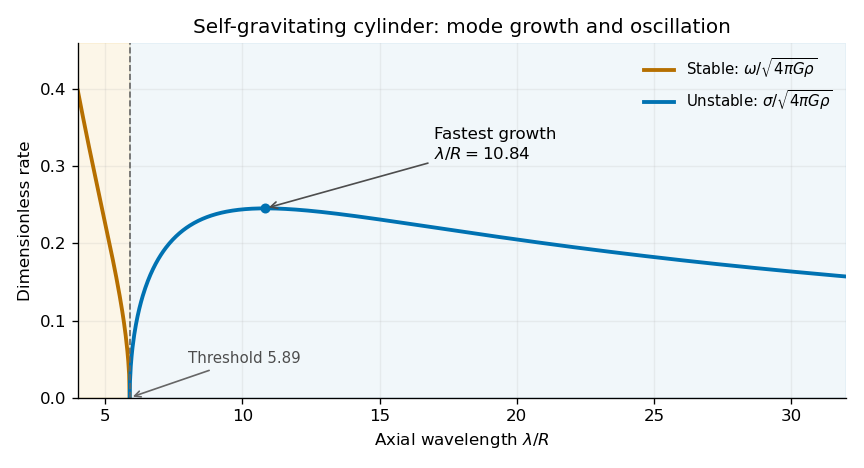
Rates computed from the cylinder dispersion relation as a function of wavelength, showing stable oscillation and unstable growth
. Details. 
Articles by others on the same topic
There are currently no matching articles.