Treat the cylinder as infinitely long, with a vacuum exterior and no surface tension. Let be its gravitational potential. Integrating the gravitational Poisson equation over a coaxial cylinder of radius and length , then applying the divergence theorem, givesThus the inward gravitational acceleration is . Hydrostatic equilibrium requiresImpose zero pressure on the free surface, , and integrate inward:This is the hydrostatic self-gravitating incompressible cylinder. Its central pressure is , and the units of the expression are . A nonzero external pressure would add that constant to .
Write total pressure and gravitational potential asHere is the Eulerian perturbation of a fluid variable applied to pressure, while is the corresponding gravitational potential perturbation. They have units and , respectively. The constant interior mass density is .
The Euler equations areSubtract the hydrostatic equilibrium relation and discard terms quadratic in the perturbation. Mass conservation gives incompressible flow, and the gravitational Poisson equation has no bulk density perturbation. Thus, strictly inside the fluid,The last equation is Laplace equation, not a statement that self-gravity has disappeared. The displaced surface carries a first-order surface mass density , where is its radial displacement, and this supplies the source and matching conditions for at the moving interface. The axisymmetric gravitational potential of a displaced cylindrical interface, expressed using modified Bessel functions, incorporates that boundary source.
It is useful to define . Taking the divergence of the momentum equation gives . For an axisymmetric Fourier mode with axial wavenumber , regularity at selects radial dependence , the Modified Bessel function of the first kind, since is singular there. In what follows can always be chosen nonnegative.
Use complex amplitudes and take their real parts at the end. Write the radial surface displacement as and the combined potential asThe linear kinematic boundary condition is . Differentiate it once more in time and use the radial momentum equation, , evaluated at the unperturbed radius :With , the mode amplitudes therefore satisfyThe prime differentiates the Modified Bessel function of the first kind with respect to its dimensionless argument, rather than with respect to . The result has units , as required because is a potential. It applies to ; the uniform limit requires separate treatment.
The vanishing total pressure must be imposed at the displaced free surface, not at fixed . The first-order Taylor expansion isSince and , the Lagrangian pressure perturbation condition isThe supplied gravitational perturbation and the combined potential, evaluated at , then giveHere is the Modified Bessel function of the second kind. Equating mode amplitudes and using part (c) yieldsRearrange to obtain the dispersion relation for the axisymmetric gravitational instability of an incompressible cylinder:Every quantity on the right is dimensionless, consistent with having units . The stabilizing term comes from displacing the background hydrostatic pressure profile; omitting the Lagrangian pressure perturbation would lose it.
Define the dimensionless right-hand side of part (d) by . Then . Because and for , its sign is the sign of . The original plot is positive for sufficiently long wavelengths and negative at short wavelengths; the nonzero crossing is approximately . Numerically solving the displayed equation gives .
For , . Write with . The time factor then contains an exponentially growing solution. For , and the ideal inviscid modes oscillate stably, without damping. At the crossing the frequency is zero and the mode is marginal. In terms of the axial wavelength ,The growth rate tends to zero as , so the very longest wavelengths are not the fastest growing. The source plot has its maximum near , corresponding to and . Thus a characteristic fragmentation spacing is several cylinder diameters; a quantitative nonlinear fragment mass is beyond this linear stability calculation.
For unstable modes the physical displacement must be interpreted as with complex amplitudes handled consistently throughout. The paper's real-part notation is harmless for the squared dispersion relation, but it should not be read as imposing real in a gravitational instability calculation. The exactly uniform mode is excluded from the finite- derivation; the limit of the curve alone does not establish a separate volume-preserving uniform-radius mode.
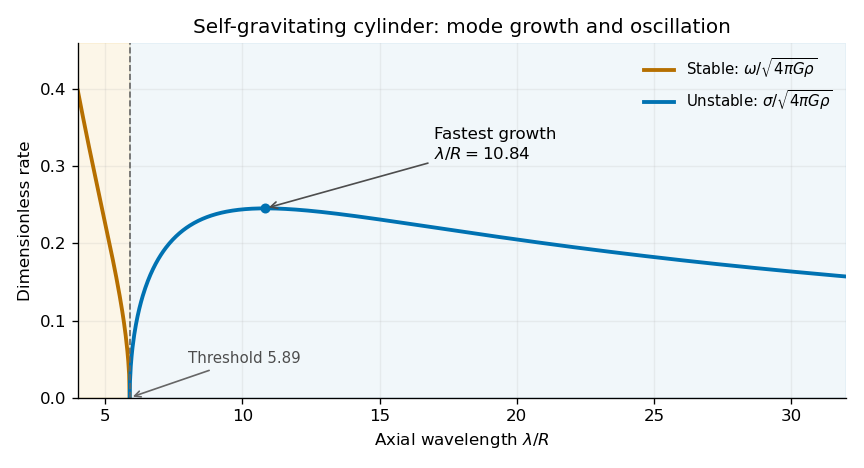
Rates computed from the cylinder dispersion relation as a function of wavelength, showing stable oscillation and unstable growth
. Details. 
Articles by others on the same topic
There are currently no matching articles.