A razor-thin disk is not a spherical mass distribution. Its exact exterior force does not become the point-mass force immediately at . For all , an exact expression isThis follows by differentiating the Newtonian potential of each mass element. At distant radii its leading behavior is Keplerian:The first disk-shape correction from the Legendre expansion of thin-disk gravity is , with positive mass-weighted . This supplies a concrete counterexample to treating as exact for a flattened disk merely because the observation point is outside its edge.
If the outer dark matter is approximately spherical, an exactly flat speed requiresIn the halo-dominated leading approximation, this is and . Such a flat curve cannot continue to arbitrarily large radius without giving infinite total mass.
Interpret the new force as attractive. With outward position vector , this requires a minus sign in front of the source's printed expression; the literal positive sign and positive would repel a test particle. The radial force magnitude is , so circular balance gives . Constant exterior therefore requiresThis is not an acceleration parameter. Matching the outer speed sets . The entire rotation curve defined by this enclosed-mass toy law isSince , it rises linearly from zero at small radius and flattens outside. The enclosed-mass prescription defines this modified model; it is not a derivation of a general modified field equation for arbitrary flattened matter.
The central obstruction to an outer halo mass offset requires an explicit distinction. Extending the full distant-outer expression to zero gives . It becomes negative for and cannot be a physical halo. Its formal total squared speed, , even becomes negative near the centre. Thus there is no physical entire rotation curve under that literal extrapolation.
If instead one extends only the positive halo-dominated leading term, , the entire Newtonian model isFor a full calculation of the disk contribution, the elliptic-integral circular-speed kernel of a thin disk giveswhere is the complete elliptic integral of the first kind and the complete elliptic integral of the second kind. The principal value is needed inside the disk; outside it the integral is ordinary. The disk term vanishes at the centre, so this halo extrapolation has , develops a stellar contribution at intermediate radii and approaches from above. A discontinuous, exactly zero-thickness truncation has an artificial logarithmic force singularity right at the edge; a smooth edge or finite thickness removes it. The figure omits the single singular edge point.
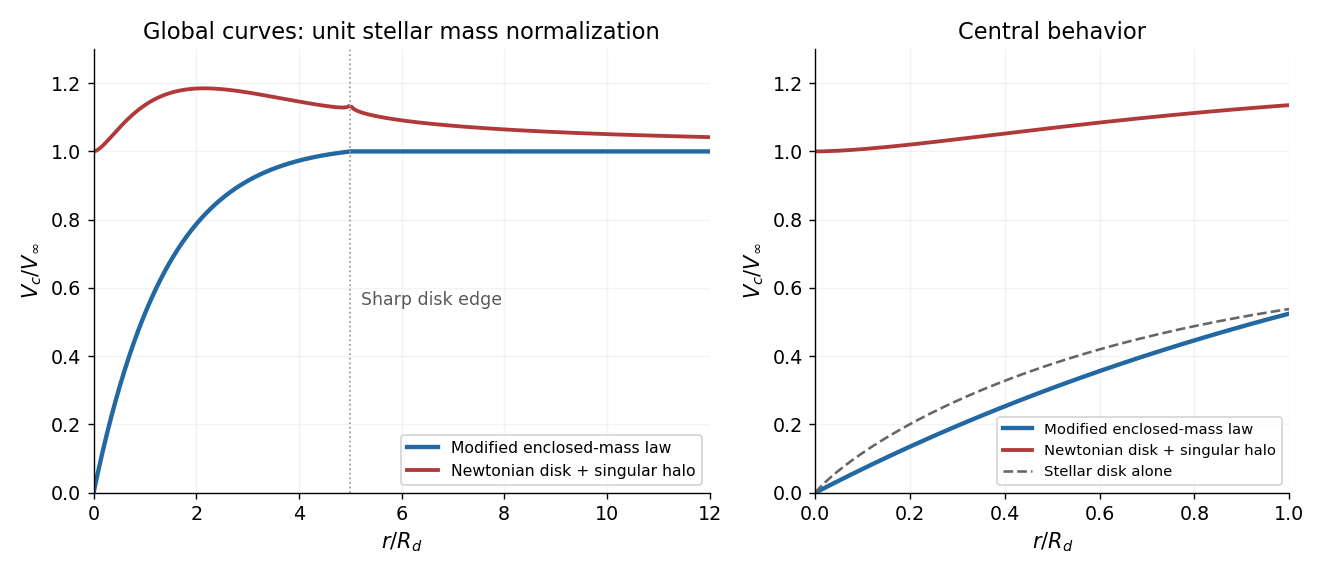

Observed galaxy rotation curves generally rise from the central region rather than beginning with a nonzero constant. The modified toy curve therefore captures that qualitative behavior better than this particular singular isothermal halo extrapolation, without establishing that its force law is correct. If dark matter is the explanation, the inner halo cannot universally retain , down to zero. For a spherical density , tends to zero when ; a constant-density core gives a linear rise. A shallower cusp can also tend to zero. Stellar mass-to-light ratio, baryonic structure and disk–halo degeneracy prevent this qualitative argument alone from proving that every halo has a constant-density core.
Articles by others on the same topic
There are currently no matching articles.