Inverse Compton scattering transfers energy from fast electrons to lower-energy photons. In the Thomson scattering limit the scattering is approximately elastic in the electron's instantaneous rest frame, but the transformations into and out of that frame can greatly increase the photon energy in the original frame.
In a blazar, relativistic jet electrons can scatter their own synchrotron radiation, producing synchrotron self-Compton radiation, or scatter photons from an accretion disk and its surrounding reprocessing material. The two spectral humps constrain electron Lorentz factors, the electron distribution and, with assumptions about geometry and relativistic beaming, the magnetic field. For the same electron population in the Thomson regime, the ratio of inverse-Compton to synchrotron power scales as in the plasma rest frame. It does not determine the field without information about the photon energy density and beaming.
In a galaxy cluster, hot thermal electrons scatter cosmic microwave background photons and slightly raise their mean energy, producing the thermal Sunyaev-Zeldovich effect. The spectral distortion measures the line-of-sight integral of electron pressure, approximately for nonrelativistic thermal electrons. Combined with X-ray emission, which weights density approximately quadratically, it constrains the gas density, temperature and mass distribution. These are distinct source populations and seed photon fields from the blazar example.
For the power derivation, use an isotropic incident radiation field of total photon energy density in the laboratory frame. Its stress-energy tensor has and , with zero mean flux. Boosting to an electron moving at along givesThe radiation energy flux in this rest frame is . Elastic Thomson scattering exerts the drag . The parallel three-force has the same value in the laboratory frame, so the electron's positive energy loss rate isThis isotropic inverse-Compton drag assumes photon energies small compared with in the electron rest frame, negligible recoil and an isotropic seed field in the specified frame. An anisotropic photon field requires its directional moments; the recoil-dependent differential scattering cross-section of Compton scattering becomes necessary at larger rest-frame energies.
There are two conventions to qualify in the printed expression. First, the density multiplying must be , not literally only the magnetic part of a propagating electromagnetic field. That field has equal electric and magnetic energy densities, so and the corresponding formula is . Second, this is net electron energy loss, rather than all incident plus scattered photon energy. At an electron still scatters power , but transfers no kinetic energy to the photons, so the inverse-Compton gain is zero.
For an individual incident photon of energy , the electron-frame energy is . For a head-on photon followed by forward emission in the laboratory,Averaging an isotropic seed field gives for ultrarelativistic electrons. The original plot has an inverse-Compton maximum of order , a synchrotron maximum around and a disk component around . ThusThe head-on maximum gives the same order of magnitude, about to . These are approximate readings of a broad spectrum, not precise fitted parameters. Disk and synchrotron seed photons need not be scattered by the same part of the electron distribution, and bulk jet Doppler factors also enter the observed peak relation. The indicated rest-frame seed energies remain well below the electron rest energy in this estimate.
For an optically thin collisionally excited line, the volume emissivity is approximately below the transition's critical density. The excitation coefficient includes a factor , so temperature is needed to convert luminosity into an ionic abundance. Density is needed both to assess collisional quenching of a metastable line and to convert an emission measure into a gas mass. For a uniform recombining ion, for example, . Temperature structure, density clumping, extinction and unobserved ionization stages introduce further corrections.
A useful density doublet has closely spaced upper energies but different spontaneous decay rates and hence different critical densities. Nearly equal excitation energies reduce temperature dependence of the ratio; similar wavelengths reduce differential extinction and relative calibration errors. Metastable upper levels have sufficiently small Einstein coefficients for collisional de-excitation to compete at nebular densities.
Use statistical weights , . The source's O II ground-state term has a typographical error: it is , not . A term has , so the printed term is internally inconsistent. The tabulated values, wavelengths and rates can still be used.[ref]
Handbook of Basic Atomic Spectroscopic Data by Jean E. Sansonetti and William C. Martin. O II energy-level table: ground state at zero and the two metastable D levels near 26810.55 and 26830.57 inverse centimetres
At high density, collisions establish a Boltzmann distribution between the upper states. Their energy splitting is small compared with , so . If both lines escape without absorption,The exact ratio includes , an approximately correction at .
At low density, assume excitation from the common ground state and radiative decay back to it dominate, with no substantial collisional transfer between upper states. Statistical equilibrium gives . Detailed balance relates excitation to the supplied de-excitation coefficient, yieldingEach excitation then produces one line photon, so the spontaneous rate cancels:At high density the upper populations are collisionally thermalized and the ratio retains the radiative lifetimes; at low density radiative escape is nearly certain and the ratio is set by the excitation probabilities instead.
At , the two de-excitation coefficients are and . ThusThe useful density range lies between and around these scales. In the independent-upper-level approximation,The density sensitivity of a metastable doublet depends on the error measure. The fractional response is maximal atIf absolute ratio errors are constant, maximizing instead gives . An unspecified experimental noise model therefore does not define a unique sharper optimum than this transition-density range.
For Ne IV, the same calculation gives critical densities and , with fractional sensitivity peaking near . This is a useful higher-density diagnostic when O II is saturated. However, Ne and O need not occupy the same ionization zone, so their inferred densities need not describe the same gas. The ultraviolet Ne IV pair also needs suitable observations and extinction correction. The proposal is useful with these qualifications, not a guaranteed replacement for the density of the O II emitting zone.
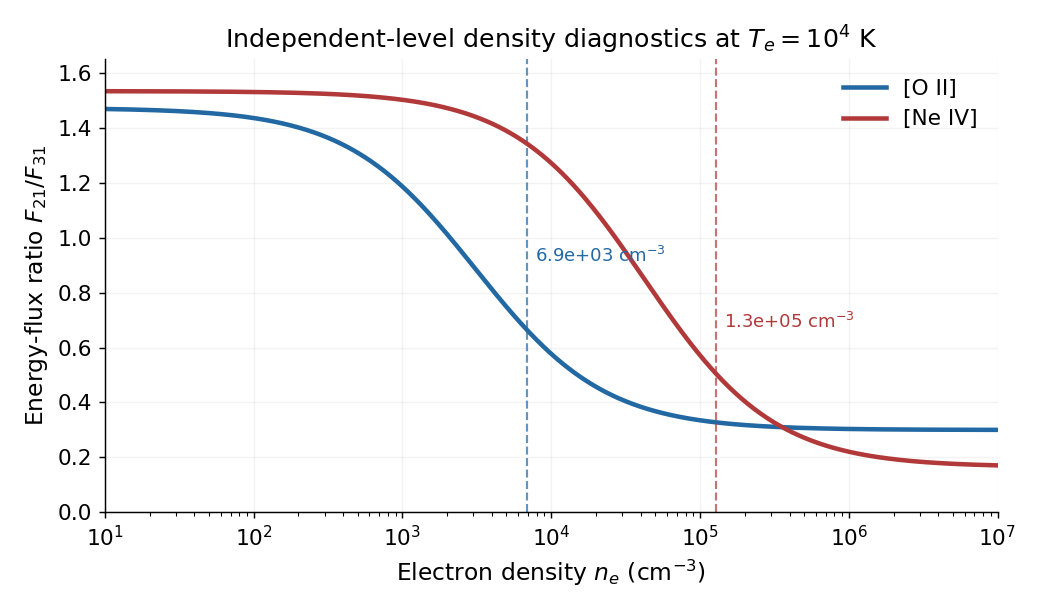
Metastable doublets probe different density ranges
. Original optically thin independent-upper-level calculation from the supplied rates. Dashed vertical lines mark the density of maximum fractional sensitivity; temperature is fixed at kelvin. Details.
A gravitational wave is a propagating tidal perturbation of spacetime. In the weak-field limit its transverse polarizations alternately stretch and compress the separation of freely falling test bodies. A laser interferometer such as LIGO measures the differential optical phase of orthogonal arms. The mirrors approximate free test masses over the detection band; arm cavities enhance the phase response, while suspension, seismic isolation and optical control reduce instrumental disturbances. A strain produces relative arm-length changes of order . Coincidence and waveform consistency between detectors distinguish candidate astrophysical signals from local noise.
Potential sources include black-hole and neutron-star binary inspirals and mergers, asymmetric core-collapse supernovae, nonaxisymmetric spinning neutron stars, and a stochastic background from many unresolved sources or early-Universe processes. Their detectability depends on frequency, strain, duration and detector noise; a source producing gravitational radiation need not be observable in a terrestrial interferometer's band.
For slowly varying approximately isotropic stellar wind loss, decreasing the binding mass widens the orbit. The prescribed Jeans-mode mass loss equation givesHot massive stars have metal-line-driven winds. Higher metallicity generally strengthens the radiative coupling and mass loss, increasing orbital expansion and leaving less massive black holes. The supplied initial-contact formula also assigns larger zero-age radii and initial minimum separations at higher metallicity.
The initial total mass is , while the final total mass is . Neglecting supernova mass loss as requested, their ratio has no additional factor of two. The wind-limited black-hole binary merger window therefore has lower boundaryA nonempty allowed initial-separation interval requires . Substituting the supplied final masses gives the following separation bounds, all in units of :The arguments 30 and 100 indicate the initial mass of each star in solar units.
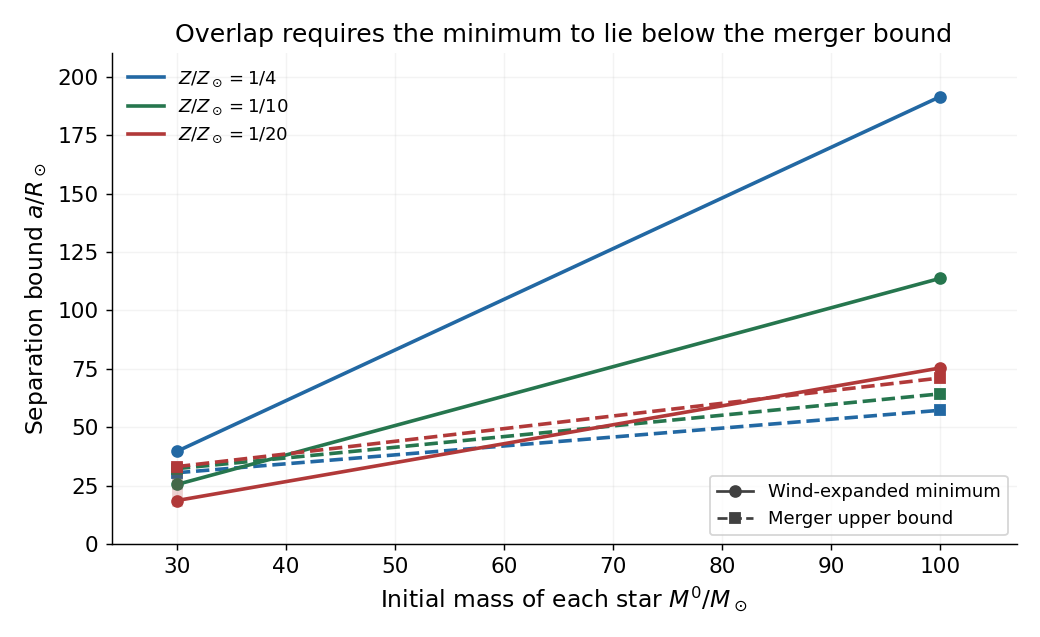
Wind-expanded minimum separations compared with merger upper bounds
. Original calculation at the six supplied initial-mass and metallicity combinations. Joining segments are visual guides between tabulated points, not a predicted interpolation of final black-hole mass. Details.
Under these particular approximate formulae, only the initial systems at and have overlapping bounds. The , system is a near miss, not formally allowed: . Given approximate evolutionary scalings, that small mismatch should not be treated as a precise astrophysical exclusion.
Lower metallicity favors merging remnants here through weaker winds, smaller initial stellar radii and larger final black-hole masses. More massive binaries can also produce stronger detectable signals over a suitable frequency range, although the detection volume and band limitations must be considered. The observed rate further depends on formation efficiency, metallicity history, delay times and binary survival. Common-envelope evolution, stellar rotation, supernova mass loss and natal kicks could alter this simplified channel; the wind-only inequalities do not establish that such mergers are impossible through other channels.
The density contrast is , and is one spatial Fourier mode with comoving wavevector . The scale factor is , is the Hubble parameter, is the physical sound speed, the mean matter density, and the gravitational constant. For each fixed the displayed equation is an ordinary differential equation in cosmic time. It compares pressure restoration, self-gravity and expansion-induced damping:The pressure term resists compression; self-gravity enhances an overdensity; the term slows the motion relative to a static background. The Newtonian treatment is appropriate to small perturbations on subhorizon scales within the specified fluid model, rather than an arbitrary gauge-independent treatment of superhorizon perturbations.
The physical Jeans length follows by equating pressure and gravity:The comoving Jeans wavenumber is . Perturbations well below the physical Jeans length are pressure-supported acoustic oscillations whose amplitude is modified by expansion; those above it admit gravitational growth when the background evolution permits. Pressureless matter in a matter-dominated universe is the example below. Merely having a large wavelength is not sufficient to apply this Newtonian equation outside the horizon.
For a gas of particle mass and temperature , write , with for the isothermal sound-speed convention or the appropriate adiabatic heat-capacity ratio otherwise. ThenAt fixed density it is larger for hotter or lighter particles, and it decreases with increasing density. Numerical coefficients differ between sound-crossing and self-gravitating-sphere conventions; the expression here uses the Fourier instability boundary of the stated equation.
In an Einstein-de Sitter universe, the spatially flat Friedmann-Lemaître-Robertson-Walker metric is . Conservation of pressureless matter gives ; the Friedmann equation then gives , and . With ,Trying gives . Hence the Einstein-de Sitter density-growth modes areThe growing mode increases only as a power law because the expansion dilutes and slows the collapsing matter.
Conformal time is defined by , so the metric becomes . Choosing its origin at the big bang gives and . ThereforeEquivalently the equation is , where primes denote conformal-time derivatives.
Before and through cosmological recombination, photons diffuse between hotter and cooler parts of the tightly coupled photon–baryon fluid. Radiative viscosity and heat transport erase short-wavelength acoustic perturbations. As free electrons disappear, the photon mean free path grows, enhancing this diffusion before decoupling. Silk damping can be represented by a factor approximately in the linear acoustic amplitude. The comoving Silk wavelength may be defined as ; the associated diffusion-length convention is .
A random-walk estimate is up to transport and baryon-loading factors, with physical . Scales much shorter than the damping wavelength are strongly suppressed. This is photon diffusion, not the Jeans boundary and not erasure of every cold-dark-matter perturbation. After decoupling, photon free streaming is a distinct part of the evolution.
An H II region is photoionized interstellar gas around young massive stars. Its optical spectrum contains hydrogen and helium recombination lines, collisionally excited forbidden metal lines, and weaker free-free, free-bound and two-photon continua. Typical hot main-sequence ionizing stars have effective temperatures of a few ; their ultraviolet output, age and metallicity determine the ionization balance. Gas and dust can also emit strongly outside the visible band.
A planetary nebula is expelled evolved-star material illuminated by a much hotter exposed stellar core. Its central star can reach temperatures of order , allowing higher ionization stages and prominent He II emission. The gas may carry nucleosynthetic enrichment from its progenitor, while expansion lowers density and changes line strengths with age. Both object classes produce nebular spectra, but their ionizing sources and evolutionary contexts differ; neither spectrum is simply the blackbody spectrum of the exciting star.
For an optically thin recombination line under Case B recombination, the line emissivity isThe effective coefficient includes recombination cascades feeding the line. For approximately common conditions and matching sampled volumes,The wavelength factor is essential because the tabulated energy flux counts photons weighted by their energies. More generally the result is an emissivity-weighted ionic ratio, not an unweighted pointwise abundance.
Assume corrected extinction and underlying stellar absorption, suitable electron temperature and density, negligible additional collisional or optical-depth effects on the chosen lines, and essentially ionized hydrogen. The total helium abundance is thenprovided neutral helium is negligible or an ionization correction is applied. A line emitted by neutral He after recombination measures the recombining He population; He II measures recombining He.
Using the supplied line coefficients and fluxes givesThereforeIf hydrogen and helium dominate the mass, this corresponds to helium mass fraction , with . It is an approximate elemental estimate under the ionization assumptions, not merely a ratio of two observed line fluxes.
An ordinary H II region would typically have – by number, with metallicity-dependent enrichment, rather than necessarily the larger value inferred here for an evolved-star nebula. Hydrogen ionization requires , neutral helium and He . Typical H II region stars often produce little He, so He II can be extremely weak or absent despite substantial helium. He I relative to H can still be useful, but neutral helium inside the H zone may require an ionization correction. A very hot planetary-nebula core is more favorable for observing both ionic stages, although ionization structure must still be checked.
A razor-thin disk is not a spherical mass distribution. Its exact exterior force does not become the point-mass force immediately at . For all , an exact expression isThis follows by differentiating the Newtonian potential of each mass element. At distant radii its leading behavior is Keplerian:The first disk-shape correction from the Legendre expansion of thin-disk gravity is , with positive mass-weighted . This supplies a concrete counterexample to treating as exact for a flattened disk merely because the observation point is outside its edge.
If the outer dark matter is approximately spherical, an exactly flat speed requiresIn the halo-dominated leading approximation, this is and . Such a flat curve cannot continue to arbitrarily large radius without giving infinite total mass.
Interpret the new force as attractive. With outward position vector , this requires a minus sign in front of the source's printed expression; the literal positive sign and positive would repel a test particle. The radial force magnitude is , so circular balance gives . Constant exterior therefore requiresThis is not an acceleration parameter. Matching the outer speed sets . The entire rotation curve defined by this enclosed-mass toy law isSince , it rises linearly from zero at small radius and flattens outside. The enclosed-mass prescription defines this modified model; it is not a derivation of a general modified field equation for arbitrary flattened matter.
The central obstruction to an outer halo mass offset requires an explicit distinction. Extending the full distant-outer expression to zero gives . It becomes negative for and cannot be a physical halo. Its formal total squared speed, , even becomes negative near the centre. Thus there is no physical entire rotation curve under that literal extrapolation.
If instead one extends only the positive halo-dominated leading term, , the entire Newtonian model isFor a full calculation of the disk contribution, the elliptic-integral circular-speed kernel of a thin disk giveswhere is the complete elliptic integral of the first kind and the complete elliptic integral of the second kind. The principal value is needed inside the disk; outside it the integral is ordinary. The disk term vanishes at the centre, so this halo extrapolation has , develops a stellar contribution at intermediate radii and approaches from above. A discontinuous, exactly zero-thickness truncation has an artificial logarithmic force singularity right at the edge; a smooth edge or finite thickness removes it. The figure omits the single singular edge point.
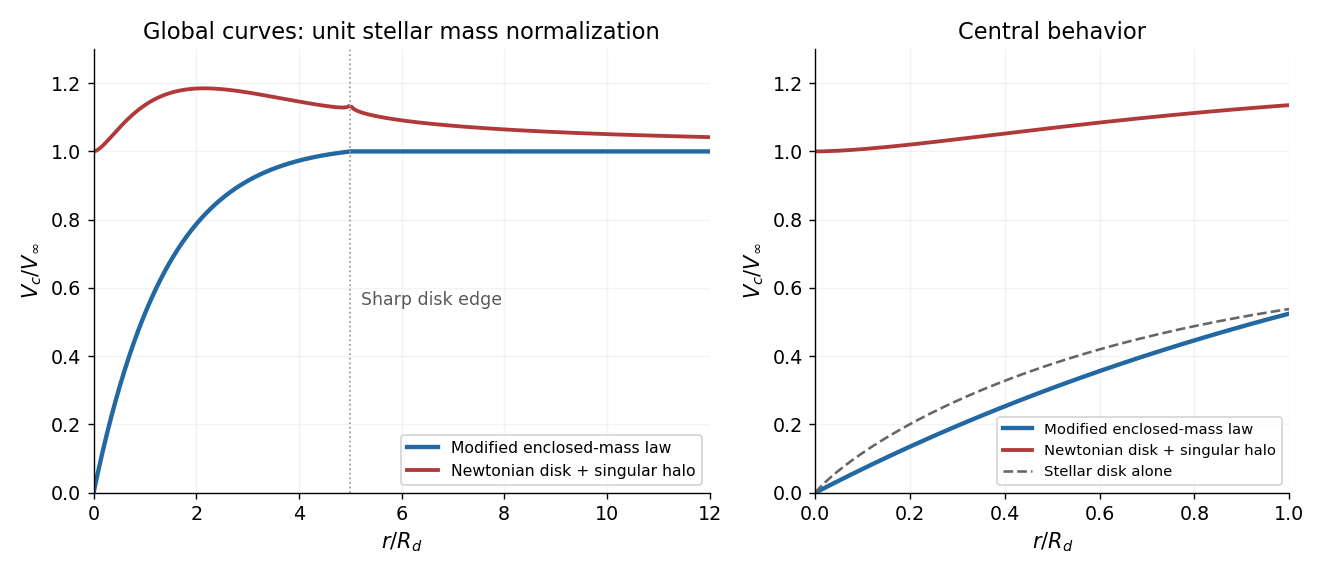

Observed galaxy rotation curves generally rise from the central region rather than beginning with a nonzero constant. The modified toy curve therefore captures that qualitative behavior better than this particular singular isothermal halo extrapolation, without establishing that its force law is correct. If dark matter is the explanation, the inner halo cannot universally retain , down to zero. For a spherical density , tends to zero when ; a constant-density core gives a linear rise. A shallower cusp can also tend to zero. Stellar mass-to-light ratio, baryonic structure and disk–halo degeneracy prevent this qualitative argument alone from proving that every halo has a constant-density core.
The main evidence combines a large luminosity with a compact source and a massive central gravitating object. Rapid continuum variability bounds the emitting size by a light-crossing scale, while broad emission lines and reverberation delays constrain the gas orbital speeds and characteristic radii. Their virial masses, together with stellar and gas dynamics in galactic nuclei, imply compact central masses far larger than ordinary stars. Thermal optical/ultraviolet disk emission, a high-energy coronal component, jets and relativistically broadened inner-disk features are naturally associated with an accretion flow. No one signature alone is a unique proof, but the combined compactness, mass and energy requirements strongly favor accretion onto supermassive black holes. Gravitational accretion releases a much larger fraction of rest energy than ordinary stellar burning, without requiring the luminosity to come from the black-hole interior.
For a fully ionized pure-hydrogen plasma, each electron receiving Thomson radiation force is coupled electrostatically to a proton carrying almost all the mass. With spherical isotropic luminosity , the outward force per electron is , while gravity per electron–proton pair is approximately . Equality defines the Eddington luminosity:Here is the gravitational constant, the proton mass, the speed of light, the central mass and the Thomson cross-section. The estimate assumes electron-scattering opacity, tight electron–ion coupling and no other dominant force. Geometry, beaming, other opacities and photon trapping can change the relevant luminosity limit.
If is the supplied rest-mass rate and a fraction of its rest energy is radiated, . The associated Eddington accretion rate is consequentlyThis is a supply rate. The black-hole growth rate is if the remaining supplied energy increases the hole's mass. Confusing these rates loses a factor relevant to the growth-time calculation.
The order-of-magnitude efficiency is motivated by orbital binding energy released near the innermost stable orbit. A Newtonian orbit at has binding energy per unit mass ; the exact nonspinning thin-disk value is . Black-hole spin changes the innermost stable orbit and can raise or lower the efficiency. Thus is a useful radiatively efficient accretion estimate, not a universal constant; an advective or jet-dominated flow can have a different radiative efficiency.
Using the stipulated luminosity and ,The source's redshift and age are treated as its supplied data; its record wording is historical, not a present-day claim about the most distant known quasar.
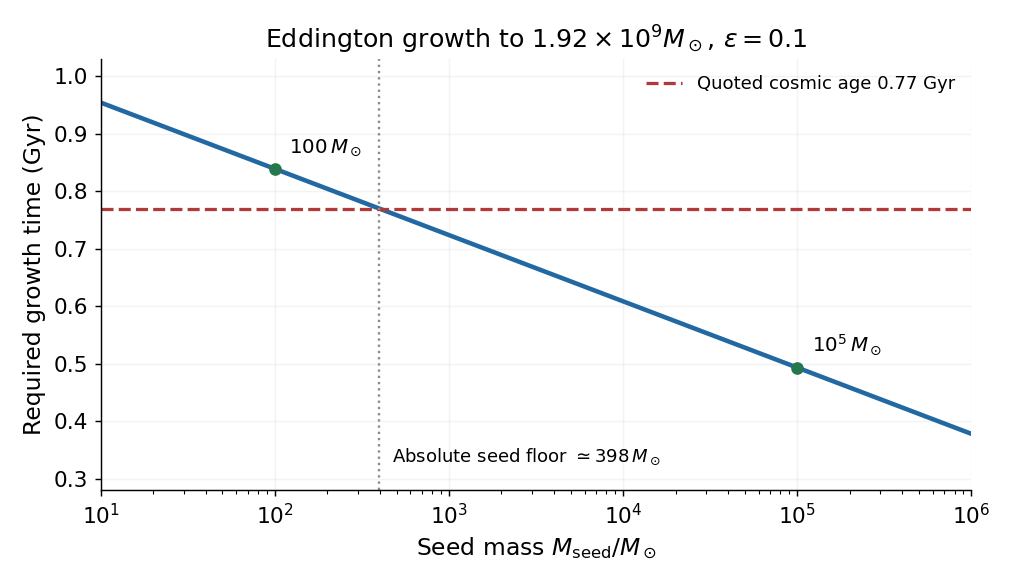
At continuous Eddington luminosity and fixed efficiency, growth is exponential:This is the Salpeter time, including retained-mass efficiency. Even granting all since the big bang permits only about 15.4 e-folds, requiring a seed of at least roughly . A seed would take about under these assumptions, before allowing any formation delay; a seed takes about . These numbers motivate early massive seeds, sustained high duty-cycle accretion, lower radiative efficiencies, super-Eddington phases or contributions from mergers. They do not prove a unique seed channel, since the luminosity-to-mass conversion and accretion history are model-dependent.

A core-collapse supernova occurs when the core of a massive evolved star loses stable pressure support and collapses. Iron-group nuclei no longer provide an exothermic fusion route, while electron capture and photodisintegration reduce electron pressure and consume energy. Collapse accelerates until nuclear-density matter stiffens the inner core and launches a shock. That shock loses energy to dissociation and neutrinos and can stall. Neutrino heating, aided by multidimensional flow, can revive it; sufficiently rapid rotation and magnetic stresses provide other possible channels. Most of the liberated compact-object binding energy escapes as neutrinos rather than optical light or ejecta kinetic energy.
Successful explosions can leave neutron stars, with additional fallback sometimes producing black holes. Failed explosions or very substantial fallback can form black holes more directly. Important theoretical uncertainties include progenitor structure and mass loss, nuclear equation of state, neutrino transport and interaction rates, convection and shock instabilities, rotation, magnetic fields and the relation between these effects and explosion asymmetry. A successful shock launch alone does not guarantee unbinding all overlying layers.
For an initially uniform-density iron core, . Assemble spherical shells from infinity:At the supplied density , the numerical coefficient is about , consistent with the printed rounded estimate:The negative sign represents the work recovered in assembling the bound core.
The ejecta binding energy of an initially uniform core is the negative gravitational energy of the outer shells in the original core, including their interaction with the material inside them. It is not the final neutron star's entire binding energy. With and , the shell integral givesAdding the supplied dissociation cost, , givesThe calculation assumes the initial common density for the shell binding, all the indicated outer iron encounters the dissociating shock, and dissociation is charged as the stated energy cost. It does not subtract the much larger final compact-object binding energy as though all that energy were directly available to the ejecta. Later recombination can return some nuclear binding energy, and overlying noniron layers add their own energy requirements, so the table is a simplified shock-energy budget.
Compared with a characteristic explosion, ejecting a very thin remaining core layer is relatively easy in this estimate; is already demanding, and requires substantially more energy. More massive tightly bound cores therefore tend to make shock revival and complete ejection harder, increasing the possibility of fallback or failed explosions and black-hole remnants. A thin steep-gradient outer layer may allow a rapid, relatively weak explosion and a surviving neutron star.
A natal kick requires asymmetry of ejecta, neutrino emission or subsequent gravitational interaction, not merely a large scalar energy budget. Rapid relatively symmetric low-ejecta explosions can produce small kicks; a shock that develops strong asymmetries can give larger neutron-star kicks, while direct collapse need not do so. A schematic momentum estimate is , but neither the asymmetry nor its direction is fixed by the three core masses. The source data support tendencies, not a unique mapping from iron-core mass to remnant kick.
Articles by others on the same topic
There are currently no matching articles.