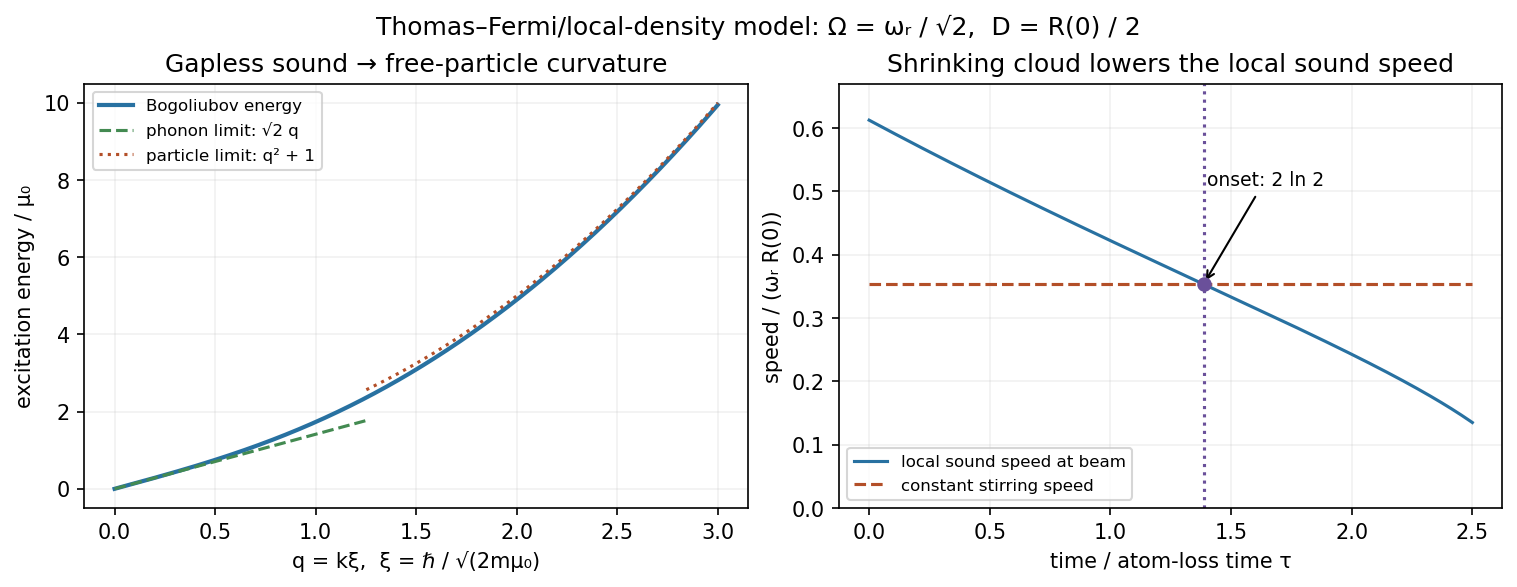
For the Bogoliubov spectrum, define and . For repulsive interactions and ,Thus the low-momentum excitations are gapless phonons and the high-momentum branch approaches free-particle curvature. The crossover occurs when kinetic and interaction energy are comparable. The Landau criterion follows because an obstacle moving at velocity can supply energy to an excitation. HereThis is the homogeneous phonon kinematic threshold, not a guarantee that every perturbation dissipates immediately above it.

In two dimensions, has units of inverse area and has units of energy times area. Therefore is dimensionless. Neglecting the kinetic term in the Gross–Pitaevskii equation, with positive coupling, giveswith outside the radius in the Thomas–Fermi approximation for a condensate. Multiplication givesThe sharp edge is an approximation; the neglected gradient term rounds it over a healing length scale.
Using the local sound-speed criterion for circular condensate stirring, the moving beam has speed . The local interaction chemical potential is , soThe onset equality is and the permitted excitation condition isThis uses the beam speed as the local relative-flow scale. A finite hole can distort the surrounding flow or nucleate vortices, so the result is the requested local phonon estimate, not a universal necessary condition for all experimental stirring.
For the loss-driven onset of condensate stirring, first integrate the density:At fixed coupling and trap frequency, and . Hence while stays fixed. For , threshold requires . Starting at ,At onset, , and the beam is still inside the cloud. Excitations become kinematically allowed just beyond this equality, provided the stipulated adiabatic regime of the Thomas–Fermi approximation for a condensate remains valid.
Articles by others on the same topic
There are currently no matching articles.