Set the ground-state energy to zero. Bose-Einstein occupation of an excited level is , with . As particles are added, approaches zero and the excited-state population saturates. Separating the ground state from the density-of-states integral therefore givesThe excited-state integral must actually converge: alone is not a sufficient condition in complete generality. A power law with suffices at low energy, as in the stated three-dimensional box.
Let denote the density-of-states prefactor, not a heat capacity. Substitution givesThe condensate has zero energy on this reference, so a further factor of in the integral givesRelative to the classical value, the ratio is . Macroscopic occupation of the zero-energy state and the Bose distribution both lower the average energy.
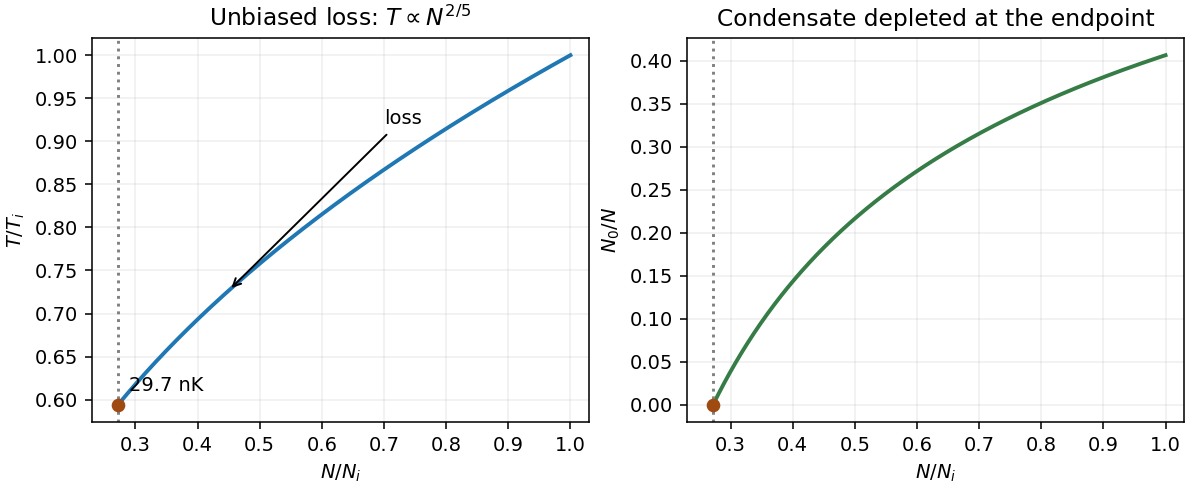
At fixed volume the condensed gas has . Unbiased random loss keeps average constant, henceRemoving a condensate atom removes essentially no energy and by itself leaves the excited cloud's temperature unchanged. Removing an excited atom removes its energy; during re-equilibration, some zero-energy condensate atoms join the excited population and share the remaining energy, lowering temperature. Averaging over unbiased loss gives the stated constant energy per particle, even though each individual type of loss need not preserve it separately.
Using and the supplied volume,There is only one occupied internal spin state, so no factor belongs in the density of states. During loss, , hence . Condensation disappears at :As a consistency check, agrees with .
Both this process and evaporative cooling of atoms require particle loss and re-equilibration. Ordinary evaporation preferentially removes energetic atoms, reducing , and can cool an uncondensed classical gas. Here loss is energy independent, stays constant, and cooling relies on the condensed gas's unusual equation of state; random loss of a classical ideal gas would leave its temperature unchanged. Exact noninteraction would prevent collisional rethermalization: the imposed equilibrium assumption can be understood as weak thermalizing interactions whose equation-of-state corrections are neglected.

Articles by others on the same topic
There are currently no matching articles.