For hydrogen, the leading characteristic scales areOrder-one spin and nuclear magnetic factors, and state-dependent factors, are suppressed here. Gross atomic structure is Coulomb binding. Fine structure includes relativistic kinetic and spin-orbit effects, with Thomas precession affecting the spin-orbit coefficient. Hyperfine structure couples electronic motion and spin to the nuclear magnetic moment, whose inverse nuclear mass makes it much weaker. The contact spin interaction can remain in an s state where orbital spin-orbit coupling vanishes.
For positronium, the reduced mass is . Its gross levels and separation scale areThus the mean ground-state electron–Positron separation is twice the infinite-proton-mass hydrogen value: both means have the same factor multiplying their respective Bohr radii. Retaining proton recoil makes the ratio , very slightly below two. Separation is not the distance of either positronium constituent from its centre of mass.
Interpret the spin operators in units of , as required by the printed Zeeman term, so has units of energy. Two spin halves give four eigenstates. At zero field, total spin and projection label the singlet and triplet. At high field relative to the hyperfine scale, the individual projections become approximately good quantum numbers. Total projection remains exact at every field, but does not for the two mixed states.
Choose the quantization axis along . The aligned-spin states and both have because their Zeeman shifts cancel. In the other product-state sector,For physical positronium . At there is a triplet at and a singlet at . At large positive field the mixed states approach and , with energies and respectively, while the aligned pair remains degenerate at .
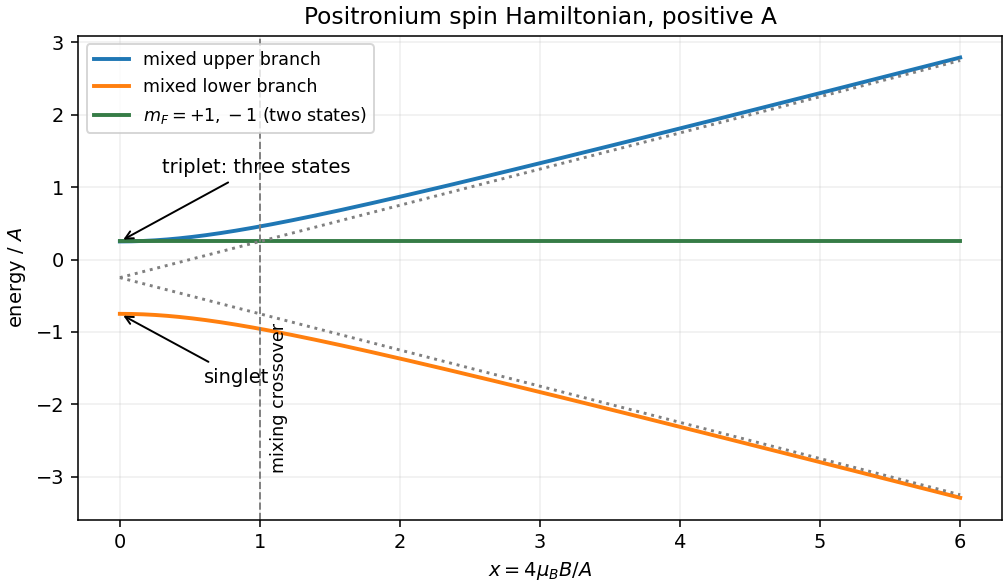
The dimensionless mixing parameter is . A crossover estimate is , rather than a sharp transition. The scale already gives a field of a few tesla. Using the physical hyperfine interval givesThe numerical hyperfine interval is external physical input, not a number supplied by the symbolic Hamiltonian.[ref]
New Precision Measurement of Hyperfine Splitting of Positronium by A. Ishida and others. arXiv:1310.6923, abstract, measured interval approximately 203.39 GHz
The high-field limit here still presumes that orbital distortion is negligible compared with Coulomb binding.Set the ground-state energy to zero. Bose-Einstein occupation of an excited level is , with . As particles are added, approaches zero and the excited-state population saturates. Separating the ground state from the density-of-states integral therefore givesThe excited-state integral must actually converge: alone is not a sufficient condition in complete generality. A power law with suffices at low energy, as in the stated three-dimensional box.
Let denote the density-of-states prefactor, not a heat capacity. Substitution givesThe condensate has zero energy on this reference, so a further factor of in the integral givesRelative to the classical value, the ratio is . Macroscopic occupation of the zero-energy state and the Bose distribution both lower the average energy.
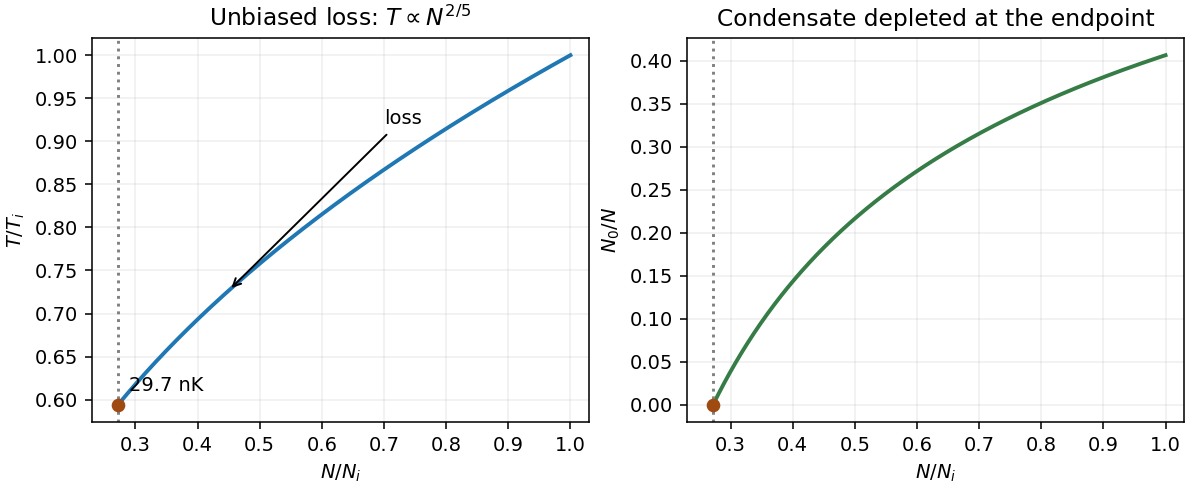
At fixed volume the condensed gas has . Unbiased random loss keeps average constant, henceRemoving a condensate atom removes essentially no energy and by itself leaves the excited cloud's temperature unchanged. Removing an excited atom removes its energy; during re-equilibration, some zero-energy condensate atoms join the excited population and share the remaining energy, lowering temperature. Averaging over unbiased loss gives the stated constant energy per particle, even though each individual type of loss need not preserve it separately.
Using and the supplied volume,There is only one occupied internal spin state, so no factor belongs in the density of states. During loss, , hence . Condensation disappears at :As a consistency check, agrees with .
Both this process and evaporative cooling of atoms require particle loss and re-equilibration. Ordinary evaporation preferentially removes energetic atoms, reducing , and can cool an uncondensed classical gas. Here loss is energy independent, stays constant, and cooling relies on the condensed gas's unusual equation of state; random loss of a classical ideal gas would leave its temperature unchanged. Exact noninteraction would prevent collisional rethermalization: the imposed equilibrium assumption can be understood as weak thermalizing interactions whose equation-of-state corrections are neglected.


An electric dipole transition has amplitude proportional to . The electric dipole operator is odd under parity, so the initial and final states must have opposite parity. As a rank-one spherical tensor it also requires , excluding , and . These follow from angular-momentum addition and the Wigner-Eckart theorem; vanishing Clebsch-Gordan coefficients can impose further restrictions. Relative to the quantization axis, polarization drives , while drive .
For a single active electron, parity and the orbital triangle rule combine to give . In LS coupling, the spin-independent electric dipole operator gives and , excluding ; total parity must still change. Spin-orbit mixing can weakly relax the approximate spin rule. For resolved hyperfine states the corresponding triangle rule is , excluding , with . These labels require the appropriate coupling regime. There is no universal E1 rule demanding a particular change in principal quantum number. An E1-forbidden line may occur through another multipole or a multiphoton process.
The two-level Doppler limit, , balances velocity-dependent scattering friction with momentum diffusion. Multilevel atoms have additional, slower internal dynamics. Counterpropagating beams with orthogonal linear polarizations create a spatially varying polarization, giving different position-dependent light shifts for ground-state magnetic sublevels. A moving atom climbs a light-shift hill, loses kinetic energy and is optically pumped into a lower-energy sublevel: this repeated Sisyphus cooling cycle dissipates motion through emitted light.
Optical pumping responds with a finite delay. Its rate, rather than only the excited-state linewidth, sets the low-velocity response scale. In the opposite-circular-polarization arrangement, motion instead produces unequal sublevel populations and unbalanced radiation pressure. Both mechanisms can cool below the two-level Doppler temperature; diffusion heating still balances the cooling, and recoil matters at the lowest temperatures.[ref]
Laser cooling below the Doppler limit by polarization gradients: simple theoretical models by Jean Dalibard and Claude Cohen-Tannoudji. 1989, pages 2023–2025, two polarization-gradient mechanisms and pumping timescale
Ground-state substructure, optical pumping and polarization gradients enable the extra cooling. Magnetic fields that disturb the required sublevel dynamics can suppress it. Optical molasses damps velocity but does not by itself provide position-restoring confinement.
Sound propagation. In the 1997 experiment, a focused laser beam abruptly modified the trapping potential of a dilute condensate, producing a local excitation. A rapid sequence of nondestructive phase-contrast imaging measurements followed the resulting density motion. Measuring propagation speed at different densities tested the sound-like collective excitation spectrum, rather than individual free-particle flight.[ref]
Propagation of Sound in a Bose-Einstein Condensate by M. R. Andrews and others. 1997, primary abstract and author publication record; Physical Review Letters 79, 549–552, with 1998 erratum
For a weakly interacting uniform condensate, the Bogoliubov spectrum isDensity dependence and trapped-geometry averaging matter when comparing a measured pulse speed with this local uniform formula. A strictly ideal gas would have no nonzero interaction-supported sound speed.Moving-obstacle dissipation. In the 1999 experiment, a blue-detuned focused beam repelled atoms and acted as an obstacle swept through a sodium condensate. Heating was inferred from the condensate fraction after stirring and re-equilibration. The heating rose markedly near , below the quoted peak sound speed .[ref]
Evidence for a Critical Velocity in a Bose-Einstein Condensed Gas by C. Raman and others. pages 2502–2504, obstacle method, heating onset and comparison with sound
Landau's criterion motivates a dissipation threshold, but density variation, flow acceleration around the obstacle and vortex nucleation make the observed threshold different from simply substituting the peak sound speed. Together these experiments probe a collective excitation spectrum and the onset of dissipative flow; condensation alone is not a complete demonstration of superfluidity. Articles by others on the same topic
There are currently no matching articles.