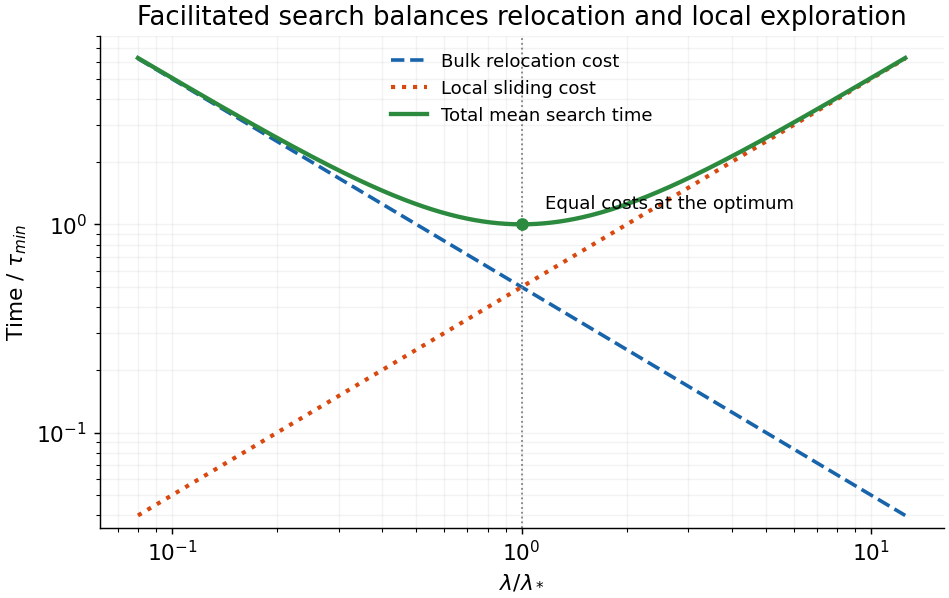
Write A=V/D3 and B=L/D1. The given mean-search scaling is τ=A/λ+Bλ. Three-dimensional relocation sees an effective capture length of order λ, givinga bulk encounter time V/(D3λ). A sliding excursion explores length of order λ in time of order λ2/D1; sampling order L/λ contour segments gives a total sliding cost of order Lλ/D1. Prefactors, correlations and repeated visits are coarse-grained in this scaling model.
Small slidinglengths make relocation inefficient; very long slidingwastestime revisiting a local DNA region rather than relocating to another. The optimum balances both contributions:
Bulk relocation and local sliding impose opposing search-time costs
. The original dimensionless plot shows a decreasing inverse-sliding-length contribution and an increasing sliding contribution. Their sumhas a minimum where the two costs agree, at a sliding length equal to the analytic optimum. Details.
The model is meaningful only over an accessible range between molecular steps and the available chromosomelength. An optimum outside that range is replaced by a boundary choice; the unphysical divergences at arbitrarily small or large λ describe limits of the scaling expression. A common multiplicative searcher-number factor would not change the optimum, but an exact many-searcher first-arrival mean is not generally obtained by dividing an arbitrary single-searcher mean by their number without a waiting-time assumption.