At initiation, RNA polymerase recognizes a promoter and forms a closed bound complex; bacterial promoter recognition involves its specificity factor. Local strand opening exposes the template in an open complex, after which initial RNA synthesis can precede promoter escape into elongation. Binding, opening and productive escape are distinct transitions.
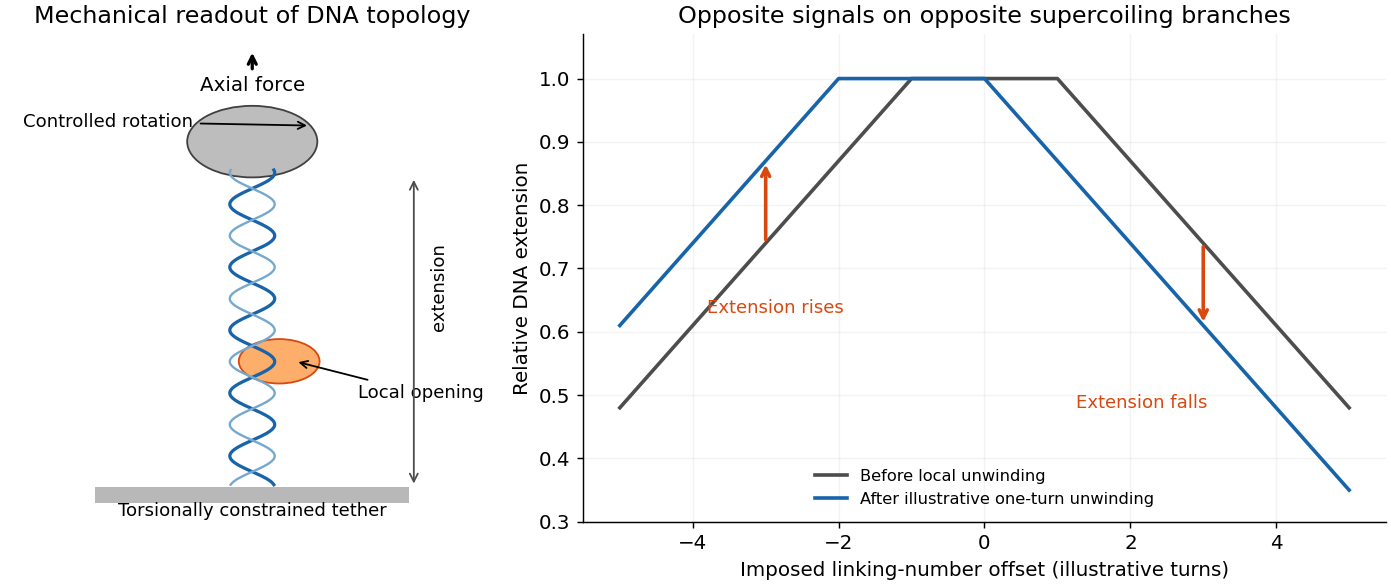
Opening a small helical region decreases twist, so the rest of the tether acquires compensating positive writhe. On a negatively supercoiledtether this removes some writhe magnitude and raises its extension; on a positively supercoiledtether it increases writhe magnitude and lowers extension. A change with opposite signs under the two torsional conditions therefore distinguishes unwinding from simple compaction, which would shorten both tethers. Calibrating extension against imposed turns converts a mechanical step into a change in helical winding. This is a conceptual readout of local opening, rather than a direct optical image of separated bases.[ref]
Torsional constraint converts local DNA opening into a bead-extension signal
. An original conceptual magnetic-tweezers schematic is paired with illustrative extension-versus-turns curves. Local unwinding shifts the curve and produces opposite extension changes on its negatively and positively supercoiled branches. The diagram does not reproduce the source experiment or specify alaboratory protocol. Details.
Model the target asa perfectly absorbing sphere of reaction radius r0, with a fixed target and a dilute far-field polymerase density c∞. Steady radial diffusion satisfies ∇2c=0, c(r0)=0, c(∞)=c∞, hence
This is an idealized 10−2-second-scale estimate, not a unique geometric prediction. Finite cellshape, crowded motion, accessibility and orientational restrictions can reduce the ideal capture rate.
If nonspecific binding merely sequesters searchers and their freefraction is 0.2, the three-dimensional capture hazard is reduced fivefold: τ≃τ3/0.2≃0.067s for those estimates. If bound molecules instead search productively by sliding, afree-timefraction alone cannot determine the total arrival time or its sign of change. That is the distinct facilitated-search mechanism treated in c.
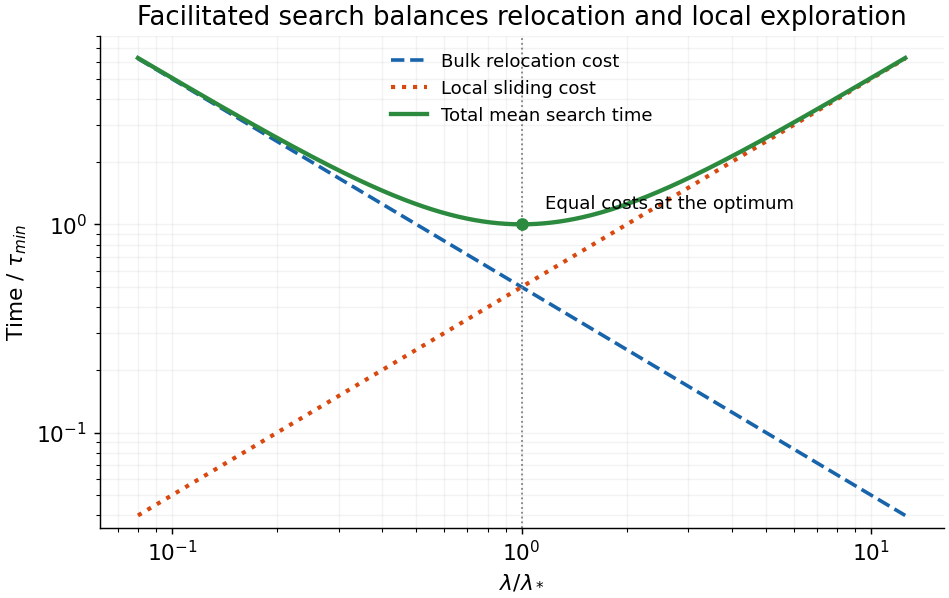
Write A=V/D3 and B=L/D1. The given mean-search scaling is τ=A/λ+Bλ. Three-dimensional relocation sees an effective capture length of order λ, givinga bulk encounter time V/(D3λ). A sliding excursion explores length of order λ in time of order λ2/D1; sampling order L/λ contour segments gives a total sliding cost of order Lλ/D1. Prefactors, correlations and repeated visits are coarse-grained in this scaling model.
Small slidinglengths make relocation inefficient; very long slidingwastestime revisiting a local DNA region rather than relocating to another. The optimum balances both contributions:
Bulk relocation and local sliding impose opposing search-time costs
. The original dimensionless plot shows a decreasing inverse-sliding-length contribution and an increasing sliding contribution. Their sumhas a minimum where the two costs agree, at a sliding length equal to the analytic optimum. Details.
The model is meaningful only over an accessible range between molecular steps and the available chromosomelength. An optimum outside that range is replaced by a boundary choice; the unphysical divergences at arbitrarily small or large λ describe limits of the scaling expression. A common multiplicative searcher-number factor would not change the optimum, but an exact many-searcher first-arrival mean is not generally obtained by dividing an arbitrary single-searcher mean by their number without a waiting-time assumption.
Independent localization errors of varianceσloc2 add an intercept 2σloc2. Finite exposure adds motion blur, and drift, binding transitions and the finite DNA contour must be distinguished from free sliding. Aslope fit with those limitations can estimate D1; simply fitting all observed displacements to a noiseless line can bias it.
Consequently no fluorescencecamera could temporally resolve trajectories under the stated formal values, regardless of the spatial excursion'slength. An actual corrected exponent cannot be inferred uniquely from the paper. If a physically plausible D1 were supplied instead, resolving sliding would require exposures substantially shorter than τbound and diffusiondisplacements larger than localization error, with enough detected photons. The dependence on D1 is explicit above, so no guessed source correction is needed.