Source bundle pages 55–61. The cover identifies Trinity Term 2022, C7, despite the attachment's 2021 filename. Solutions use the conventions and figures on the original pages.
The bacterial RNA polymerase core associates with a sigma factor to form a holoenzyme. The sigma factor recognizes promoter features and helps position the DNA and stabilize its opening. Initial binding gives a closed promoter complex; local DNA unwinding creates an open promoter complex with the template accessible. Initial RNA synthesis can produce short abortive products while the RNA polymerase remains attached to the promoter, taking in downstream DNA by scrunching. Growth of the RNA eventually permits promoter escape and productive elongation. The sigma factor changes its interactions during this transition; immediate complete dissociation is not obligatory.
In magnetic tweezers, torsionally constrained DNA joins a surface to a magnetic bead. A field gradient applies upward force, rotation of the magnets controls the imposed DNA supercoiling, and optical tracking measures bead height. At suitable modest force, DNA supercoiling forms writhed loops, shortening the tether. Opening roughly one helical turn at fixed linking number makes the remaining DNA more positively twisted: . Thus opening lengthens a negatively supercoiled tether by removing some negative writhe, but shortens a positively supercoiled tether by adding positive writhe. This opposite sign distinguishes unwinding from ordinary compaction, which shortens both tethers. Height-versus-turn calibration converts the two extension changes into an unwinding angle and a compaction contribution. Repeated height transitions give opening and closing dwell times.[ref]
Promoter unwinding and promoter clearance by RNA polymerase: Detection by single-molecule DNA nanomanipulation by Andrey Revyakin and others. Figures 1–3: torsionally constrained tether, opposite-sign extension responses, and approximately one-turn unwinding
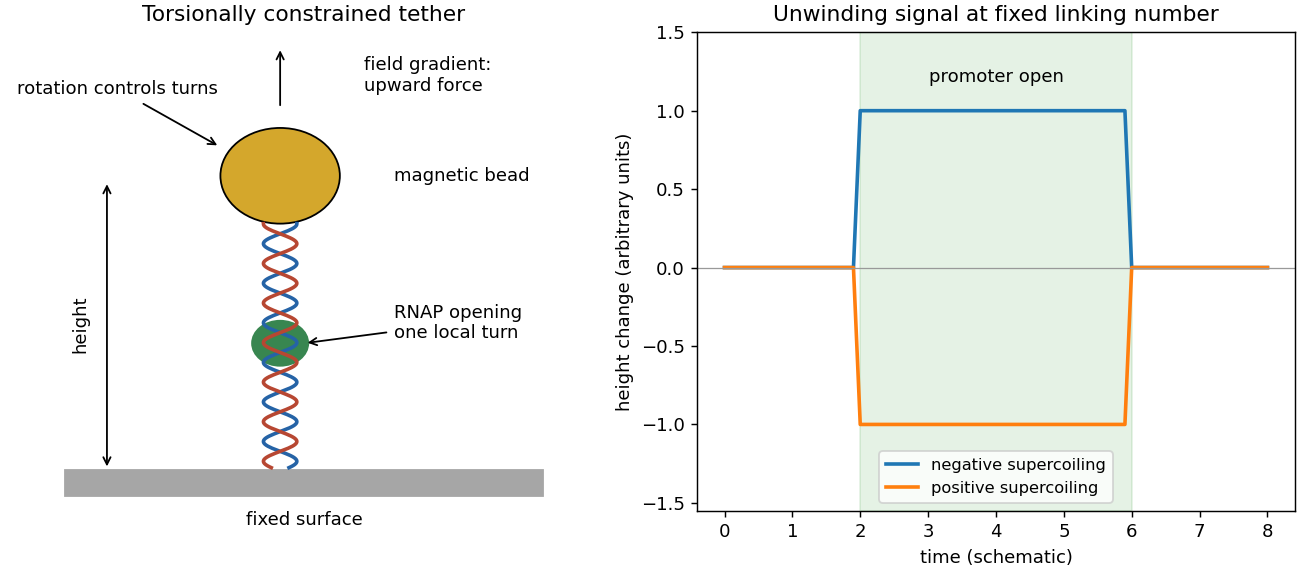
The sketch is a schematic prediction, not a copy of an experimental trace. Opening must be distinguished from promoter escape: an unwound DNA region can remain associated with an elongating RNA polymerase.
Treat the target as an absorbing sphere of effective capture radius , surrounded by a uniform dilute reservoir of RNA polymerase with number density . The steady diffusion equation, spherical symmetry, and boundary conditions giveBy Fick's laws, the inward capture rate per target is . Multiplying by the target number density and comparing with the bimolecular rate law therefore yields the Smoluchowski association rateIts units here are , since the concentrations count particles rather than moles. The absorbing boundary assumes every encounter is productive; orientation constraints would reduce the effective association rate constant.
The Stokes–Einstein relation, for RNA polymerase radius at an illustrative temperature , givesNeither cell volume nor the effective is specified, so a unique numerical time is unavailable. A representative Escherichia coli volume is . The -base pair target has a DNA contour extent of about ; using this as an order-of-magnitude capture radius gives . For independent searchers, the target's approximately constant encounter hazard is , henceUsing half the target's contour extent for instead gives about ; the spherical capture model is not exact target geometry. One searcher's mean would be about under the first convention, whereas the first arrival among is much faster.
If only a fraction of each searcher's time is available for three-dimensional diffusion, and nonspecific DNA binding neither scans nor delivers the target, the effective searching population is . Thus , about under the stated estimate. This assumes stationarity, well-mixed searchers and no additional target-access route; nonspecific binding alone is sequestration, not facilitated diffusion.
Write and . The search time is : it decreases from infinity at small positive , reaches one minimum, and increases without bound at large within this idealized model.
During a facilitated diffusion search, roughly separate DNA landing-and-sliding episodes sample a chromosome. A three-dimensional encounter with any chromosomal landing region has characteristic time , so the total bulk-search contribution is . Each one-dimensional diffusion excursion lasts order ; multiplying by gives . Longer sliding therefore reduces the number of bulk relocations but increases time spent repeatedly exploring local DNA. Numerical constants and overlap corrections are already omitted in the given model.
Differentiating and using the positive second derivative givesAt the two time contributions are equal. The optimum is meaningful only if lies between the microscopic capture scale and the available chromosomal contour length.
A decrease in DNA concentration means a decrease in , but its effect on the time is not determined by that ratio alone. At fixed chromosome length , dilution by increasing increases at fixed and increases as ; bulk relocation becomes slower. If instead decreases at fixed , while the target is retained, the stated model predicts a smaller sliding contribution and a smaller optimized time, proportional to . In both cases . This distinction prevents attributing a unique time trend to concentration without specifying how it changes.
Let be the donor's total decay rate without acceptors, including radiative and nonradiative decay, and let be its transfer rate to one acceptor. In weak excitation, independent equivalent acceptors supply additive transfer rates, so FRET efficiency isEliminating givesThis assumes the same Förster distance, equivalent donor–acceptor distances and unchanged donor decay, with no acceptor saturation or other transfer pathways affecting donor de-excitation.
For Förster resonance energy transfer, , henceHere the single-pair FRET efficiency would be , which indeed produces .
Use the logic approximation for gene regulation: production is either or zero, and every species has linear removal rate . Put and assume zero basal expression, inactive X before time zero, and all required thresholds strictly between and . The input is for and zero otherwise. The common ordinary differential equation is , with Boolean production gate . Both networks therefore havewhere the latter uses the stipulated attained steady state. Define the threshold-crossing delayBecause , . In both networks, stays zero until and then follows until the OFF response. Write for the activation threshold of on Z in diagram (a), and for the level of that blocks Y's repression in diagram (b); these thresholds were not supplied numerically.
Diagram (a). All three inputs X, Y and must permit Z production. Since Y has already crossed its Z threshold before starts, the final permission arrives atThus until and subsequently. Solving givesFor the frequently adopted but extra convention that both required thresholds are , this is . At the OFF step, X's direct AND input disappears, so immediately. Y also decays immediately. remains at while Y remains above ; it starts decaying at . This is a coherent feed-forward loop persistence response: activation is delayed, while removal of the direct required input switches production off promptly.
Diagram (b). The production gate is . Z initially rises, Y switches Z production off at , and restores production at . The continuous solution during the ON phase isThe derivative changes from positive to negative at , and from negative to positive at . Consequently the first temporary minimum following the initial pulse occurs atIts value is . At the OFF step Z again decays immediately because X is required for production, with Y and behaving as above. If a required threshold is unattainable, these late switching events do not occur; equal production and removal rates alone do not fix threshold values.
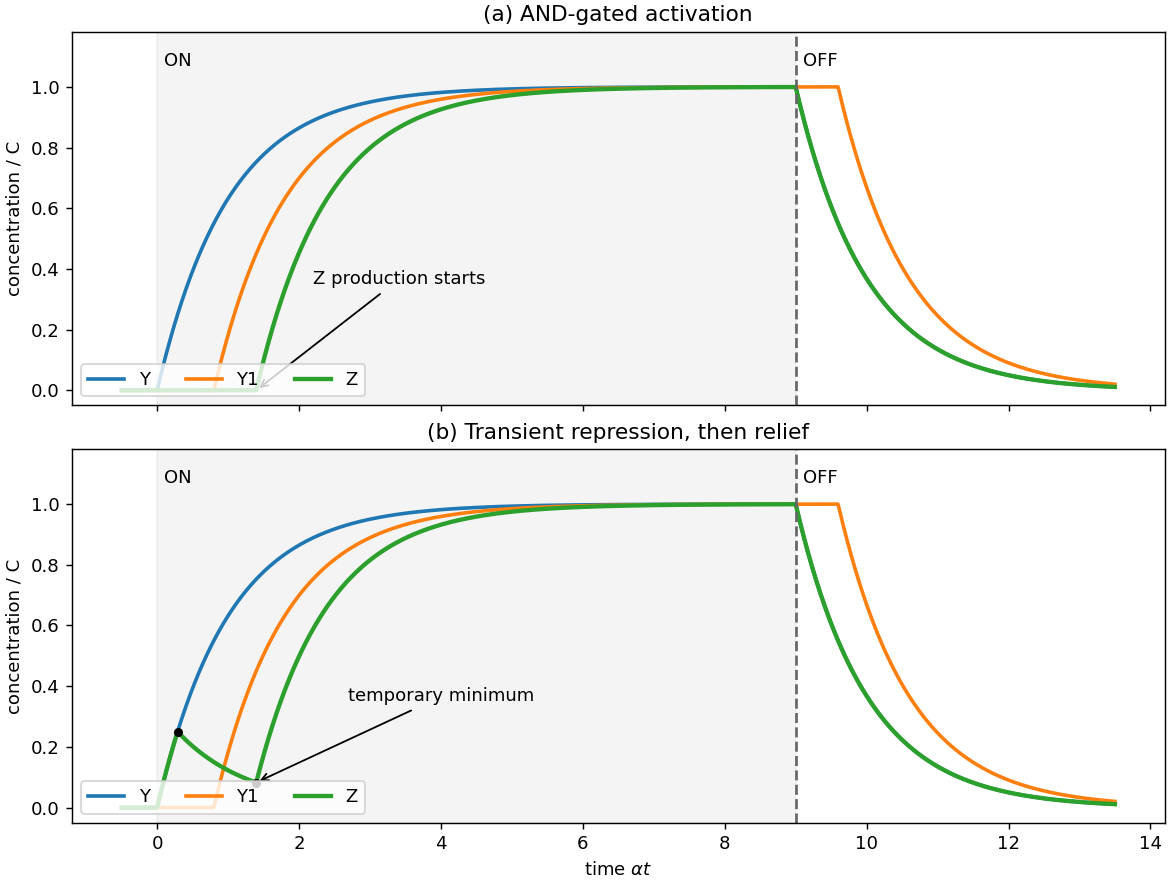


The plotted thresholds are explicitly illustrative, with , and .
The protein production rate is proportional to the current messenger RNA concentration, not an independently constant : . Setting the two coupled rate equations to zero givesWith first-order removal, a messenger RNA molecule has mean lifetime . At biological translation rate per molecule, it produces an expected proteins before its removal. Thus the translational burst size is a dimensionless mean number of offspring proteins per messenger RNA, not a concentration and not a fixed number produced in every event. When production and removal are independent Poisson events, mixing a Poisson number of biological translation events over an exponentially distributed lifetime makes the burst count geometrically distributed on the nonnegative integers. Its mean is and its variance is .
Convert number density into molecule count: . For the explicitly assumed representative cell volume , the two densities correspond to and . The concentrations alone do not fix fluctuation sizes without a volume.
For activation from zero messenger RNA and protein, solving the two mean rate equations givesThus all three normalized mean curves are almost identical. Sample paths differ. For Poisson transcription with biological translation bursts, the stationary Fano factor and squared coefficient of variation areOne way to obtain the fast-messenger RNA limit is to use burst arrivals at rate , a geometrically distributed burst with and , and independent unit protein degradation at rate . The first stationary moment gives ; the second gives .
At , typical relative fluctuations are and many small bursts make the trajectory smooth. At , they are ; individual bursts have mean normalized height , with only about bursts per protein lifetime. At , the relative fluctuations are again , but the typical burst height is and about bursts occur per lifetime. The latter two examples can look similarly noisy after normalization even though their mean molecule counts differ by two orders of magnitude. Burst arrival times and sizes fluctuate: a high-burst trace is not a periodic sawtooth.
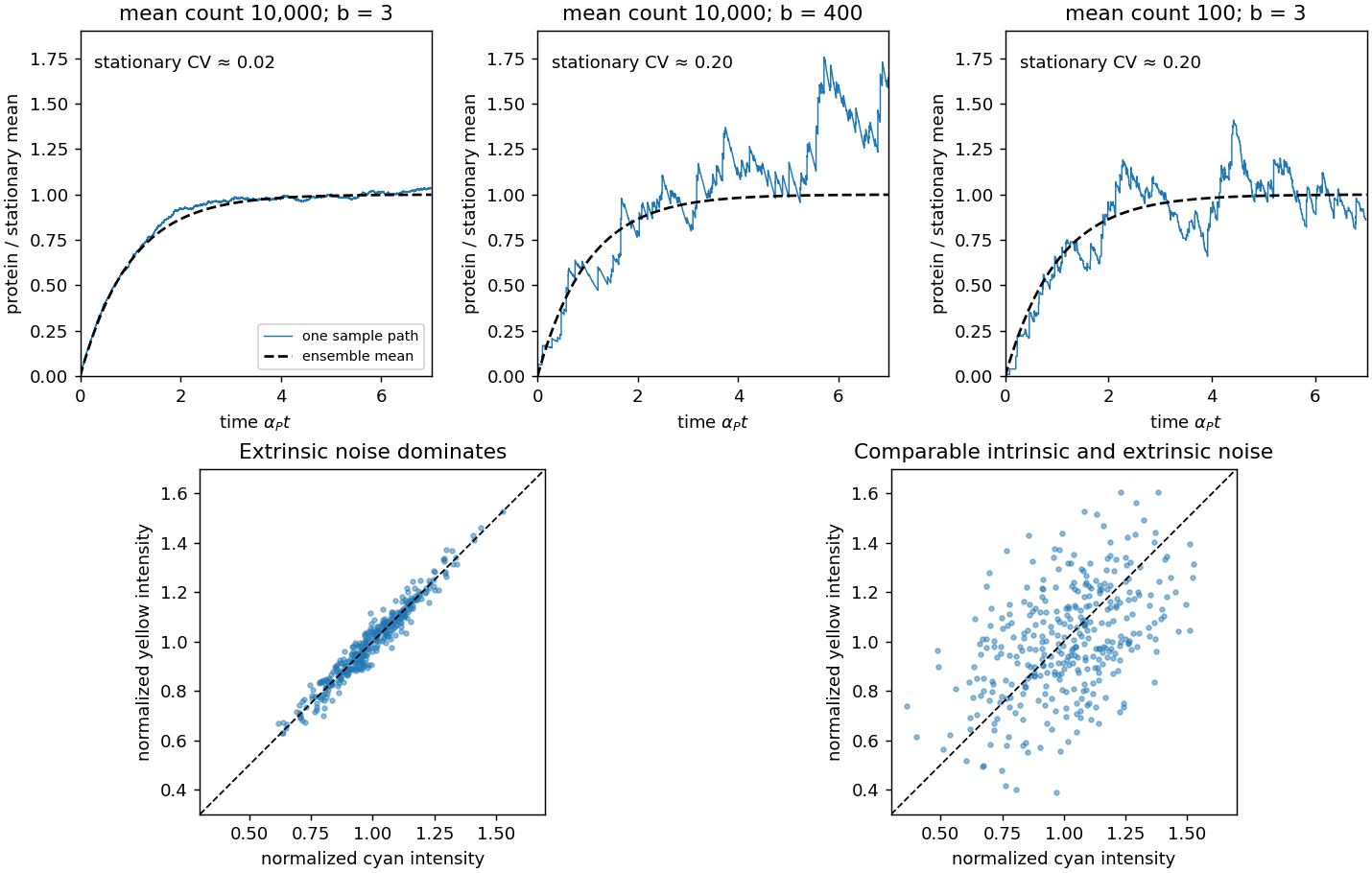
Stochastic gene expression trajectories and dual-reporter intrinsic gene-expression noise and extrinsic gene-expression noise
. Details. 
The upper panels are independently simulated burst-arrival and unit-removal processes, shown alongside the common mean. The lower panels illustrate d; their point clouds are schematic, not experimental data.
Normalize each reporter by its mean intensity, after correcting background and unequal brightness, so equal expression lies on . Write , , where the common fluctuation is extrinsic gene-expression noise and the independent reporter-specific fluctuations are intrinsic gene-expression noise. The extrinsic gene-expression noise includes shared variation in cell size, expression machinery and growth state; intrinsic gene-expression noise includes independent molecular production and removal events at each reporter.
If intrinsic gene-expression noise is much smaller, points form a narrow elongated cloud along : a cell that is bright in cyan is usually bright in yellow. If the two contributions have comparable magnitude, the cloud is still positively correlated but has substantial width perpendicular to , because the two reporters can differ within the same cell. With variance in and equal variance in each independent intrinsic term,Equal intrinsic and extrinsic variances therefore give correlation coefficient , rather than an uncorrelated circular cloud. For mean-normalized reporters, and . Measurement noise must be separately estimated before assigning perpendicular scatter to expression itself. These are the geometric diagnostics of the original dual-reporter experiment.[ref]
Stochastic Gene Expression in a Single Cell by Michael B. Elowitz and others. Figure 1 and definition of intrinsic and extrinsic noise: within-cell reporter differences versus correlated cell-to-cell variation
The lower panels of c show these two cases. Repeated observations of one cell can move both along and across the diagonal; a static population cloud alone does not determine the time scales of the fluctuations.
In the continuum cylindrical-pore estimate, the electrical resistance is , with radius , length and electrical resistivity . ThereforeUnrestricted approach from the reservoirs removes access barriers, but still permits a continuum spreading or access resistance of a circular pore. Including on each side givesThus the usual estimate neglecting the access contribution is about , or about with spreading resistance. A -ångström diameter is at the molecular scale, smaller than hydrated ions; bulk electrical resistivity cannot quantitatively describe dehydration, selectivity or discrete-ion transport. These values are the requested continuum estimates, not evidence that such a pore freely passes hydrated potassium ions.
The rising sigmoid shows activation by depolarization: is almost zero at very negative membrane potential, rises steeply around , and approaches about at positive membrane potential. The graph describes the fraction of time a single ion channel is open, not a continuously variable opening amplitude. A convenient phenomenological fit isHere refers to half the maximum, about , not absolute . The effective gating charge describes the steepness; a sigmoid alone does not identify the microscopic gating sequence or explain why the observed maximum is below one.
A voltage-gated potassium channel has four pore-forming subunits. Each canonical subunit contains an S1–S4 voltage-sensing domain and S5–S6 pore elements. Positive charges in S4 respond to the electric field; their displacement during depolarization changes the energetic preference of sensor conformations. Coupling through the sensor–pore interface favors opening of the intracellular pore gate. The potassium selectivity filter is structurally distinct from this voltage sensor.
Several independent observations support this account. Voltage clamp detects transient gating electric currents before pore conduction, even when ionic conduction is blocked: charge movement precedes opening. Charge-neutralization studies change total gating charge and voltage dependence, with contributions from charged S4 residues and an S2 residue. Accessibility and voltage-sensitive optical measurements support conformational motion rather than permeating potassium itself acting as the sensor. Structural measurements locate the charged sensor beside the pore. These observations constrain a coupled moving-sensor mechanism, while the exact displacement cannot be deduced from this curve alone.[ref]
Voltage-sensing residues in the S2 and S4 segments of the Shaker K+ channel by S. A. Seoh and others. Abstract: gating-charge measurements identify contributions from S2 and S4 charged residues
[ref]Crystal structure of a mammalian voltage-dependent Shaker family K+ channel by Stephen B. Long and others. Structure of Kv1.2: separate voltage-sensor and pore domains and their coupling
An open ion channel carries the electric currentThe macroscopic mean is , so is the mean number open, not the total number present. Reading from the original graph givesThe graph reading is approximate, so a precision of hundreds is appropriate. Only a few hundred active ion channels generate a nanoampere-scale cellular electric current; molecular discreteness and stochastic gating therefore matter. For independent identical ion channels, the open-count standard deviation is , corresponding to a coefficient of variation in electric current of about . This is an instantaneous ideal independent-gating estimate, before temporal filtering and other noise sources, and requires the single-channel recording to apply to the cellular recording conditions.
In ball-and-chain inactivation, also called N-type inactivation, a flexible intracellular N-terminal region carries an inactivation particle. Once a voltage-gated potassium channel opens, this tethered particle can enter and occlude the inner pore, stopping electric current even while the activation machinery favors an open configuration. Recovery requires the particle to leave, after which the activation gate can return to its resting conformation. This supplies an additional unavailable state, not merely reversal of activation.
The decisive evidence separates necessity from sufficiency. Removing the relevant N-terminal region greatly reduces fast ion-channel inactivation while preserving activation. Applying a peptide corresponding to the missing N-terminal region on the cytoplasmic side restores blocking with similar properties. Changes in the blocking region alter blocking kinetics, and altering the tether affects the rate at which the particle reaches the pore. Open-pore access and competition with intracellular pore blockers support occlusion of the inner cavity. A tether makes the particle's local effective concentration high, explaining rapid intramolecular block.[ref]
Biophysical and molecular mechanisms of Shaker potassium channel inactivation by Toshinori Hoshi and others. N-terminal perturbations separate rapid inactivation from activation
[ref]Restoration of inactivation in mutants of Shaker potassium channels by a peptide derived from ShB by William N. Zagotta and others. Cytoplasmic N-terminal peptide restores inactivation in deletion mutants
This mechanism is distinct from slower filter-associated C-type inactivation. An N-terminal particle is a mechanism for certain potassium ion channels, not a universal explanation of all ion-channel inactivation.
In a classical action potential, delayed activation of voltage-gated potassium channels supplies outward electric current that drives repolarization. In the Hodgkin-Huxley model, for example, and . Increasing the opening rate at depolarized membrane potential, other properties fixed, recruits outward electric current earlier: the action potential generally becomes narrower and may have a smaller peak. Slower opening delays repolarization and broadens the action potential.
Slower closing after repolarization retains excess potassium electrical conductance, lengthening the after-hyperpolarization and often the interval of reduced excitability. Faster closing shortens this tail and permits earlier recovery. If activation or the available electrical conductance is insufficient, normal repolarization may fail; changing rates can also change the steady open fraction. Duration is therefore determined by the whole balance of inward and outward electric currents, not by a closing rate in isolation.
Detailed balance means that at thermodynamic equilibrium each elementary transition and its reverse carry equal probability flux. For normalized state probabilities and ,With the printed convention , the sign is thereforeThe values are free energies per system, including internal degeneracies; for molar Gibbs free energies, replace by . If B has lower free energy, its forward-to-reverse rate ratio exceeds one, as it should.
For constant rates, conservation gives , so the master equation is . Its steady state is , and separation of the decaying deviation yieldsfor the specified initial state A. The relaxation time constant is .
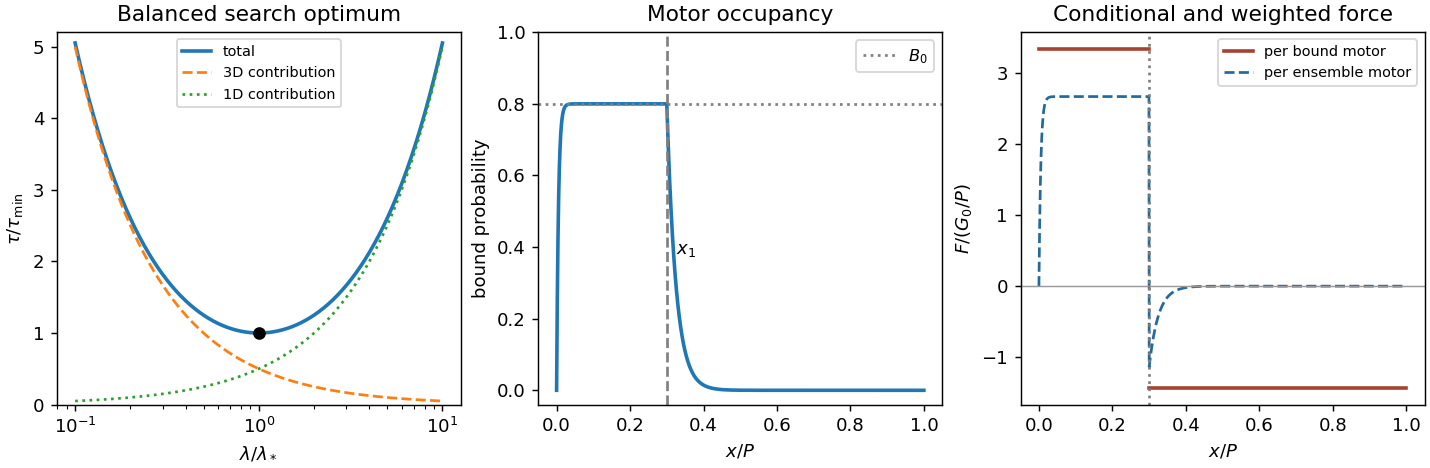
Take and the displayed potential energy to be the position-dependent mechanical free energy of a bound motor. On the descending ramp , and on the ascending ramp . Thus the force conditional on being bound isIt is periodic, piecewise constant and undefined at idealized sharp corners; the corners have zero measure in averages. An unbound motor has zero force.
A cohort transported through position obeys . Its bound probability therefore satisfiesDefine , , , and . The exact periodic steady state includes a small carry-over :These expressions follow by solving each first-order ordinary differential equation, requiring continuity at , and imposing periodicity.
The stipulated implies , so the incoming bound fraction is exponentially small. Dropping it gives the simpler intended formsThe occupancy rises towards on the binding interval, then decays over length outside it. The mean force per member of the full ensemble at a given position is , distinct from the force per bound motor. The right panels of c show both the occupancy and the conditional force.
For a uniform distribution of phases along one period, average the ensemble force :Using the negligible-carry-over form in b givesConsequentlywhere . This is the printed expression to the accuracy justified by the velocity condition.
It is not an exact identity for the periodic problem at arbitrary . Keeping instead givesFor a concrete counterexample outside the small-velocity approximation, choose and . Then the exact periodic value is about , whereas the printed reset expression is about . The discrepancy is due to nonzero incoming occupancy, not an integration sign change.
As , both and diverge, and both formulas giveThe bound population occupies the downhill binding region, while occupancy on the uphill region is confined to a vanishing boundary layer. A nonzero limiting stall force is compatible with zero mechanical power . The spatially restricted binding and uniform unbinding do not obey local detailed balance for this sawtooth free energy: a passive equilibrium model would require to reflect the local energy difference and not vanish on an interval of finite energy. This is a driven or prescribed-kinetics motor model; the equilibrium relation in a cannot be imposed on it without an energy supply and additional states.
Write the end-to-end random vector as , with independent isotropically distributed unit vectors. At zero applied force, , , and for independence gives . ThereforeHere “size” is the root mean square end-to-end distance of a polymer chain. It is not the magnitude of the mean random vector, which is zero, nor the mean distance . In the long-chain Gaussian limit of the end-to-end distribution of a freely jointed chain, , illustrating why these definitions cannot be interchanged.
Each Cartesian component of one link has zero mean and variance , with zero cross-component covariance. By the multivariate central limit theorem, for large on the coil scale the vector probability density isIt is normalized with respect to ; the radial probability density is . The Gaussian limit of the end-to-end distribution of a freely jointed chain is an approximation, not the exact finite- law near .
At prescribed vector separation the configurational entropy is . The ideal chain has no extension-dependent internal energy, so its Helmholtz free energy isThe externally required force is , while the chain's restoring force has the opposite sign. ThusThe last equation also follows by multiplying by the Boltzmann factor and completing the square. This entropic spring resists extension because fewer link configurations realize a stretched chain. At the same small applied force, increasing temperature reduces extension; at the same extension it increases the required force. Do not differentiate to obtain the fixed-vector Hooke law, since that radial measure includes an additional geometric multiplicity. The low-force condition is , equivalently .
In atomic force microscopy, one end of the polyacrylic acid chain is attached to the substrate and the other to a compliant cantilever tip. Controlled separation displaces the cantilever; calibrated cantilever stiffness converts its deflection into force. The molecular extension is the tip–surface separation after correcting for cantilever deflection and instrumental offsets. A quasi-static interpretation requires relaxation to be fast compared with the pulling motion.
At low force a coiled polymer has many available configurations and extends mainly by changing segment orientations. This is the entropic spring regime. As the available contour is aligned, the loss of configurational entropy becomes steep. For an inextensible three-dimensional freely jointed chain,where is the Langevin function. The limiting extension is the polymer contour length ; the ideal model approaches it only as . Real polymer backbone stretching permits extension beyond the fitted rigid-link contour, explaining why the experimental curve lies on the more extensible side at high force.
The original trace has a sharp force drop after its peak. Finite contour length explains the steep preceding rise, but does not itself cause that drop: release of an attachment, desorption or mechanical failure ends tensile loading. The graph alone does not distinguish these possibilities. If the intact chain is released from tension, thermal motion restores a coil with characteristic end-to-end distance of a polymer chain of order , because this macrostate has many more configurations. Recoil is reversible for an intact equilibrating chain; irreversible chain scission or attachment loss can prevent repetition of the same pulling curve.
Identifying the fitted limiting extension with the polymer contour length givesThese are statistical links of the freely jointed chain, not necessarily chemical polymer repeat units. A measured maximum just before detachment need not equal the true contour length exactly, so the identification is itself an estimate.
The stated temperature request mixes two distinct quantities. At unchanged and , the true freely jointed chain maximum is geometric:In contrast, the low-force relation predicts a ratio at the same small force, not a new maximum:Formally multiplying by this ratio gives about , but is outside the small-extension domain, so that is not a justified maximum-extension prediction. A concrete internally consistent counterexample uses the same chain at : the low-force extensions are about and , while both contour lengths remain . Any temperature dependence of the segment length, solvent interactions, attachment strength or rupture force needs information absent from the model.
The rigid-link freely jointed chain stores extension entirely in orientation. It predicts and a divergent force as that limit is approached. Real chemical bonds and bond angles can deform, adding energetic compliance. This permits the measured chain to stretch farther at the same large force and removes the rigid-link vertical asymptote over the experimentally accessible range. Other limitations include segment correlations, solvent effects and eventual failure; a fit alone does not isolate their contributions.
Introduce one axial stretch modulus with units of force. A useful phenomenological extensible freely jointed chain law adds a linear strain contribution:Equivalently, if each aligned segment is a spring of stiffness in force per length, and the additional extension is . At high force, ; the extra term supplies finite axial compliance. At small force, the compliances add: .
This additive law is a simple requested one-term modification, rather than an exact angular average for harmonic links. Another common approximation is , which couples stretching to orientation. Neither should be extrapolated through bond rupture or claimed to predict a universal finite maximum for an extensible chain. A positive fitted could improve the high-force extension while leaving the entropic part largely intact.
Position from many photons. An isolated fluorophore produces a diffraction-broadened point spread function, but its unknown center can be inferred much more precisely than the width of that function. Fit a calibrated two-dimensional Gaussian function plus background to the detected photon positions or pixel intensities. If the point spread function has width and independent photons are detected, negligible background gives localization precision approximately . Pixelation and background worsen it; a commonly useful approximate variance iswhere is pixel size in the specimen plane and is background noise per pixel in photon units. Bright, isolated emitters can therefore have nanometre localization precision despite a spot hundreds of nanometres wide. Stage drift, finite exposure motion, incorrect fitting, label displacement and photobleaching can dominate the photon limit.[ref]
Precise nanometer localization analysis for individual fluorescent probes by Russell E. Thompson and others. Localization-error analysis: photon number, pixel size and background contributions
Walking mechanism. Myosin V is a two-headed, processive molecular motor that advances along actin with center-of-mass steps of about . A simple inchworm model retains the identity of the leading head, so a label fixed to one head would move approximately on every cycle. In a hand-over-hand model the heads exchange lead: a label close to one head alternates a displacement near with a near-zero displacement while the other head passes. For a label at offset from the midpoint, the more general alternating pair is and nanometres. The pair sums to ; individual steps need not always equal .
Single-label imaging records a moving spot on a camera while the motor travels along surface-associated actin. Fitting the spot in successive frames resolves plateaus and jumps much smaller than the diffraction width. The observed alternating displacements distinguish a passing-head mechanism from uniform inchworm steps. This experiment combines a specific geometric prediction with single-molecule fluorescence microscopy; the center-of-mass stride alone would not make that distinction.[ref]
Myosin V Walks Hand-Over-Hand: Single Fluorophore Imaging with 1.5-nm Localization by Ahmet Yildiz and others. Science 300, pp. 2061–2065: single-label tracking, 1.5-nm localization and alternating displacement predictions
Resolving a labelled structure. Accurate localization of one emitter does not automatically resolve two simultaneously overlapping emitters. Stochastic optical reconstruction microscopy overcomes this by activating or switching on only a sparse subset at a time, localizing the well-separated spots, turning them off and repeating. The accumulated coordinates reconstruct a densely labelled structure at scales below the diffraction limit. The original demonstration used repeated photoswitching and localization of individual dyes to reconstruct subdiffraction features.[ref]
Sub-diffraction-limit imaging by stochastic optical reconstruction microscopy (STORM) by Michael J. Rust and others. Nature Methods 3, pp. 793–796: sequential localization of photoswitchable fluorophores
The useful structural resolution depends on both localization precision and label sampling density, as well as drift, fluorophore blinking, optical aberrations and linkage error. Sparse activation separates emitters in time; it does not shrink the diffraction-limited point spread function. A reconstructed image must have enough independent labels to represent its finest claimed feature.
An ionic atmosphere. A negatively charged molecule attracts positive counterions and repels negative co-ions; signs reverse for a positive molecule. The resulting electric double layer partially screens the bare electric field. Far from an isolated molecule, the electrolyte recovers its neutral bulk composition. At thermodynamic equilibrium, spatial uniformity of each species' electrochemical potential requiresThe logarithm implicitly uses a common reference density. This result for Boltzmann ion densities in a symmetric electrolyte neglects ion correlations, finite size and nonideal activities, but shows immediately why equal concentrations of the two signs do not persist close to a charged surface.
Self-consistent screening. Insert these densities into Poisson's equation, with solvent permittivity and fixed charge density :This is the Poisson-Boltzmann equation. For a symmetric monovalent salt with bulk density of each sign, outside the fixed charge it becomesFor , linearizing and using bulk neutrality gives the Debye–Hückel approximationThus added salt shortens the Debye length: electrostatic screening becomes stronger over a shorter distance. The factor of two in a salt comes from two ionic species, not from double-counting the density of salt pairs.
For example, a charged sphere of radius and total charge has the exterior linearized solutionassuming fixed uniform surface charge and no ions inside. It follows from the decaying spherical solution and . At zero salt it reduces to the Coulomb potential; at finite salt it decays exponentially as well as geometrically. The excess mobile charge integrates to in an infinite neutralizing reservoir, although a finite sphere surrounding the molecule generally contains only part of that ionic atmosphere.
Biophysical scales and limitations. In water at room temperature, the monovalent formula is approximately , with the ionic strength. It gives about at and at . Consequently the same charged protein can exert very different long-range interactions mediated by electrostatics at different salt concentrations. Close to strongly charged DNA, the linear approximation fails; nonlinear screening, counterion condensation, ion-specific adsorption and changes of surface ionization through charge regulation may matter. Mean-field theory also misses strong multivalent-ion correlations and finite-size saturation: the exponential law cannot be extrapolated to arbitrarily large near-surface concentrations.
An ion channel can disturb cellular electrical activity by changing unitary electrical conductance, open probability, gating kinetics or the number delivered to the cell membrane. A useful organizing relation isHere outward electric current is positive. Altering one channel's biophysical behavior changes the balance governing membrane potential and hence the timing or recurrence of action potentials.
Long QT syndrome, type 3. Certain disease-associated SCN5A variants impair fast ion-channel inactivation of the cardiac voltage-gated sodium channel NaV1.5. Instead of vanishing promptly after the upstroke, a small persistent inward sodium electric current remains during the plateau and repolarization. Because in this phase, the residual electric current is inward and opposes the outward electric currents that would terminate the cardiac action potential. The ventricular action potential lasts longer, extending the QT interval on the electrocardiogram. Excessively prolonged or uneven repolarization permits early afterdepolarizations and dangerous ventricular rhythm disturbances.
Genetic association identifies the channel, while voltage clamp distinguishes defective ion-channel inactivation from a mere increase in channel abundance. Recordings of disease-associated channels show persistent or bursting openings; coupling measured mutant sodium electric current into an otherwise modeled cardiac membrane through dynamic clamp tests whether that kinetic defect prolongs the action potential. The phenotype is variant-specific: not every SCN5A variant increases late electric current or causes long QT syndrome.[ref]
Cardiac sodium channel mutations in patients with long QT syndrome, an inherited cardiac arrhythmia by Qing Wang and others. Human Molecular Genetics 4, pp. 1603–1607: familial variants affecting the inactivation machinery
[ref]Long-QT syndrome-related sodium channel mutations probed by the dynamic action potential clamp technique by Géza Berecki and others. Measured mutant-channel currents coupled to a ventricular-cell model test action-potential prolongation
Myotonia congenita. CLCN1 encodes the skeletal-muscle ClC-1 chloride channel, which normally supplies a large resting stabilizing electrical conductance. Because the chloride reversal potential is near the resting membrane potential, that pathway resists small depolarizing disturbances. Loss of functional channels, reduced electrical conductance, or a shift in opening toward more positive membrane potential reduces the resting electrical shunt. Potassium accumulation in the transverse-tubule space during activity can then produce larger depolarizing afterpotentials and trigger further muscle action potentials after the intended stimulus has ceased. Continued electrical firing sustains contraction and delays relaxation: this is myotonia, rather than a primary inability of the contractile apparatus to relax.
Patient-family linkage and variant analysis connect the disease to ClC-1. Functional recordings of disease-associated channels demonstrate shifted voltage dependence and reduced availability near resting membrane potential; single-channel and noise measurements also resolve two conductive protopores and their gating behavior. Different variants can act through different mechanisms, so a gating shift is an example rather than an explanation of every case.[ref]
The skeletal muscle chloride channel in dominant and recessive human myotonia by Manuela C. Koch and others. Science 257, pp. 797–800: familial disease linked to the muscle chloride-channel gene
[ref]Mutations in dominant human myotonia congenita drastically alter the voltage dependence of the ClC-1 chloride channel by Michael Pusch and others. Neuron 15, pp. 1455–1463: disease-associated changes in voltage dependence
[ref]The muscle chloride channel ClC-1 has a double-barreled appearance that is differentially affected in dominant and recessive myotonia by Caterina Saviane and others. Single-channel and fluctuation analysis of ClC-1 and myotonia-associated gating changes
These examples connect contrasting current defects to their consequences: persistent inward sodium electric current prolongs cardiac action potentials, whereas loss of stabilizing resting chloride electrical conductance permits repetitive skeletal-muscle action potentials. Both causal chains require functional channel measurements in addition to a disease-associated sequence change.
The source bundle's filename says 2020, but the paper's cover identifies Trinity Term 2021, C7, A11050W1. All optional answers are included. The unavailable figure in a is explicitly distinguished from deductions supported by the surviving text.
At the initial negative membrane potential, most voltage-gated potassium channels have a closed activation gate. Depolarization moves charged residues in each voltage-sensing domain, particularly the S4 helices, through the electric field. Coupling between the voltage-sensing domains and the pore opens the intracellular gate. A classical voltage-gated potassium channel has four subunits, each with six transmembrane helices; S5, the pore loop and S6 contribute to the central pathway and selectivity filter. The rising open probability produces increasing outward potassium electric current, since the imposed positive membrane potential is above the potassium Nernst equilibrium potential. Here outward electric current is positive: , where is channel number and is single-channel electrical conductance.
The electric current subsequently falls because the rapidly inactivating Shaker form exhibits ball-and-chain inactivation. An intracellular N-terminal domain, tethered to the channel, blocks the open pore. The ion channel can therefore stop conducting while the membrane potential remains depolarized and the activation machinery remains activated. This is ion-channel inactivation, rather than reversal of the voltage step, loss of the ionic driving force, or ordinary gate closure. Repolarization favors removal of the block and recovery of channel availability. Slower C-type inactivation involving the outer pore can coexist, but is not the principal explanation of the rapid decay described here.
Several independent observations connect this functional explanation to structure. Small transient gating electric currents report movement of sensor electric charge before ionic conduction; charge-neutralization studies of S4/S2 change the measured gating charge and activation. Structural studies resolve separate sensor and pore regions.[ref]
Voltage-sensing residues in the S2 and S4 segments of the Shaker K+ channel by S. A. Seoh and others. Gating-charge measurements identify voltage-sensing residues
[ref]Crystal structure of a mammalian voltage-dependent Shaker family K+ channel by Stephen B. Long and others. Voltage-sensor and pore architecture of Kv1.2
Historical N-terminal removal abolished rapid ion-channel inactivation while preserving activation, and the corresponding free peptide restored block from the cytoplasmic side. These results separate the activation gate from the tethered blocker and identify which side of the cell membrane contains the blocking domain.[ref]Biophysical and molecular mechanisms of Shaker potassium channel inactivation by Toshinori Hoshi and others. N-terminal perturbations distinguish rapid inactivation from activation
[ref]Restoration of inactivation in mutants of Shaker potassium channels by a peptide derived from ShB by William N. Zagotta and others. Cytoplasmic peptide restores inactivation to channels lacking the native N-terminal domain
Source-gap TODO: the supplied PDF's figure invokes an undefined image object, so its actual pulse duration, pulse sequence, current scale, peak amplitude, decay time and any tail-current waveform cannot be read. The account above uses only the stated change from to and the stated rise and rapid decay; no numerical kinetic fit or reconstruction of the missing trace is claimed.
For two-state ion-channel gating, write . Gain minus loss of open probability gives the ordinary differential equationThus the ratio of the transition rates determines the final open probability, while their sum determines the response speed. Both given channels have . For an initially closed population, with measured in milliseconds,The mean individual open and closed lifetimes are and : both are for A and for B. With the same channel number, single-channel electrical conductance and driving force, the steady macroscopic electric currents are equal, but B reaches that value ten times faster. If both populations were already at , neither would show a mean relaxation under these fixed rates: a response also requires an initial condition or a change in rates.
The stationary variance of the number open is for independent channels. Its autocovariance is , so B's fluctuations decorrelate ten times faster even though their instantaneous variance is unchanged. Faster gating allows an ion channel population to follow a brief stimulus and contribute to rapid action potential timing. Slower gating integrates over brief changes and can provide a delayed opposing electric current, useful in setting action potential duration or frequency selectivity. Those examples describe consequences of kinetics; the stipulated voltage-independent rates alone do not define a complete excitable neuron.
Add a nonconducting inactivated state to the continuous-time Markov chain:For example, and . Depolarization first increases , then transfers population into by ball-and-chain inactivation. A small recovery rate during the pulse permits a sustained decline of . Repolarization favors recovery, eventually restoring the closed but available population. Several sequential closed states can represent the cooperative movements of four voltage-sensing domains; three states are the minimal explanation of rise followed by decay, rather than a quantitative fit to the missing trace.
Loss of outward potassium electric current weakens repolarization and can broaden an action potential. Reduced residual potassium electrical conductance can reduce the subsequent hyperpolarization and permit faster repeated firing. Conversely, prolonged depolarization can maintain sodium ion-channel inactivation, delay recovery and lower the maximum firing frequency or cause depolarization block. The sign of the frequency change depends on the other ion channels and recovery kinetics; rapid potassium ion-channel inactivation alone does not fix it.
The passive upper limiting membrane potential for a purely sodium-selective pathway is its Nernst equilibrium potential. Equal inside and outside electrochemical potentials, using ideal concentrations, requireThis is the maximum absolute inside-minus-outside voltage under the stated passive assumptions. If the reference resting membrane potential is , the corresponding increase is about .
Actual action potentials usually peak below because voltage-gated sodium channels undergo ion-channel inactivation, while outward potassium and leak electric currents oppose inward sodium electric current. Finite membrane capacitance and finite available time also prevent instantaneous equilibration. At , the sodium driving force itself is zero.
Use the logic approximation for gene regulation, zero basal production and initially vanishing X, Y and Z. Let , , and assume the activated Q level exceeds the X activation threshold. The circuit combines a coherent feed-forward loop with negative autoregulation. While X is below its self-repression threshold it obeys , hence X first crosses atY production begins then. While X remains above , . The AND gate for Z first becomes active when Y reaches , soThe approximation drops the short X build-up time because . Strictly the input must last longer than this onset time to produce a nonzero amount of Z. This requires : at equality the threshold is approached only asymptotically, and below it Z never switches on. No numerical delay follows without the threshold-to-production ratio.
In the strong negative autoregulation limit, X is held close to ; a smooth repression law regularizes the rapid switching of the ideal Boolean rule. After the input disappears at , production of X stops and . It takes for X to fall below . Until then Y remains at and the Z AND gate stays on, so Z stays at . After that Z decays by dilution, taking another to halve. ThereforeMore generally replace the first by . This distinguishes disappearance of the external ligand from disappearance of the persistent X transcription factor.
Put , and . Saturated CheR supplies a constant receptor methylation flux, while CheB removes it with Michaelis-Menten kinetics:At a finite steady state, , givingIt requires and below the total available receptor pool. The steady state is stable because . If , the ideal equation has no finite positive steady state; actual methylatable sites would become exhausted.
Attractant binding reduces receptor signalling, reducing CheA-dependent phosphorylation of CheY and initially reducing tumbling frequency, so smooth runs become longer. A spatially uniform stimulus provides no preferred direction. Perfect adaptation means that after this transient the tumbling frequency returns exactly to its pre-step value despite continued attractant presence.
The equation above alone does not specify attractant occupancy or its influence on activity. If binding simply changes activity from to with , without changing either modifying flux, remains and the output remains : there is no adaptation. Thus the usual fall followed by recovery requires the additional feedback mechanism developed in c or d, rather than following from the stated Michaelis-Menten kinetics alone.
Let attractant reduce signalling activity per methylated receptor by a factor , so the output is . Before stimulation take and . Perfect adaptation requires the final methylated receptor concentration . With , the new steady state condition isEquivalently . Since , this reduces demethylation relative to the initial condition. Immediately after binding, activity and tumbling fall. The excess CheR flux then increases receptor methylation, compensating the activity loss until . The methylated population must have sufficient remaining capacity to reach .
Increasing CheR concentration raises and the baseline activity; increasing CheB concentration raises and lowers it. If the attractant-dependent ratio remains fixed after such a change, the new pre- and post-step outputs areTheir equality requires . Thus a ratio tuned for one generally loses perfect adaptation when either enzyme level changes independently. For a concrete example, initially and require ; changing to requires , so keeping fails. Proportionally scaling both enzyme levels preserves the ratio and the adaptation condition, while changing response speed. This is fine tuning, rather than robust perfect adaptation.
In the simplified Barkai-Leibler model, let be the total methylated receptor concentration and the active, unoccupied part. Ligand-bound methylated receptors contribute zero activity. Because CheB acts only on active receptors,At a finite steady state,The output is independent of attractant concentration : attractant changes the necessary receptor methylation level, while the flux balance fixes activity. This proves perfect adaptation for , and enough methylatable receptors. At fixed , , so this steady state is locally stable. If every receptor is permanently bound, , or if the required exceeds the available pool, compensation fails.
This feedback couples demethylation directly to the output. Lower activity lowers demethylation; continuing CheR action restores it. The structural dependence on active receptors removes the separate adjustment of required in c.[ref]
Robustness in simple biochemical networks by Naama Barkai and Stanislas Leibler. Figure 1b and equation 1: saturated modifying flux and output-dependent reverse modification
Changing CheR or CheB concentration changes and hence the baseline tumbling frequency, but the output still returns to that new baseline after an attractant step within the operating range. Raising CheR raises ; raising CheB lowers it. Adaptation time also changes: linearization gives . Thus robustness of the return property does not mean an invariant tumbling frequency or response time across different enzyme abundances.
If CheR instead has Michaelis-Menten kinetics on the unmethylated pool , its flux is . ThenThe left side depends on ligand through , even at fixed output ; consequently the equilibrium output generally depends on attractant and perfect adaptation is lost. It is recovered approximately when throughout the response, so the CheR flux is effectively saturated.
Dense DNA packaging opposes three main physical effects. The negatively charged DNA backbones repel through electrostatic interactions, moderated by electrostatic screening and counterion condensation. At close approach, hydration forces and excluded volume become important. Bending a semiflexible DNA polymer on a radius comparable with its persistence length stores elastic energy. Confinement also removes configurational entropy, and concentrating mobile counterions can impose an additional osmotic pressure and free energy cost. Their relative importance depends on geometry and ionic conditions.
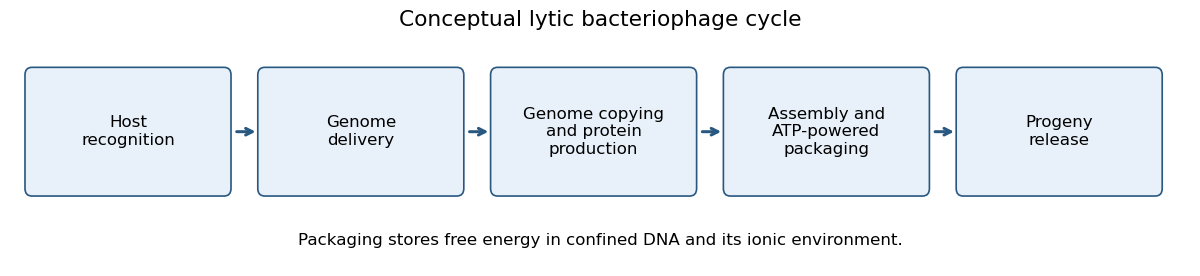
Conceptual lytic bacteriophage cycle and active DNA packaging
. Details. 
In many double-stranded DNA bacteriophages, a portal-associated molecular motor uses ATP hydrolysis to move DNA into a preformed capsid. Chemical free energy pays for bending, repulsion and confinement, so the opposing force rises as filling proceeds. This is active packaging rather than spontaneous equilibrium compaction. Optical tweezers can infer that opposing force from displacement of a trapped bead and monitor packaging through the changing external DNA extension. Such measurements establish the mechanical principle without requiring any virus-handling procedure. The inverse spool model used below is an idealized packing geometry, not an exact structural claim for every bacteriophage.
For an inextensible worm-like chain, the DNA bending energy iswhere is curvature and is polymer contour length. A circle of radius has and length . Its elastic energy is therefore . Adding the contributions of rings at each radius givesThis ignores short connecting segments, twist, interactions between neighboring DNA segments and end effects. In a cylindrical stack with axial spacing , away from the ends.
Correction of the printed limits: ordinary positive polymer contour length requires integration from to , because and the ring count is positive. For example, taking , and makes the printed outward-to-inward integral negative. Thus its sign cannot be retained as a physical length.
For hexagonally packed strands choose axial ring spacing and radial layer spacing . With and radial layer density ,The same continuum replacement in b givesEliminating the inner radius yieldsThe resisting packaging force is the marginal free energy per added polymer contour length, at fixed , and :The force opposing insertion is positive; its contribution to outward ejection has the same magnitude. The domain is . The divergence as the inner hole closes reflects the singular curvature of ideal rings and marks breakdown of the continuum model. If spacing also relaxes, the full free energy must include interstrand interactions before optimization; simply varying in this bending-only formula is insufficient.
The small binding RNA can serve conceptually as an RNA aptamer recognition probe. Coupling recognition to an optical label would make a specifically bound virus appear as a moving fluorescent spot. Single-particle tracking estimates successive spot positions and fits their displacement statistics. Specificity is assessed by comparison with a nonbinding recognition probe or a sample without the target, while the much faster diffusion of unbound probes distinguishes freely moving label from target-associated signal. Subnanomolar dissociation constant supports appreciable occupancy at low probe abundance, but affinity alone does not determine the dissociation lifetime because . This describes detection principles, not an operational virus preparation or labelling protocol.
For a dilute spherical particle of radius in bulk water, the Stokes–Einstein relation gives, at an explicitly assumed ,A free probe would have , roughly thirty times larger. The recognition probe changes the target's hydrodynamic size only modestly in this estimate.
For isotropic Brownian motion, the mean vector displacement is zero. In , distinct measures of how far it moves areA two-dimensional image instead gives projected root-mean-square displacement and mean projected distance . The projected mean squared displacement is ; independent localization errors of variance in each coordinate add . Finite exposure blurs motion, and nearby walls reduce diffusion; those effects must be separated from particle size when interpreting a trajectory.
The named bacteriophage, Bacillus virus phi29, infects Bacillus subtilis; the paper's identification of Escherichia coli as its host is incorrect. This correction does not alter the idealized geometry or numerical inputs used below.[ref]
The stipulated DNA volume is and the spherical capsid volume is . ThusThe packed DNA occupies a substantial fraction of the available space: the remaining nominal fraction is . Compared with the paper's stated reference, it reaches about of that value. This indicates dense confinement, but does not prove crystalline order or specify interstrand spacing. DNA is a connected elongated polymer, rather than a collection of independent hard spheres.
There is also a numerical qualification: the exact densest equal-sphere packing fraction is , not . Using it changes the comparison to about without changing the calculated volume fraction or its physical interpretation.
The polymer contour length and magnitude of total electric charge areUse a uniform charged-sphere model for the packed DNA, a homogeneous dielectric with , and initially neglect electrostatic screening. Gauss's law gives inside the sphere and outside. Integrating the electrostatic energy both inside and outside,For an illustrative aqueous relative permittivity and ,The question does not specify permittivity; the result scales as . Using vacuum instead would increase it eightyfold and would not describe an aqueous interior.
Strictly, the work of packaging is a difference of electrostatic energies, rather than the packed self-energy alone. An extended charged rod also has self-energy. With a microscopic cutoff of order the DNA radius, the thin-rod approximation isOne derivation integrates the pair Coulomb potential along the rod, replacing separation by : the exact regularized expression is . The diagram's transverse label suggests , giving . Hence this explicit reference-state estimate is . The cutoff and precise initial conformation are additional model assumptions, but their correction is small compared with the unscreened sphere value.
The bare packed-sphere estimate exceeds by approximately ; subtracting the estimated extended-rod self-energy still leaves a factor of about . The dominant missing effect is electrostatic screening: mobile positive counterions accompany the negatively charged DNA, greatly reducing long-range repulsion. Counterion condensation can further reduce its effective electric charge. Treating the genome's bare charge as uncompensated throughout and outside a sphere therefore grossly overestimates its long-range electrostatic energy.
An optical tweezers measurement integrates an imposed force over a displacement. A reversible extraction or packaging comparison concerns a free energy difference relative to the unconfined DNA and ionic reservoirs. It can include entropy, bending and hydration contributions; dissipative pulling can add further work. Extraction can also be assisted by stored internal free energy, so the sign of externally supplied work requires the experimental convention. Here the supplied positive value is compared as an energy magnitude.
Adding monovalent counterions makes the combined genome-plus-ion electric charge nominally zero. It does not make the local electric field or free energy vanish: opposite charges have spatial distributions, and confining mobile ions costs entropy.
A definite screened continuation of b replaces the bare Coulomb potential by , with and . In the Debye–Hückel approximation, a uniformly distributed fixed charge density satisfies inside, with zero fixed charge outside and matching potential and radial field at . Its interior solution isThe screened charging free energy is thereforeFor , the bracket approaches one: only charges within roughly a screening length contribute appreciably, yielding the local estimate . With the same as before, gives bracket andabout times smaller than the unscreened packed-sphere self-energy. This is a specified continuum estimate of packed-state charging free energy; a full packaging free energy also subtracts the screened unpacked reference and includes ion redistribution. It should not be presented as a unique exact packaging work fixed by the problem's few inputs.
The supplied counterion count also permits an independent estimate of the entropic contribution. For ideal confined ions, , so compression from an accessible reference volume to costsFor example, approximate the original screening atmosphere as an annulus of thickness around a rod. With , . Taking gives . This useful order-of-magnitude ion-entropy model is distinct from the screened charging model; the two estimates must not simply be added as independent terms without a consistent ionic free energy functional. The rod cutoff, fixed DNA volume and screening-atmosphere geometry are rough geometric assumptions, not a microscopic reconstruction of the source sketch.
There is a further consistency limit. The nominal ion number density is . For a uniform ideal monovalent screening gas, would give at , rather than ; added salt would shorten it further. Thus the stated ion inventory and screening length cannot both be interpreted as a self-consistent dilute uniform screening gas with this dielectric. Bound counterions, nonuniform distributions and an effective phenomenological screening length can change that interpretation. Linear screening is itself only an estimate near highly charged DNA.
The specified screened-sphere charging model gives , about times the supplied experimental magnitude. It is much closer than the unscreened result. The separate ideal counterion-compression estimate gives , within about of that magnitude, but this numerical proximity does not validate its rough geometry.
Remaining differences can arise from the unpacked reference self-energy, counterion condensation, ion exchange with the surrounding reservoir, nonuniform charge density, nonlinear electrostatic screening, finite DNA thickness and the actual capsid shape. DNA bending energy, hydration forces and configurational entropy also contribute. The experiment measures a process-dependent work or inferred free energy, whereas the simple screened sphere computes just one model contribution. Neither a zero-net-charge argument nor agreement of one approximate number establishes an exact total energy.
For ideal freely mobile counterions, their gross osmotic pressure isIf the DNA volume is excluded from the ion-accessible volume, use instead, giving . These are ideal-ion estimates; bound counterions contribute less like independent mobile particles, and the net outward osmotic pressure also subtracts the external osmotic contribution.
Stored free energy associated with this pressure, together with bending and interstrand repulsion, can favor initial genome release when a delivery pathway becomes available. This explains a possible mechanical benefit of dense packaging at a conceptual level. It does not imply that internal pressure necessarily supplies all the work of complete genome delivery into a host, whose own environment and interactions also matter.
A major source of ATP is chemiosmosis: an electron transport chain uses downhill electron transfer to establish a proton-motive force, and ATP synthase converts that electrochemical gradient into ATP formation. In aerobic oxidative phosphorylation, reduced carriers supply electrons, ultimately reducing oxygen to water; selected respiratory complexes couple the favorable oxidation-reduction reaction to uphill proton translocation. In a mitochondrion, this takes place across the inner membrane, creating a relatively positive, acidic exterior side and a relatively negative, alkaline matrix. Bacteria use their cell membrane. In photosynthetic systems, light-driven electron transfer can supply the gradient instead. Substrate-level phosphorylation is another ATP-producing route, so the description is not universal to every organism and condition.
The membrane region of ATP synthase contains a rotating ring of c-subunits next to subunit a. Two offset aqueous half-channels expose the ring's proton-binding sites to opposite membrane sides. Proton binding and release bias ring rotation down the electrochemical gradient. The central shaft transfers torque to the catalytic head, while a peripheral stator prevents the head from simply co-rotating. This is the ATP synthase rotary mechanism, rather than unrestricted proton leakage through a pore.
The three catalytic beta subunits cycle through different binding states as the shaft turns: ADP and inorganic phosphate bind, bound ATP is favored, then ATP is released. The binding-change mechanism uses mechanical work to alter binding affinities and product release as well as the chemical step. A full coupled revolution produces three ATP molecules; a ring with c-subunits transfers approximately protons per revolution in the tightly coupled model, or per ATP.[ref]
Structure of a bacterial ATP synthase by Hui Guo and others. Proton-translocation half-channels and rotor architecture
[ref]The overall cycle must have a favorable Gibbs free energy change. If the proton-motive force becomes too small, synthesis stops; under suitable conditions the same molecular motor can reverse, using ATP hydrolysis to pump protons uphill. A catalyst changes kinetics, not the thermodynamic condition for synthesis.
Articles were limited to the first 100 out of 426 total.
Articles by others on the same topic
There are currently no matching articles.