For the supporting inequality, assume first that is convex and fix . For ,Subtract , divide by and let . Differentiability givesConversely assume this inequality for every pair. Put and apply it with base point to both and . Multiply those two inequalities by and and add. The gradient terms cancel, proving . Thus the supporting inequality characterizes a differentiable convex function.
For the integral inequality let . Apply the supporting inequality at to and integrate. Its affine term has integral , yieldingThis is Jensen's inequality. Since is integrable, the supporting affine lower bound has integrable negative part, so the right side is well-defined as an extended real integral. If its positive part is infinite, the inequality remains valid.
A convex function satisfiesIts value on a line segment never lies above the chord joining its endpoint values.
A strictly convex function satisfies the strict inequalityEndpoint and coincident-point cases are excluded because they necessarily give equality.
A global minimizer is an admissible function for whichEquivalently it attains the infimum over the whole admissible class. Its endpoint traces must equal the prescribed boundary values; comparing only with nearby functions would define a local rather than a global notion.
The integrand is nonnegative, so . For each positive integer , setThis is a continuous piecewise affine sawtooth with zero endpoints, , and almost everywhere. It belongs to , and almost everywhere. ThereforeTogether with nonnegativity this proves . The functions converge uniformly to zero while their derivatives retain magnitude two; small amplitude does not force small gradient.
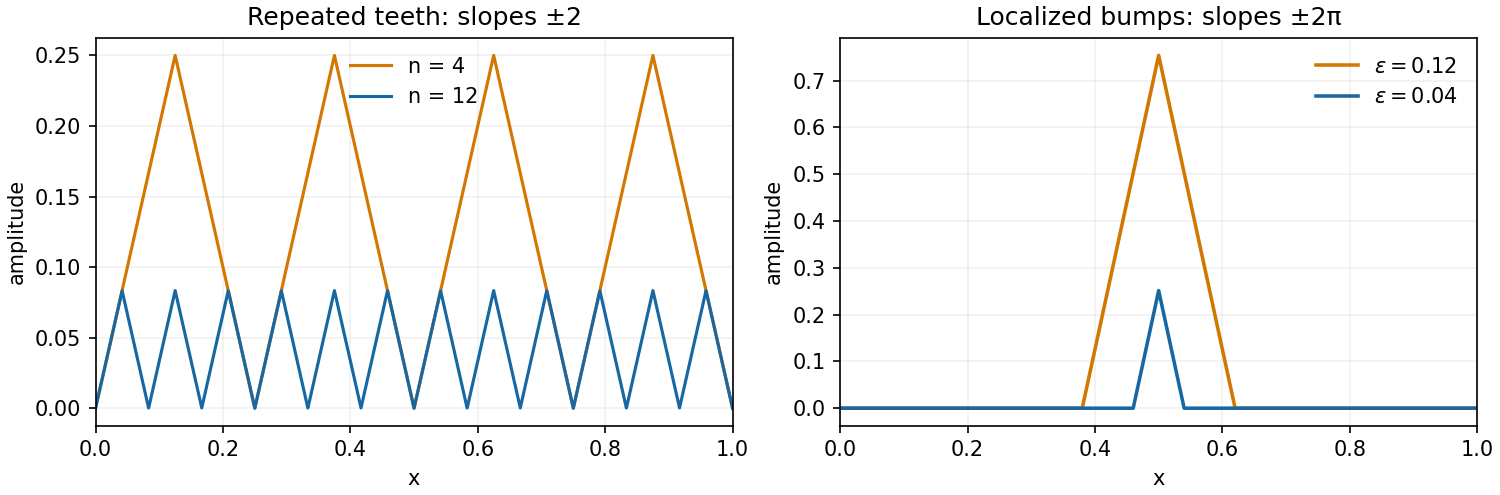
Uniformly small competitors can retain fixed nonzero slopes: repeated teeth and a shrinking localized bump
. Details. 
If an admissible attained the infimum zero, each nonnegative term of its integrand would vanish almost everywhere. In particular almost everywhere, so in its Sobolev space and its weak derivative is zero. But then the remaining term is almost everywhere, giving , a contradiction. Thus the infimum is zero but no global minimizer exists. The oscillatory sequence has no convergence of derivatives compatible with substitution into this nonconvex energy.
Articles by others on the same topic
There are currently no matching articles.