Original solutions to the paper released at the source request. The complete editable transcription is retained in the private examination archive.
For the supporting inequality, assume first that is convex and fix . For ,Subtract , divide by and let . Differentiability givesConversely assume this inequality for every pair. Put and apply it with base point to both and . Multiply those two inequalities by and and add. The gradient terms cancel, proving . Thus the supporting inequality characterizes a differentiable convex function.
For the integral inequality let . Apply the supporting inequality at to and integrate. Its affine term has integral , yieldingThis is Jensen's inequality. Since is integrable, the supporting affine lower bound has integrable negative part, so the right side is well-defined as an extended real integral. If its positive part is infinite, the inequality remains valid.
A convex function satisfiesIts value on a line segment never lies above the chord joining its endpoint values.
A strictly convex function satisfies the strict inequalityEndpoint and coincident-point cases are excluded because they necessarily give equality.
A global minimizer is an admissible function for whichEquivalently it attains the infimum over the whole admissible class. Its endpoint traces must equal the prescribed boundary values; comparing only with nearby functions would define a local rather than a global notion.
The integrand is nonnegative, so . For each positive integer , setThis is a continuous piecewise affine sawtooth with zero endpoints, , and almost everywhere. It belongs to , and almost everywhere. ThereforeTogether with nonnegativity this proves . The functions converge uniformly to zero while their derivatives retain magnitude two; small amplitude does not force small gradient.
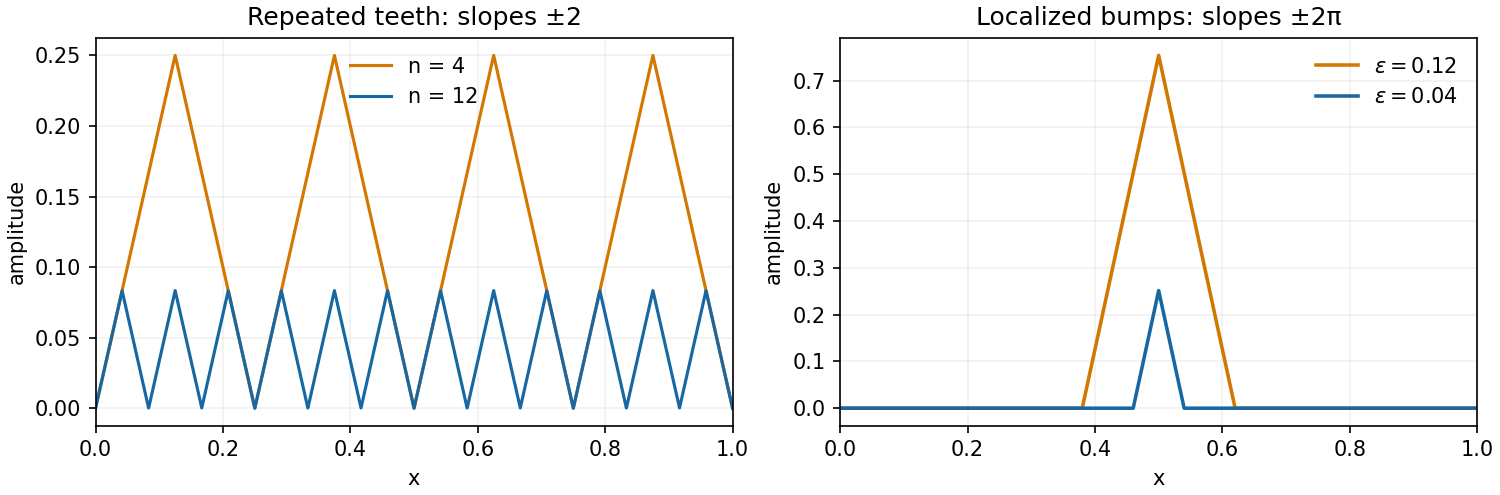
Uniformly small competitors can retain fixed nonzero slopes: repeated teeth and a shrinking localized bump
. Details. If an admissible attained the infimum zero, each nonnegative term of its integrand would vanish almost everywhere. In particular almost everywhere, so in its Sobolev space and its weak derivative is zero. But then the remaining term is almost everywhere, giving , a contradiction. Thus the infimum is zero but no global minimizer exists. The oscillatory sequence has no convergence of derivatives compatible with substitution into this nonconvex energy.
The variational terminology refers to the size of a neighborhood, rather than weak versus strong convergence in a Banach space. The definitions in the two numbered children giveThe second implication holds because smallness in implies smallness in the uniform norm. Reverse implications need not hold.
For differentiable in its slope variable, define the Weierstrass excess functionThe strengthened Weierstrass condition means that some givesIt requires support at nearby heights and nearby reference slopes, while the trial slope is arbitrary. Requiring this only exactly on the curve is the unstrengthened necessary condition.
A standard Weierstrass sufficient condition assumes the usual smoothness of , , the weak Euler-Lagrange equation, a coercively positive second variation, and the strengthened condition above. Explicitly, for some ,for zero-endpoint variations. Then is a strong local minimizer. If the excess is strictly positive for throughout the tube, the strong minimum is strict. The second-variation hypothesis supplies a neighboring field of extremals. Its slope gives the comparison identityfor uniformly close admissible . This explains how the condition controls competitors with large derivatives.
A weak local minimizer of a variational integral is an admissible for which there is such thatBoth the function and its first derivative must remain uniformly close, up to the almost-everywhere convention for the derivative.
A strong local minimizer of a variational integral is an admissible for which there is such thatThe competitor's derivative need not be close. This compares with a larger family of competitors, which is why it is the stronger minimality property.
For any zero-endpoint admissible , use and the sharp Poincaré inequality on :The coefficient is positive, and equality forces , hence by its endpoint values. ThusIt is therefore both a strict strong and a strict weak local minimizer.
Here . First restrict . On that slope interval, the second derivative of is . Taylor's theorem givesThe linear term integrates to zero because . Since , the Poincaré inequality yieldsThe coefficient is positive. Thus zero is a strict weak local minimizer.
For failure of strong minimality, take a triangular bump supported on , with slopes and , and zero outside. Its height is . Almost everywhere its slope is or , so the cosine term has exactly its zero-function value everywhere. The potential term is strictly negative on the bump. ThereforeHence it is not a strong local minimizer. The derivatives of these bumps stay large, so they do not contradict weak local minimality.
A scalar Tonelli existence theorem states: if is continuous, convex in , and has a uniform superlinear lower bound with , and at least one fixed-endpoint admissible absolutely continuous function has finite energy, then the energy attains its infimum in the fixed-endpoint class. One may take nonnegative and convex. The lower bound makes derivatives uniformly integrable; endpoint control then gives uniform compactness of a minimizing sequence, and convexity supplies the required lower semicontinuity.
For the specified functional, the integrand is continuous, nonnegative, and convex in the derivative, withThe affine function has the required endpoints and finite energy. Thus a global minimizer exists. In fact any finite-energy minimizer belongs to , since its derivative's 52nd power is integrable.
It is unique. The admissible class is convex, and the integrand is strictly convex in : and are strictly convex, with the latter multiplied by . If two distinct admissible finite-energy functions minimized the energy, their midpoint would have strictly smaller energy. Distinct continuous representatives differ on a set of positive measure, so the strict integral inequality really applies. This contradiction proves uniqueness.
In one dimension, has an absolutely continuous bounded representative. For any smooth zero-endpoint test function , the functions are admissible and arbitrarily close to for small . Local minimality forces the first variation to vanish. Differentiation under the integral is valid because are bounded and the derivative terms are integrable, giving the weak Euler-Lagrange equationIn distributional form this says . The fundamental theorem for weak derivatives, or the fundamental lemma applied after subtracting an antiderivative, gives a constant withThis is the integrated Euler-Lagrange equation. The boundary difference determinesThe weak identity extends to all zero-trace test functions by density.
The continuous representative of makes continuous on the closed interval. The integrated formula therefore gives a continuously differentiable representative of , and hence withDifferentiate once more. The right side is continuously differentiable because , andThus . These formulas give continuous one-sided derivatives at the endpoints as well. Repeated bootstrapping would actually give smoothness of every order.
A weak local minimizer of a variational integral is an admissible for which there is such thatThe Sobolev norm controls both the function and its first weak derivative. The boundary values remain fixed because both functions are admissible.
A strong local minimizer of a variational integral is an admissible for which some satisfiesOnly the function values must be close; admissible derivatives may be large. Every strong local minimizer is therefore also a weak local minimizer of a variational integral.
A point of convexity of is a point where its tangent line supports the entire graph from below:The Weierstrass necessary condition says that, at almost every , is a point of convexity of . In terms of the Weierstrass excess function,
Now use the stated derivative coercivity. If were not a local minimizer in , there would be with and . The energy bound givesThe common value controls their function norms as well, by . Thus is bounded in . The one-dimensional compact Sobolev embedding into supplies a uniformly convergent subsequence. Its limit must be , since the same subsequence converges to in . Eventually , contradicting strong local minimality. Hence is also a local minimizer in . This is coercivity transfers strong minimality to L1 minimality.
Zero is a strict weak local minimizer, but is not a strong local minimizer. Put . Since , the Cauchy-Schwarz inequality gives , and thereforeFor sufficiently small , pointwise. Hencewith equality only when . Thus zero is a strict weak local minimizer of a variational integral.
For the strong claim, define a Lipschitz triangular waveIt has zero endpoint values, , and almost everywhere. Thus , while is nonzero on a set of positive measure. ConsequentlyThese uniformly small competitors disprove the strong local minimizer of a variational integral property.
Zero is a strict strong local minimizer, and therefore also a strict weak local minimizer. Here , andFor , Taylor's theorem gives . Also and the Cauchy-Schwarz inequality give . ThereforeThe coefficient is positive. Thus every nonzero admissible with has strictly greater energy, proving that zero is a strict strong local minimizer of a variational integral.
For a fixed-endpoint variation , the second variation iswhere all coefficients are evaluated at . The notation means this is strictly positive for every nonzero admissible variation. This is pointwise positive definiteness of the quadratic form, not an assertion of a prescribed uniform lower bound.
PutAfter integration by parts, the form is . Its Jacobi equation isIn the regular case on , a conjugate point to is a point for which a nonzero solution satisfies . Equivalently it is a zero of the normalized solution with , .
Under this regular Strengthened Legendre condition, the Jacobi positivity criterion isThe endpoint must be excluded as a conjugate point too. To prove necessity, suppose a Jacobi solution vanishes at and . Define on and zero on . It is a nonzero Lipschitz admissible variation, anda contradiction. For completeness, the converse follows from the Jacobi identity for the second variation: when the normalized has no further zero,The boundary contribution vanishes, including the limit at since has a simple zero and . Equality forces , and with forces .
Independently of regularity, positivity necessarily implies the ordinary Legendre necessary condition . If on an interval, localized rapidly oscillating test functions have a negative derivative contribution of order frequency squared, dominating the bounded zero-order term. This contradicts positivity.
The assumptions stated here do not themselves impose . That strengthened condition is a regularity hypothesis for the familiar Jacobi criterion, and is not necessary for strict positivity: the integrand gives with . For a criterion covering the full possibly degenerate class, use Regularized Jacobi criterion for a degenerate second variation. The following conditions are necessary and sufficient:
- ;
- for every , the regular equation has no conjugate point to in ;
- the original weak Jacobi boundary problem has no nonzero Lipschitz solution with zero endpoint values.
These conditions are necessary because gives , so the regular criterion just proved applies; a weak Jacobi solution tested against itself would give . They are sufficient as well: the regular criterion gives for every , hence by letting . If , nonnegativity of for every real forces its mixed bilinear term to vanish for every test . This is precisely the weak Jacobi equation. The third condition then forces . Thus the criterion treats degeneracy without silently assuming the strengthened condition.
Here , and the Jacobi equation is . With and , its solution is for , and for . Its first positive zero is when .
If , no conjugate point occurs in . The Jacobi positivity criterion givesSince itself is this quadratic form divided by two, for every nonzero admissible . Thus zero is the unique global minimizer. This argument establishes the result before using the sharp Poincaré inequality.
Fix an admissible . The preceding result gives for every . Letting increase to provesEquality is attained byIndeed the derivative and function squared integrals are and . These are all equality cases: an equality function minimizes the nonnegative threshold quadratic form, so its first variation vanishes. The resulting weak equation makes smooth and, with the endpoint conditions, yields precisely these multiples. This is the Wirtinger inequality.
Use , which is admissible for every real . Direct integration givesThe coefficient is strictly negative, so the energy tends to minus infinity as . Therefore
The function has weak derivative and the required endpoint values, so it belongs to the admissible Sobolev space. Its fourth power is , and henceSince the integrand is nonnegative, zero is a global lower bound. Thus is a global minimizer. Its derivative does not belong to , since its power is proportional to ; positive regularization therefore needs different competitors.
A convenient form of the Tonelli existence theorem is: on a finite interval with prescribed endpoint values, if a continuous integrand is convex in and satisfies for some , then, provided a finite-energy admissible competitor exists, its integral attains a minimum in the corresponding class. The lower bound may more generally subtract an integrable function of . Compact one-dimensional Sobolev embedding controls , while convexity gives weak lower semicontinuity in the derivative.
Here and is continuous, convex in , and bounded below by . The competitor has finite energy. Thus for every the Tonelli existence theorem gives an admissible minimizer in .
Any finite-energy member of the larger stated class necessarily has derivative in and bounded function values by absolute continuity; it therefore belongs to . All other competitors have infinite energy. Hence the same function is a global minimizer in the full stated class.
The finite-energy comparison gives . Together with the endpoint value and absolute continuity, this proves .
For , the power competitor is admissible and has finite derivative energy. Direct integration givesChoose and . The first three terms tend to zero as , while the last equals . By minimality and nonnegativity,One also obtains the quantitative bound : for , the mean value theorem gives , and . Thus the squared mismatch is at most , matching the order of the derivative penalty with this choice. This is a power-law comparison for vanishing derivative regularization.
Use the direct method in the calculus of variations. The affine function is admissible with finite energy, and the energy is nonnegative since is even. Thus is finite. Choose a minimizing sequence with uniformly bounded energy. ThenThe fixed value and the Cauchy-Schwarz inequality give and . Hence the sequence is bounded in and uniformly bounded and equicontinuous.
By reflexivity and the Arzelà-Ascoli theorem, pass to a subsequence with in and uniformly. The two limits coincide; uniform convergence also preserves , . Since all functions stay in a common bounded interval, uniform convergence gives uniformly, and therefore convergence of the potential integrals. The derivative term is lower semicontinuous for weak convergence, soAdmissibility gives . Thus
A convex function satisfiesThus its value on every line segment lies below the chord joining the endpoint values.
For the unlabelled Hessian criterion, convexity implies . Divide by and let to obtain for every . Thus the Hessian matrix is positive semidefinite.
Conversely, if every Hessian is positive semidefinite, Taylor's integral formula with givesThe allowed supporting-plane characterization then provesFor the integral inequality put . The supporting tangent at gives almost everywhere. Integrating cancels the linear term, soThis is Jensen's inequality. It remains valid with value on the right: the affine lower bound has integrable negative part, so the extended integral is well-defined.
An admissible is a global minimizer ifIn particular it attains the infimum; no closeness condition on competing admissible functions is imposed.
The integrand is nonnegative. Define the Lipschitz triangular wavesThey have zero endpoint values, slope almost everywhere, and height . Hence almost everywhere. On each of the equal cells, direct integration of the fourth power of the two affine pieces gives . ThereforeThis is an oscillating minimizing sequence with no minimizer.
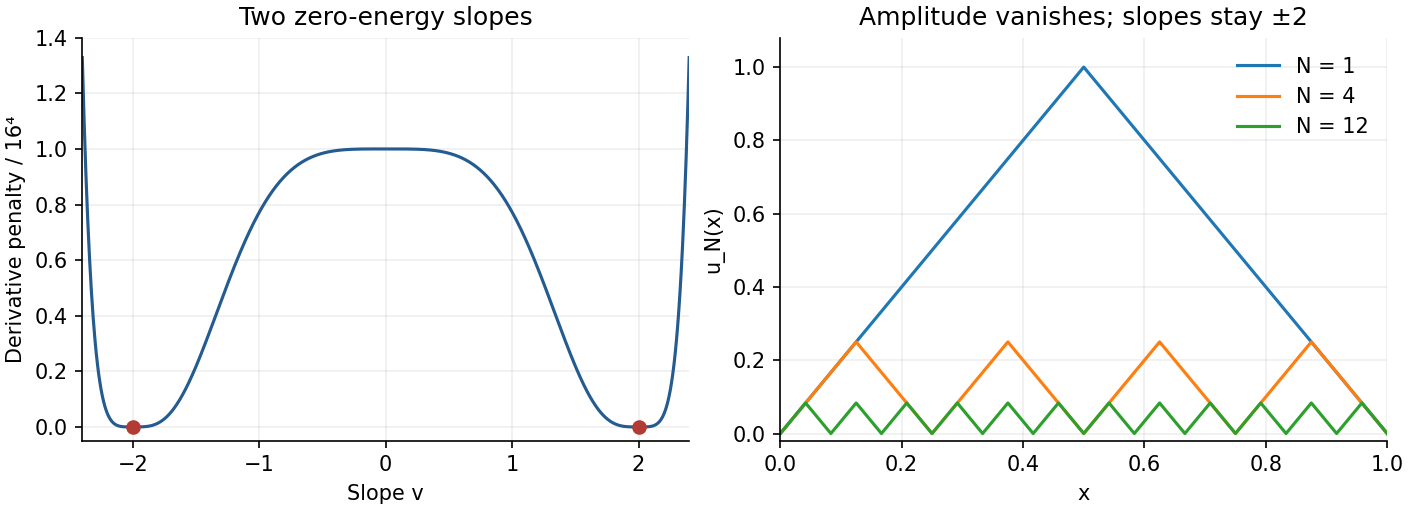


If an admissible attained the infimum, nonnegativity and would force almost everywhere, so its continuous Sobolev representative would be identically zero. Its derivative would then vanish almost everywhere, but the other integrand term would equal . This is impossible. Equivalently, zero energy would simultaneously require and almost everywhere. Thus
For fixed-endpoint variations, the second variation iswith , , evaluated along . The Jacobi equation, written without differentiating separately, isWhen is differentiable this is .
Positive definiteness means for every nonzero admissible variation. Uniform or coercive positivity of a second variation is the stronger assertion that for some fixed . On a fixed-endpoint interval this is equivalent to a positive lower bound in the norm.
The strict Legendre implication uses the uniform interpretation of positivity. If , localized rapidly oscillating variations show : otherwise support them in an interval where , so the derivative term of is negative of order frequency squared, overwhelming its mixed and zero-order terms. Continuity extends the bound to the endpoints, giving on . Under mere positive definiteness this strict conclusion is false: at gives but . In that weaker convention only the ordinary Legendre necessary condition follows. This distinction makes the implication precise.
Under the stated regular condition , a conjugate point to is an endpoint admitting a nonzero Jacobi solution with . The disconjugacy form of the Jacobi positivity criterion says that no such point in exists if and only if there is a Jacobi solution strictly positive on all of .
For the required identity, let that positive solution be and write . Set . The Jacobi equation givesExpanding the second-variation integrand therefore yieldsFor compactly supported , the boundary term vanishes, provingThis is the Jacobi identity for the second variation. The divergence form is also appropriate under the original regularity; with , the Euler-Lagrange equation gives the usual further regularity along the extremal.
At zero, the sixth-power term has zero second derivative, soFor , the Jacobi solution is strictly positive on . The preceding identity gives for nonzero zero-trace .
To control the nonlinear remainder, a uniform lower bound follows directly. Let , , and . Since and by the elementary endpoint estimate,Thus with . Also , soThis is positive for every nonzero admissible sufficiently close to zero in . Therefore zero has positive second variation and is a strict weak local minimizer. No sharp Poincaré inequality has been assumed in this proof.
For every , positivity in the preceding part gives for each fixed admissible . Let to obtainThe sharp constant is attained by , consistently with the first conjugate point occurring at the endpoint for .
Choose any nonzero admissible and set . ThenThe coefficient of is strictly positive, so the energy tends to minus infinity as . Hence
A weak local minimizer of a variational integral is an admissible for which some makes whenever and . Both the function and its derivative are required to be close.
A strong local minimizer of a variational integral is an admissible for which the same conclusion holds whenever . Every strong local minimizer is weak, because Sobolev closeness implies uniform closeness. A global minimizer is both, and the converse implication from weak to strong is not generally valid.
If the integrand is independent of , a weak local minimizer has vanishing first variation:The bounded function therefore has zero distributional derivative, so is constant almost everywhere. For an elementary test-function argument, any smooth compactly supported of integral zero is the derivative of a compactly supported smooth . Hence ; subtracting a fixed unit-integral test function from arbitrary tests shows that agrees with one constant against every test. The fundamental lemma then givesThis is the first integral for a variational integrand independent of the function value.
A point of convexity of a differentiable real function has a globally supporting tangent: for every . The Weierstrass necessary condition for a strong minimum says that is such a point for for almost every . Equivalently, the Weierstrass excess function is nonnegative at every trial slope.
Zero is neither a weak nor a strong local minimizer. Take . It tends to zero in and has zero endpoint values. Since for ,for sufficiently small positive . Thus even weakly close admissible competitors decrease the energy.
Articles were limited to the first 100 out of 104 total.
Articles by others on the same topic
There are currently no matching articles.