The axis is a axis through the centers of opposite cube faces: a half turn permutes atoms within each species. A body diagonal through sites 1 and 8 is a axis: a third turn fixes those two opposite vertices and cycles the other three vertices of each tetrahedral sublattice. These are symmetry operations of the tetrahedral symmetry group ; a quarter turn about would interchange the two chemical species and is not a symmetry of the specified cluster.
For the tetrahedral symmetry classes , each set of four atomic orbitals hasThe counts are the fixed sites of each symmetry operation: a threefold rotation fixes one vertex of each tetrahedron, a twofold or improper fourfold operation fixes none, and a diagonal mirror fixes two. Character orthogonality reduces each set toThe dimensions provide a check. Thus the complete eight-orbital model contains two copies of each of and , which can mix across the two species.
Write for the lithium orbital at site and for the sodium orbital. Reading the printed axes, the lithium coordinates have signs , , and ; the sodium sites are , , and . The normalized tetrahedral s-orbital symmetry combinations areEach row takes its signs from the corresponding coordinate, so the three functions transform together like . These coefficient vectors are orthonormal when intersite orbital overlap is neglected. A common sign reversal of any row is physically immaterial.
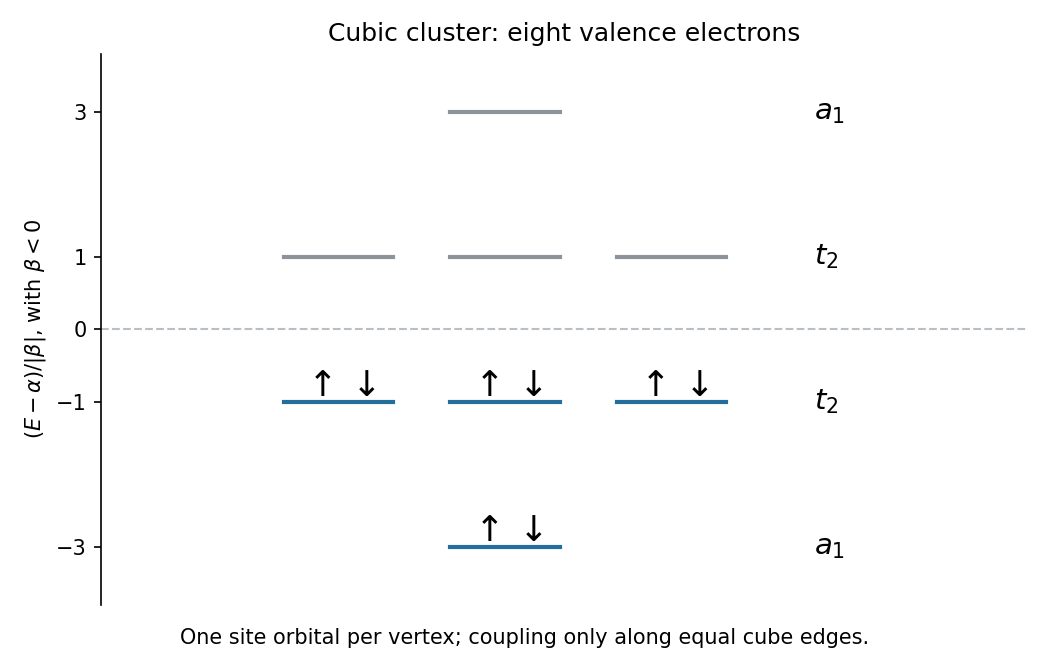
Use the stipulated common Hückel Coulomb parameter , an equal Hückel resonance integral along each cube edge, and zero coupling elsewhere; take an orthonormal site basis. Each lithium vertex has three sodium neighbors. The totally symmetric combinations therefore have the blockFor a coordinate-like combination, the sum of the three neighboring sodium coordinate signs equals the lithium coordinate sign. Thus each of the three equivalent blocks isTheir eigenvalues give the cube nearest-neighbour Hückel model:For the bonding convention these are in increasing energy order, with statistical weights . The eight valence electrons occupy , filling the four bonding spatial molecular orbitals. Their total one-electron energy is . This is a deliberately simplified model: unequal atomic energies or unequal overlaps require a generalized calculation.

Articles by others on the same topic
There are currently no matching articles.