- The atomic nuclei are much heavier than electrons, so nuclear motion is slower. In the Born-Oppenheimer approximation, first hold the nuclear positions fixed and solve
- Approximate the complete wavefunction by and neglect the nuclear-derivative couplings involving and .
- Nuclear motion then occurs on one electronic potential energy surface:Here excludes the nuclear repulsion , which must be included once.
- The mass separation makes the discarded coupling terms small when electronic energy gaps are sufficiently large; near a degeneracy or avoided crossing, a single-surface description can fail.
Differentiate the Lennard-Jones potential. Its minimum satisfiesFor dilithium, the two wells consequently haveUnder an additional same-orbital, Hund-type exchange comparison, assign to the triplet and to the singlet: the lower-energy minimum is associated with the exchange-stabilized triplet state, as in part (a).
This assignment needs that extra orbital-parentage assumption. A scalar Lennard-Jones potential does not itself encode spin, and a common atomic dissociation limit does not specify a unique molecular electronic configuration or spatial symmetry. The two curves even cross at about bohr: neither lies below the other at every separation. Thus the minima and well depths are determined unambiguously; the spin labels are a conditional qualitative inference, rather than a unique consequence of the four supplied parameters. Neither “a triplet must always have a longer bond” nor a universal ordering of unrelated excited states is justified.
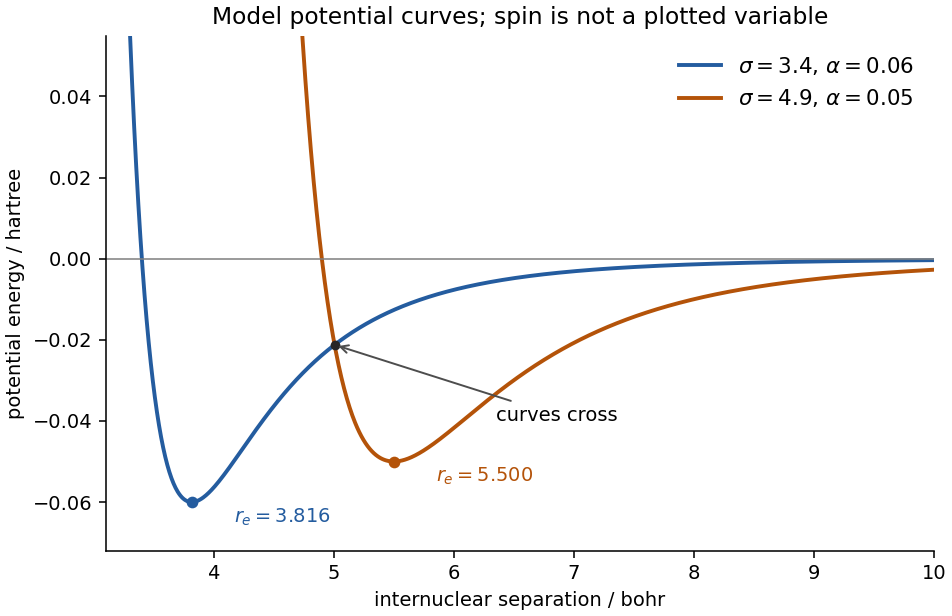
Original comparison of the two supplied model wells, showing their minima and the crossing without presupposing spin labels
. Details. 
Articles by others on the same topic
There are currently no matching articles.