The Pauli exclusion principle requires the complete electron wavefunction to change sign on exchange of any two electrons, including both position and spin labels. Let and be normalized, orthogonal spatial atomic orbitals, and let denote spin up and down.
The symmetric and antisymmetric spatial functions areThe singlet state isThe three triplet states share the antisymmetric spatial factor:Every factor and complete product is normalized. Here the subscripts are ; the spatial electron configuration is in each case.
Let exchange the complete labels of the two electrons. The spatial factors obey . The singlet state spin factor is antisymmetric, while each triplet state spin factor is symmetric. Thus in all four casesas required by the Pauli exclusion principle. In particular, the triplet state remains a triplet despite having opposite measured spin projections in each product term.
For a spin-independent Hamiltonian and the same fixed spatial atomic orbitals, direct evaluation giveswhere is the direct Coulomb integral and is the exchange integral for the helium pair. ThereforeThe antisymmetric spatial wavefunction vanishes when the two positions coincide and reduces their Coulomb repulsion. The lower energy of the maximum-spin member of this fixed electron configuration is the first of Hund's rules.
In LS coupling, add all orbital and spin angular momenta separately:The quantum numbers specifyThus and . The addition of angular momentum rule givesIn a product basis with individual projection labels,The magnitudes and are not generally the arithmetic sums of the individual magnitudes; they result from angular-momentum coupling. The sum rules for projections remain valid for every product component of a coupled angular momentum eigenstate.
An electron configuration specifies the occupied one-electron subshells and their populations, such as , without fixing how all orbital and spin angular momenta are coupled.
An atomic term groups states of a configuration with the same and . An atomic fine-structure level additionally specifies ; spin-orbit coupling can split one term into several such levels. In zero external field, a level retains magnetic substates.
The term symbol iswith letters denoting . The superscript is the spin multiplicity. Without the subscript, identifies an atomic term, rather than an individual fine-structure level.
Closed subshells have , so only the open or subshell determines each atomic term. Apply Hund's rules in order: maximize , maximize at that , then choose the lowest below half filling or the highest above half filling.
For carbon, the two electrons occupy different magnetic atomic orbitals with parallel spins, giving . Their largest allowed at that spin is , so , a term. The subshell is less than half full, giving . The ground level is .
For vanadium, three parallel-spin electrons give . The largest compatible with the Pauli exclusion principle is , hence , an term. The subshell is less than half full, so . The ground level is .
For cobalt, the subshell is equivalent to three holes for the allowed terms, so its maximum-spin, maximum- term is again . Explicitly, five spin-up electrons fill all values and two spin-down electrons can occupy , giving and . Since is more than half full, . The ground level is .
- The atomic nuclei are much heavier than electrons, so nuclear motion is slower. In the Born-Oppenheimer approximation, first hold the nuclear positions fixed and solve
- Approximate the complete wavefunction by and neglect the nuclear-derivative couplings involving and .
- Nuclear motion then occurs on one electronic potential energy surface:Here excludes the nuclear repulsion , which must be included once.
- The mass separation makes the discarded coupling terms small when electronic energy gaps are sufficiently large; near a degeneracy or avoided crossing, a single-surface description can fail.
Differentiate the Lennard-Jones potential. Its minimum satisfiesFor dilithium, the two wells consequently haveUnder an additional same-orbital, Hund-type exchange comparison, assign to the triplet and to the singlet: the lower-energy minimum is associated with the exchange-stabilized triplet state, as in part (a).
This assignment needs that extra orbital-parentage assumption. A scalar Lennard-Jones potential does not itself encode spin, and a common atomic dissociation limit does not specify a unique molecular electronic configuration or spatial symmetry. The two curves even cross at about bohr: neither lies below the other at every separation. Thus the minima and well depths are determined unambiguously; the spin labels are a conditional qualitative inference, rather than a unique consequence of the four supplied parameters. Neither “a triplet must always have a longer bond” nor a universal ordering of unrelated excited states is justified.
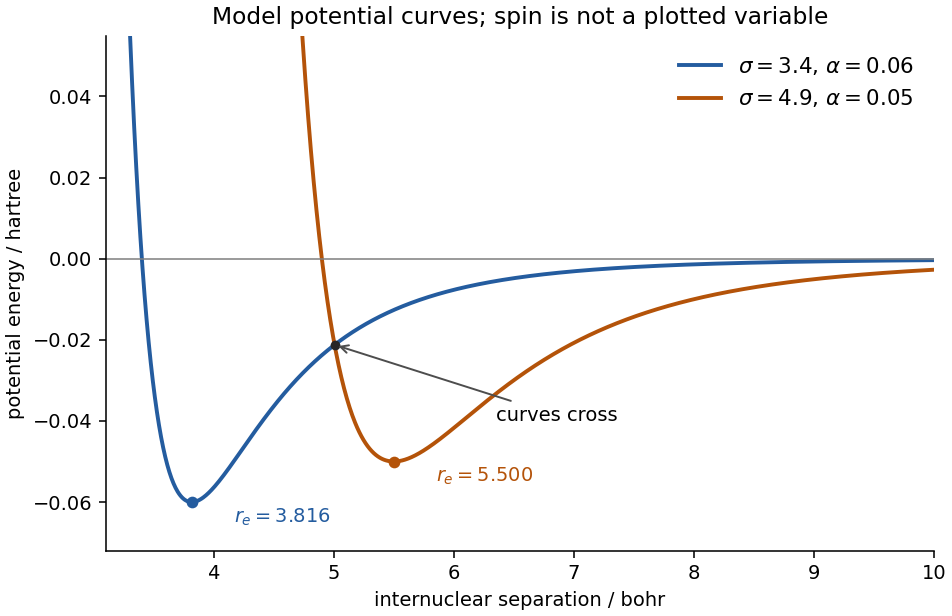
Original comparison of the two supplied model wells, showing their minima and the crossing without presupposing spin labels
. Details. 
Articles by others on the same topic
There are currently no matching articles.