With the physics convention , the adjoint operator is defined byThis definition includes the operator domains and their boundary conditions. If is a Hermitian operator on the common domain, then . Conjugate symmetry of the inner product consequently giveswhich is the required integral identity.
The boundary conditions must make the boundary form from integration by parts vanish for every pair of allowed functions. For a Schrödinger kinetic operator in one dimension, this meansSufficient examples are decay of the functions and derivatives at spatial infinity, homogeneous hard-wall conditions at finite endpoints, or matching periodic conditions on both functions and their derivatives. The exact boundary form depends on ; square integrability alone does not replace the domain requirement.
The unperturbed Hamiltonian satisfiesThe supplied eigenfunctions can be chosen as an orthonormal eigenbasis, with .
Insert the expansions into the energy eigenvalue equation . Through first order,The zeroth-order coefficients reproduce part (i). Equating the coefficients of and moving them to one side givesTerms involving first enter at order and do not affect this equation of first-order nondegenerate perturbation theory.
Multiply the first-order equation by and integrate. The first term vanishes because Hermitian conjugation moves the unperturbed Hamiltonian onto the known bra:Here is real. The remaining equation isUsing wavefunction normalization therefore yieldsThus the first-order energy coefficient is the perturbation's expectation value in the unperturbed quantum state.
For this quantum harmonic oscillator, . The Gaussian integral givesThe distinction between the coefficient and the actual first-order shift matters: the energy shift is , so in the stated atomic units.
Project the first-order equation onto , with . By orthonormality and the Hermitian operator property,ConsequentlyandThe numerator order is important: the question defines with on the bra, whereas projecting the correction onto state gives . The two coincide only when the relevant matrix element is real.
Excluding an component chooses , a permitted first-order phase and wavefunction normalization convention. A component parallel to is not determined by the projected equation. Nondegeneracy ensures nonzero denominators; a small energy gap can still make the perturbative expansion inaccurate unless .
The Pauli exclusion principle requires the complete electron wavefunction to change sign on exchange of any two electrons, including both position and spin labels. Let and be normalized, orthogonal spatial atomic orbitals, and let denote spin up and down.
The symmetric and antisymmetric spatial functions areThe singlet state isThe three triplet states share the antisymmetric spatial factor:Every factor and complete product is normalized. Here the subscripts are ; the spatial electron configuration is in each case.
Let exchange the complete labels of the two electrons. The spatial factors obey . The singlet state spin factor is antisymmetric, while each triplet state spin factor is symmetric. Thus in all four casesas required by the Pauli exclusion principle. In particular, the triplet state remains a triplet despite having opposite measured spin projections in each product term.
For a spin-independent Hamiltonian and the same fixed spatial atomic orbitals, direct evaluation giveswhere is the direct Coulomb integral and is the exchange integral for the helium pair. ThereforeThe antisymmetric spatial wavefunction vanishes when the two positions coincide and reduces their Coulomb repulsion. The lower energy of the maximum-spin member of this fixed electron configuration is the first of Hund's rules.
In LS coupling, add all orbital and spin angular momenta separately:The quantum numbers specifyThus and . The addition of angular momentum rule givesIn a product basis with individual projection labels,The magnitudes and are not generally the arithmetic sums of the individual magnitudes; they result from angular-momentum coupling. The sum rules for projections remain valid for every product component of a coupled angular momentum eigenstate.
An electron configuration specifies the occupied one-electron subshells and their populations, such as , without fixing how all orbital and spin angular momenta are coupled.
An atomic term groups states of a configuration with the same and . An atomic fine-structure level additionally specifies ; spin-orbit coupling can split one term into several such levels. In zero external field, a level retains magnetic substates.
The term symbol iswith letters denoting . The superscript is the spin multiplicity. Without the subscript, identifies an atomic term, rather than an individual fine-structure level.
Closed subshells have , so only the open or subshell determines each atomic term. Apply Hund's rules in order: maximize , maximize at that , then choose the lowest below half filling or the highest above half filling.
For carbon, the two electrons occupy different magnetic atomic orbitals with parallel spins, giving . Their largest allowed at that spin is , so , a term. The subshell is less than half full, giving . The ground level is .
For vanadium, three parallel-spin electrons give . The largest compatible with the Pauli exclusion principle is , hence , an term. The subshell is less than half full, so . The ground level is .
For cobalt, the subshell is equivalent to three holes for the allowed terms, so its maximum-spin, maximum- term is again . Explicitly, five spin-up electrons fill all values and two spin-down electrons can occupy , giving and . Since is more than half full, . The ground level is .
- The atomic nuclei are much heavier than electrons, so nuclear motion is slower. In the Born-Oppenheimer approximation, first hold the nuclear positions fixed and solve
- Approximate the complete wavefunction by and neglect the nuclear-derivative couplings involving and .
- Nuclear motion then occurs on one electronic potential energy surface:Here excludes the nuclear repulsion , which must be included once.
- The mass separation makes the discarded coupling terms small when electronic energy gaps are sufficiently large; near a degeneracy or avoided crossing, a single-surface description can fail.
Differentiate the Lennard-Jones potential. Its minimum satisfiesFor dilithium, the two wells consequently haveUnder an additional same-orbital, Hund-type exchange comparison, assign to the triplet and to the singlet: the lower-energy minimum is associated with the exchange-stabilized triplet state, as in part (a).
This assignment needs that extra orbital-parentage assumption. A scalar Lennard-Jones potential does not itself encode spin, and a common atomic dissociation limit does not specify a unique molecular electronic configuration or spatial symmetry. The two curves even cross at about bohr: neither lies below the other at every separation. Thus the minima and well depths are determined unambiguously; the spin labels are a conditional qualitative inference, rather than a unique consequence of the four supplied parameters. Neither “a triplet must always have a longer bond” nor a universal ordering of unrelated excited states is justified.
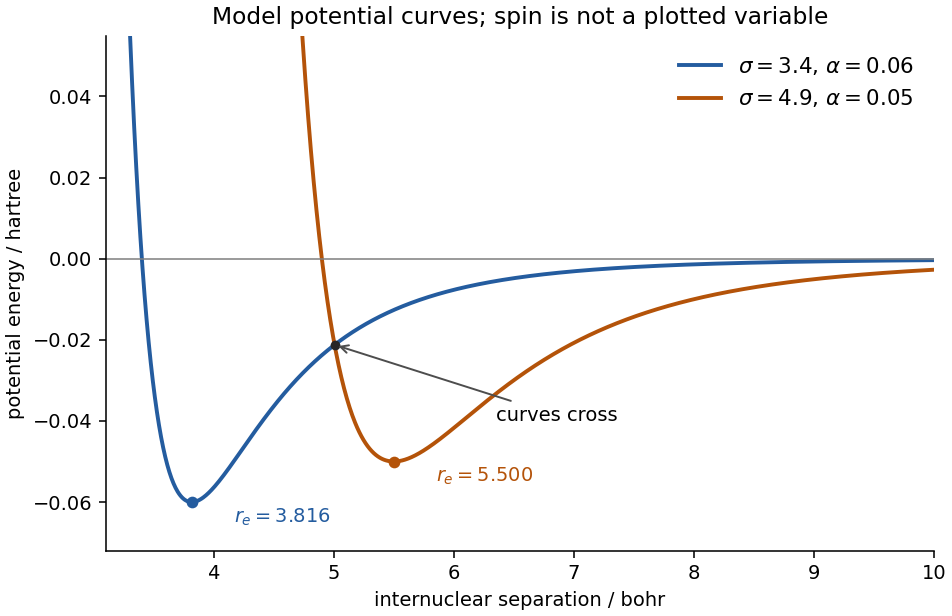
Original comparison of the two supplied model wells, showing their minima and the crossing without presupposing spin labels
. Details. 
The resolved lines arise from simultaneous changes of vibration and rotation in hydrogen cyanide. A vibrational fundamental connects many populated lower rotational levels to different upper rotational levels, giving the fine structure of a rovibrational spectrum.
The prominent central Q branch, together with flanking P branch and R branch lines, identifies a perpendicular band. For linear HCN, this is the doubly degenerate bending fundamental, not either stretching fundamental. Bending creates a transition-dipole component perpendicular to the molecular axis; its vibrational angular momentum permits as well as .
The two perpendicular bending coordinates share one vibrational frequency. Their degeneracy is different from the series of resolved rotational transitions superimposed on that fundamental. The stretches have their electric dipole transition moment along the molecular axis and would give the usual parallel-band P/R pattern without this strong central Q feature.
Let label the lower rotational state and write the elementary band model asHere are lower and upper rotational constants, in inverse centimetres; a constant term associated with upper-state vibrational angular momentum can be included in . The P branch has , and the R branch has .
In this model the six printed labels are assigned asThe low-frequency series steps away from the central origin towards increasing lower . The first two high-frequency R positions are approximately and , so the labels at and correspond to and ; they are not the first two rotational transitions.
There is a physical limitation to taking this schematic model literally. A strict bending band has , so a genuine transition to is forbidden. The printed feature has the formal position of the elementary model. The numerical analysis below follows the printed line sequence; it does not infer a physically allowed bending level from that feature.
Use rovibrational spectroscopy combination differences so that the band origin cancels. With the assignments above, and end at the same upper level , givingLikewise and start at the same lower level , soOnly the printed wavenumbers are needed:Thus . The rotational constants differ only slightly, so the average moment of inertia changes little on vibrational excitation. The upper value is slightly larger, corresponding to a slightly smaller effective moment of inertia. This sign is possible for a bending excitation; the intuition that excitation must always lengthen a diatomic bond is not a general rule for a polyatomic bend.
The rounded printed values are internally consistent: fitting all six positions to the same elementary model gives approximately , and , with residuals below . The displayed combination-difference values have more digits than their physical accuracy; the meaningful scale is about .
For a linear polyatomic molecule, the first-order polyatomic vibration-rotation interaction iswhere is the degeneracy of normal mode . The bending mode has , so the two measured states implyThe two stretching zero-point contributions are not supplied. The true all-mode equilibrium constant is therefore not uniquely determined by this band alone. Neglecting those unknown stretching corrections gives the bend-only estimateUsing and converting inverse centimetres to inverse metres,If the intended course approximation instead treats the observed vibration as a single nondegenerate oscillator with , its extrapolation givesThat is a useful effective one-coordinate estimate, but it should not be identified with an exact equilibrium constant of the doubly degenerate polyatomic bend. Both estimates give at the accuracy warranted here.
The expanded feature resolves the Q branch: each line has but starts from a different lower rotational level. In the simple rigid rotor band model,Because the upper rotational constant is larger, the lines extend towards higher wavenumber. Their adjacent spacings areso they crowd together at the low-frequency edge and become increasingly separated. A strictly resolved bending-band analysis may distinguish the upper parity component sampled by Q lines from that sampled by P/R lines; it is not necessary to impose identical high-resolution constants on every branch in this sketch.
The intensity envelope reflects rotational state populations and the rotational transition strength. For this perpendicular Q branch, the usual rotational line-strength factor gives the approximate dependenceAt small , the increasing magnetic degeneracy makes the line intensity rise; at large , Boltzmann suppression dominates. The maximum is therefore at an intermediate . This is a population envelope across distinct transitions, rather than one intrinsically broad vibrational line.
Count the successive Q branch lines from the low-frequency edge, taking as the first allowed bend transition; the first lines are crowded and partly unresolved. The maximum near is approximately . Treating as continuous in the intensity envelope from part (i),HenceUsing , and givesA useful check avoids locating the exact maximum. The plotted line has roughly of the peak height. Thusgives about . An appropriate graphical estimate is , with precision limited by line counting, line overlap and reading the plotted intensities. There is no basis for reporting a temperature to the nearest kelvin from this figure.
The alternating short and long bonds preserve fourfold, but not eightfold, rotations. Including the molecular plane and inversion symmetry, the planar structure belongs to , the D4h molecular point group.
Use the printed axes: the short bonds are –, –, – and –, and the and axes pass through the midpoints of opposite short bonds. Interchanging short and long bonds is not a molecular symmetry operation of this geometry.
For the atomic orbital basis, only orbitals whose centres remain fixed contribute to a character. Each such orbital contributes if its direction is preserved and if it is reversed. In the standard D4h molecular point group class order,No nonidentity operation other than leaves any carbon site fixed. Reflection in the molecular plane fixes all eight sites but reverses every function.
Molecular character reduction givesThe dimensions sum to . The two copies of are separate equivalent irreducible representations which may mix with one another; they do not force all four functions to have a common energy.
Write and use the orthonormal basis of the Hückel method. The four normalized one-dimensional symmetry-adapted linear combinations areFor example, the mirror plane exchanges sites , , , , without changing the sign of an individual orbital. The all-positive combination is unchanged by every vertical mirror but changes sign under , giving . The alternating combination changes sign under both sorts of vertical mirror, as required for . The two remaining sign patterns distinguish from in the printed axes. The signs refer to the upper lobes; the lower lobes have opposite quantum phases, and neither colour denotes an electric charge.
For a normalized coefficient vector , the energy isEvery site has one short-bond and one long-bond neighbour. Equivalently, apply the Hückel method matrix to any coefficient and read off its two neighbouring signs. The results areWith negative resonance integrals and , the and levels are occupied, while and are unoccupied in the closed-shell alternating-bond state.
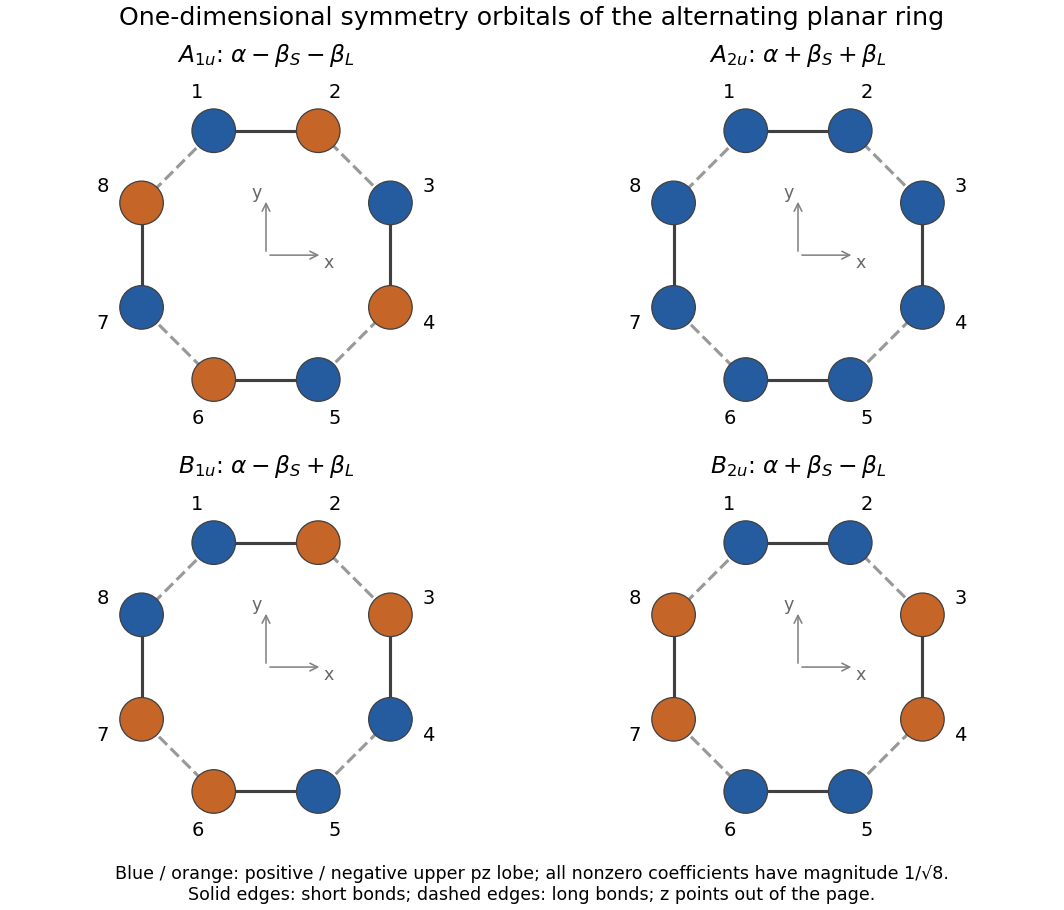
Original phase patterns for the four one-dimensional carbon-ring symmetry orbitals in the printed numbering and axes
. Details. 
Use the four supplied opposite-site combinations in the order . Their Hückel method matrix isThe negative corner is essential. For example, includes the long bonds – and –, each with opposite coefficient signs, giving .
Because the basis is orthonormal, the secular determinant isIt factors as , giving two doubly degenerate energies, .
At , the preceding matrix separates into identical and blocks. For , a normalized pair at the lower energy isA pair at the upper energy isThe four coefficient vectors are mutually orthonormal. Any orthogonal mixing within either equal-energy pair is an equally valid choice of molecular orbitals. At this limiting parameter value, additional coincidences with the one-dimensional levels occur: the full eight-orbital system is four isolated dimers, with four bonding and four antibonding levels.
Fill four spatial molecular orbitals with the eight electrons. For negative and , the occupied energies are , , and the pair at . ThereforeFor equal integrals, , this becomesAt equal bond lengths, the last two electrons occupy the frontier degeneracy at , so their distribution within that degenerate space does not change the bare Hückel method energy.
For , four isolated short-bond dimers each contribute :These are different coupling limits. Keeping while simply removing long-bond coupling does not represent a small distortion at fixed mean bond strength.
The uniform planar eight-electron ring has a partially filled frontier degeneracy. Bond-length alternation splits those levels, permitting the two frontier electrons to occupy the lowered orbital and opening a gap to the empty partner. This is the electronic mechanism for destabilizing the equal-bond planar geometry.
A controlled comparison keeps the mean resonance integral fixed. PutUsing part (i), the change from the uniform ring isThus a small alternation lowers the electronic energy, with a leading gain linear in . An ordinary elastic cost starts quadratically, so the equal-bond planar state is unstable in this model. The equilibrium distortion requires those geometric and sigma-bond costs as well.
The eight electrons constitute a cyclic count rather than the closed-shell case associated with aromaticity. The result concerns the imposed planar geometry; it does not establish the unconstrained three-dimensional equilibrium shape of cyclooctatetraene.
For a displacement group representation, an atom contributes only if the operation leaves its site fixed. Its three Cartesian displacements then contribute the trace of the polar-vector transformation.
Take perpendicular to the ring and an in-plane axis through opposite carbon atoms. To avoid confusing the principal twofold rotation with the in-plane axes, write for the former, for an in-plane axis through atoms and for one through opposite bond midpoints. The carbon displacement characters in the D6h molecular point group areA through-atom half-turn fixes two carbon sites and has Cartesian trace , giving . The molecular-plane reflection fixes all six carbons with trace , giving . A through-atom vertical mirror fixes two sites with trace , giving .
Using molecular character reduction, the 18-dimensional carbon-only result isThe six one-dimensional terms contribute six dimensions and the six copies of two-dimensional representations contribute twelve, totaling eighteen. The distinction between carbon-only and whole-molecule displacements is needed in part (ii).
Each hydrogen lies on the radial line through its attached carbon. Consequently every molecular symmetry operation fixes or permutes the hydrogen sites exactly as it does the carbon sites, and the Cartesian trace is the same. Thus and the complete benzene displacement group representation is , of dimension .
Subtract translations and rotations . The full set of normal modes isThe one-dimensional components contribute coordinates. The two-dimensional components contribute , giving vibrational degrees of freedom. There are twenty distinct symmetry-labelled fundamentals before accidental coincidences, because each doubly degenerate pair has one frequency.
Subtracting translations and rotations directly from the carbon-only result would instead give twelve carbon-skeleton coordinates. That is a six-site mechanical model, not all the normal modes of . The hydrogen contribution is required for the actual molecule.
The transition strength depends on , so a necessary condition is that at least one Cartesian electric dipole transition moment is nonzero. An integral can be nonzero only if its integrand contains the totally symmetric representation:The harmonic vibrational ground state is totally symmetric, and a one-quantum state of normal mode transforms as . For the real irreducible representations here, the fundamental is therefore symmetry-allowed precisely whenEquivalently, expand the electric dipole moment near equilibrium:The fundamental has , so vibrational infrared activity requires a nonzero dipole derivative of the matching symmetry. In , and , giving and as the IR-active species. Symmetry permission does not guarantee a large band intensity.
From the complete normal mode result, the vibrational infrared activity belongs toThe fundamental couples to the out-of-plane dipole component and each fundamental to the two in-plane components. Counting one frequency for each degenerate pair, the expected number is fundamental bands, containing seven vibrational coordinates.
This is the symmetry count for the full molecule, including hydrogen displacements. The experimental compilation likewise lists the out-of-plane fundamental and three fundamentals; anharmonic resonances and weak intensity borrowing can produce additional observed features beyond the ideal fundamental count.[ref]
Benzene vibrational data in the NIST Chemistry WebBook. Vibrational energy-level table: A2u row and three E1u fundamentals
The electronic transition starts from , so the electric-dipole test reduces to whether the final electronic irreducible representation occurs among . The excited state matches the dipole components and is therefore electric-dipole allowed.
The state matches neither nor and is electric-dipole forbidden at the equilibrium geometry. Both excited states are singlets, so the difference is spatial symmetry rather than the spin selection rule. Inversion parity alone does not decide the result: both final states are ungerade, but only the matching vector representation is allowed.
The overall vibrational ground state is invariant under every molecular symmetry operation, so it transforms as . Combining it with the electronic ground state givesFor a degenerate harmonic normal mode, the zero-quantum wavefunction depends on the invariant sum , so the ground vibrational symmetry remains totally symmetric even when excited vibrational states form multiplets.
One quantum in an normal mode gives an vibrational pair. The electronic factor is , henceThis follows by multiplying the characters of the two group representations. In particular, multiplication of by produces in the hexagonal group, and the inversion parities multiply as . The resulting vibronic state is twofold degenerate.
The initial vibronic state is and the final one is , so an in-plane dipole component satisfiesThe product contains the totally symmetric representation. The combined electronic–vibrational transition is therefore symmetry-allowed, with an in-plane electric dipole transition moment.
A nonzero intensity still needs vibronic coupling. In a coordinate-independent separation, the forbidden electronic matrix element would remain zero. Its first derivative with respect to the coordinate can instead be nonzero, and the vibrational factor supplies the required one-quantum transition. This is vibrational activation of an electronic transition and explains why the band can be weak.
A coordinate of an normal mode is unchanged by every molecular symmetry operation. Every harmonic-oscillator excitation therefore also has symmetry , including odd values of . Consequentlyfor any number of quanta in that totally symmetric coordinate. The same electric-dipole permission survives every excitation.
This statement concerns symmetry. Actual progression intensities depend on vibrational inner products, equilibrium displacements and the coordinate dependence of the electric dipole transition moment; a permitted line need not have measurable intensity for every vibrational quantum number.
Articles by others on the same topic
There are currently no matching articles.