In the orthogonal nearest-neighbour tight-binding model,The on-site integral sets the band centre, while the hopping integral describes coupling between neighbouring orbitals. With a consistent phase convention, the bonding combination at the zone centre has .
For p orbitals directed along the chain, useHere every positive lobe points in the same spatial direction. Neighbouring equal-sign coefficients then bring opposite-sign facing lobes together and make the zone-centre combination antibonding; the alternating zone-boundary combination is bonding. Thus the usual axial hopping has the opposite sign to hopping. Orbital phase and the sign of one-dimensional hopping must be treated consistently; replacing only by while silently keeping the same physical hopping sign would give the wrong band ordering.
Write and , soThe labelled key points of the two dispersion relations areThe band rises from centre to boundary and the axial band falls. The separated-band assumption requires . The upper-left panel shows a representative pair, with the other panels supplying the requested comparisons in part (b).
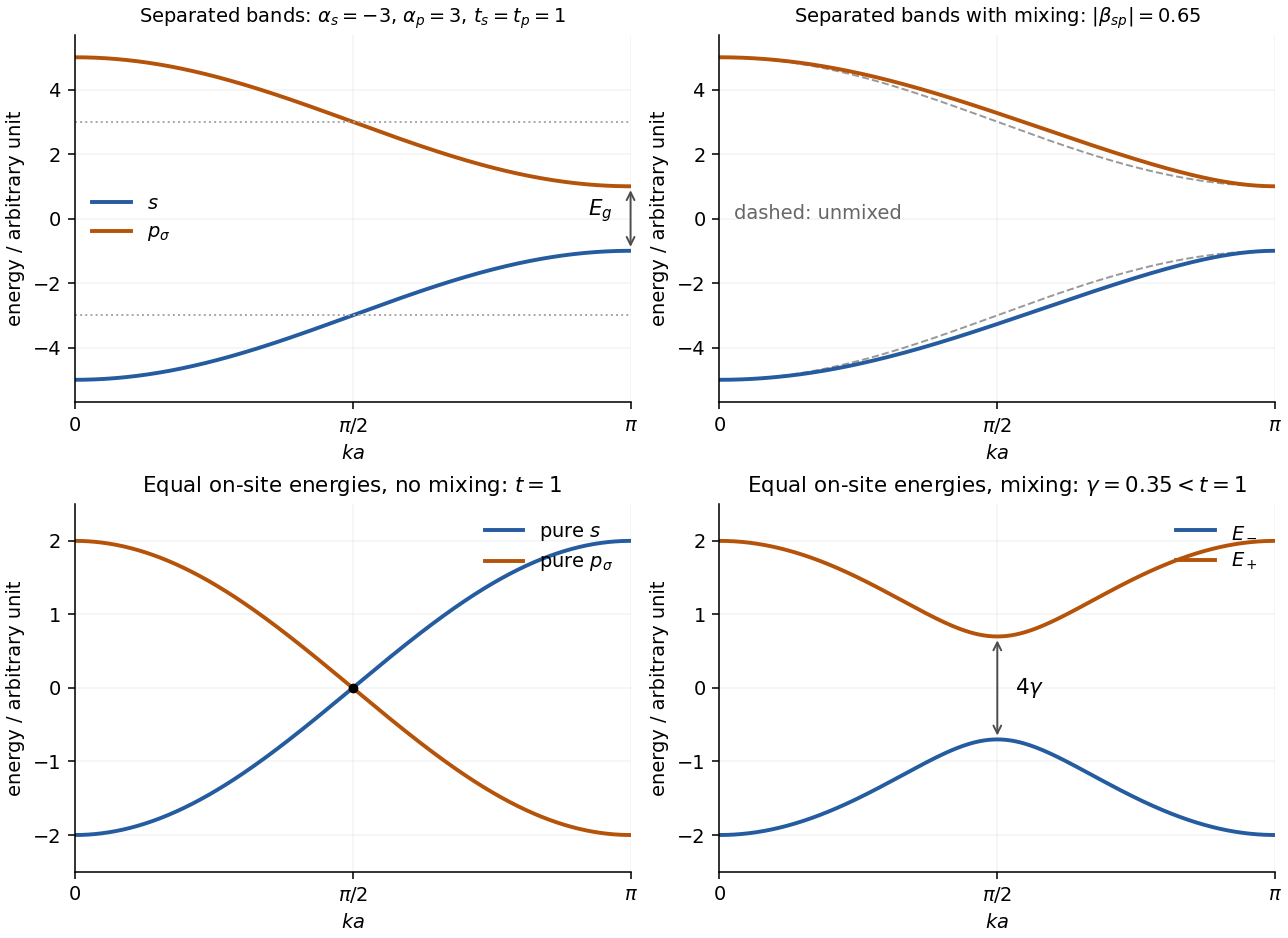
Original one-dimensional s and axial-p band sketches, comparing separated bands, mixing, and the equal-on-site-energy special case
. Details. 
The energy-band widths are the difference between their extrema:For the separated bands, the top of the band and bottom of the band are both at . HenceIt is a direct band gap at the zone boundary, because both limiting states have the same wavevector. This result uses the opposite signs of the and axial- hoppings.
Articles by others on the same topic
There are currently no matching articles.