Take the energy of an isolated, field-free gas atom as zero, and let be the field-independent binding energy at one adsorption site. The two adsorbed spin energies areHere is the Bohr magneton. The lower state is stabilized by increasing ; the assignment of the two signs to names for the spin projections is a convention.
Put . Summing the two Boltzmann factors gives the occupied-site internal partition functionIf the single atom can occupy any of the identical sites, its complete surface partition function isOne also commonly calls the one-site factor itself . Both conventions are valid, but the combinatorial factor in part (c) must use the same convention. We use the complete one-atom surface function below and give the equivalent one-site expression.
Use the ideal Langmuir adsorption model: identical independent sites, at most one atom per site, no lateral interactions, and no additional thermally active adsorbed degrees of freedom beyond the two spin states. Treat the atoms as indistinguishable and localized after adsorption; only site occupancy and spin choices distinguish configurations.
There are ways to select occupied sites. For any such selection, independent spin sums contribute . ThusWith as defined in part (b), this isEquivalently, starting from labelled particles gives distinct assignments to different sites; division by removes particle relabellings. The removes the site multiplicity already included in each full one-particle function.
If denotes the one-site internal factor instead, and . These are identical physical results, not different counting models. In particular, the complete-function convention gives and hence .
For the adsorbed lattice gas, the Helmholtz free energy isUse Stirling's approximation with large, then differentiate at fixed . Writing surface coverage as gives the adsorption chemical potentialThe occupation ratio comes from site-mixing entropy; it is essential near saturation.
Let be the number of free atoms and . In the field-free gas, both spin states have zero energy, so the one-atom partition function is , where is the thermal de Broglie wavelength. For a dilute ideal gas,ThereforeThe last equality uses . The bulk spin degeneracy is two even though the bulk magnetic field vanishes: degeneracy is not the absence of spin states.
At adsorption equilibrium, . The expressions from part (d) giveDefineSolving the occupation ratio yieldsThe coefficient has units of inverse pressure, so is dimensionless. The two spin states contribute a factor two on both sides of the adsorption equilibrium and cancel; retaining the surface factor but dropping the bulk degeneracy would incorrectly double .
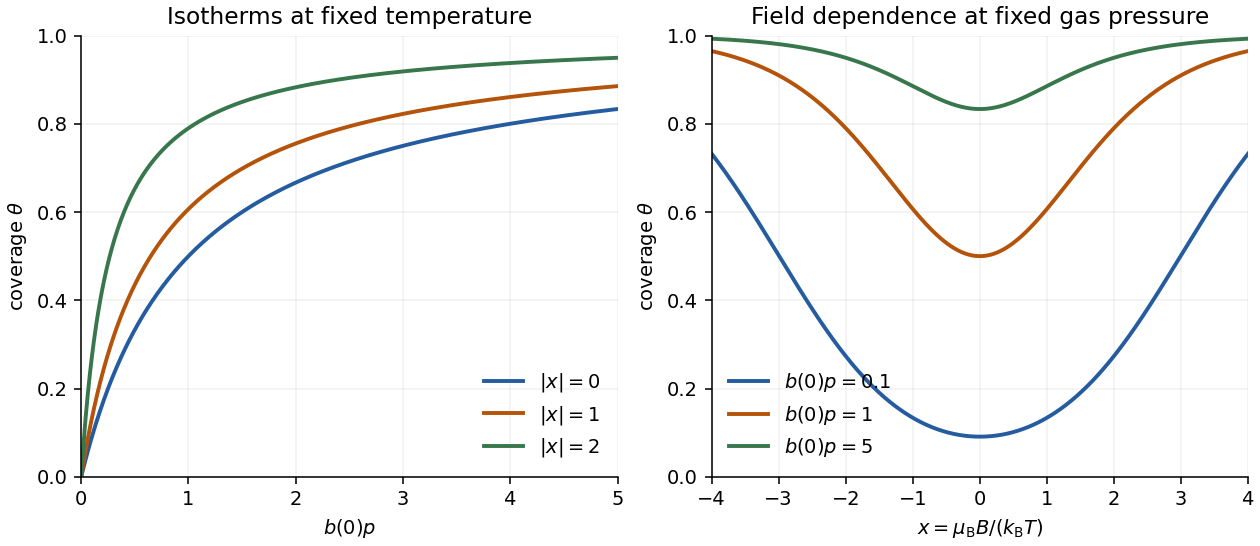
At fixed temperature,Thus magnetic-field-dependent Langmuir adsorption is even in and increases with . At fixed nonzero gas pressure, stronger field increases surface coverage; in an isotherm plot, the half-coverage pressure moves to lower pressure. The saturation coverage remains one because the number of sites is unchanged.
For weak fields, with ,There is no linear small-field change. At large , , and at fixed the coverage approaches one. The field lowers the free energy of the surface spin ensemble relative to the unsplit bulk; simply averaging the two surface energies to would miss this equilibrium effect.

Chemical equilibrium for requiresInsert the given chemical potential form and define the positive ionization energyAfter collecting logarithms,soDefine a dimensionless concentration equilibrium constant using a standard number density :Each is a molecular partition function density, with units of inverse volume. Consequently has density units and division by makes dimensionless. All ground-state energies must use the same energy reference.
For monatomic species, there are no molecular rotational or vibrational factors. Assume excited electronic states are negligible, so the internal partition sums are the ground-state degeneracies. A free electron has two spin states, givingwith the analogous expression for the ion. Since losing one electron changes the atomic mass negligibly, . HenceThis is the ground-state form of the Saha ionization equation. Its assumptions include a dilute, nondegenerate ideal mixture, negligible interparticle interactions, thermal and chemical equilibrium, no additional ionization stages, and consistent treatment of internal degeneracies. Nuclear-spin factors may be omitted when they cancel between the atom and ion; they must not be counted on only one side.
For fixed degeneracies and ionization energy,Therefore increases with temperature in this model. Ionization costs positive energy, so it is suppressed at low temperature by its Boltzmann factor. At higher temperature that penalty becomes less important.
Ionization also creates an additional independently translating particle and more ways to distribute the particles and their momenta. This favours the ionized mixture through its translational and mixing entropy, consistent with the prefactor and increasing ionization at high temperature.
Let be the degree of ionization. Conservation of nuclei and charge neutrality, with no pre-existing electrons or other ions, giveSubstitution into the definition of givesThe physical root lies between zero and one:The second form avoids subtracting nearly equal terms at large . The limits are when and when . The dependence on initial number density matters: alone, without and the standard-state convention, does not specify the ionized fraction.
For hydrogen, the electronic ground state has , while the proton has no electronic degeneracy, . For sodium, the neutral ground state has and the closed-shell ion has . Ignoring hyperfine structure and consistently cancelling nuclear-spin factors, for both.
At ,It is convenient to calculate the density , which avoids choosing an unnecessary numerical value of the standard density. The results areThus hydrogen is about ionized, whereas sodium is about ionized in the stated ground-state ideal-gas model. The large difference is dominated by the smaller sodium ionization energy in the exponential. The weak-ionization approximation is excellent for hydrogen but would be inaccurate for sodium, so the quadratic solution is needed there.
Assume a dilute classical ideal gas of indistinguishable, noninteracting particles, with translational states dense enough to replace their sum by a continuum integral. Separate translation from all internal degrees of freedom. ThenUsing Stirling's approximation in the Helmholtz free energy,Differentiate at fixed . Since ,Only after this derivative set and for one mole at standard pressure:This is the translational Sackur-Tetrode equation. The factor is essential for the correct extensive entropy; replacing by a temperature-dependent standard molar volume before taking the fixed-volume derivative would give the wrong constant term.
For independent internal rotational states, the rotational factor in the many-molecule partition function is . The indistinguishability factor has already been included in the translational part and is not applied a second time to the internal factor. ThusA nonlinear rigid rotor has three rotational quadratic degrees of freedom; in the high-temperature limit, . ThereforeThis is the rotational entropy contribution, with the appropriate rotational symmetry number already inside . It has no ideal-gas pressure dependence.
The integer molecular mass of the stated isotopologue isTake , the recommended standard pressure.[ref]
IUPAC Compendium of Chemical Terminology, fifth edition (Gold Book). Entry S05921, standard pressure: recommended value 100000 Pa
At , the thermal de Broglie wavelength is . The result of part (a) givesIf is used instead, the result decreases by , giving in the same units. Specifying the pressure removes that small convention dependence.
Chloroform has the C3v molecular point group. Its three identical atoms are interchanged by three proper rotations, so . The three mirror operations do not increase the rotational symmetry number to six. Isotopic identity matters for this count.
Using the supplied wavenumber form of ,All are far below , justifying the high-temperature nonlinear rigid rotor expression. ThenandThe calculation treats the molecule as rigid and separates electronic, vibrational and nuclear-spin contributions from the requested rotational term.
For each coordinate, the horizontal graph position iswith in inverse centimetres. Read from the supplied curve at these positions. Each frequency contributes one coordinate and each frequency contributes two. The graphical estimates areThus the listed frequency groups contribute approximately , , , , and , respectively, andThe nine coordinates are consistent with for a five-atom nonlinear molecule. The lowest-frequency doubly degenerate bend dominates the vibrational entropy; the C–H stretch is effectively frozen at this temperature.
As a numerical check on the graphical reading, the harmonic expression , with , gives a total . This agrees with the precision of the supplied graph.
In the orthogonal nearest-neighbour tight-binding model,The on-site integral sets the band centre, while the hopping integral describes coupling between neighbouring orbitals. With a consistent phase convention, the bonding combination at the zone centre has .
For p orbitals directed along the chain, useHere every positive lobe points in the same spatial direction. Neighbouring equal-sign coefficients then bring opposite-sign facing lobes together and make the zone-centre combination antibonding; the alternating zone-boundary combination is bonding. Thus the usual axial hopping has the opposite sign to hopping. Orbital phase and the sign of one-dimensional hopping must be treated consistently; replacing only by while silently keeping the same physical hopping sign would give the wrong band ordering.
Write and , soThe labelled key points of the two dispersion relations areThe band rises from centre to boundary and the axial band falls. The separated-band assumption requires . The upper-left panel shows a representative pair, with the other panels supplying the requested comparisons in part (b).
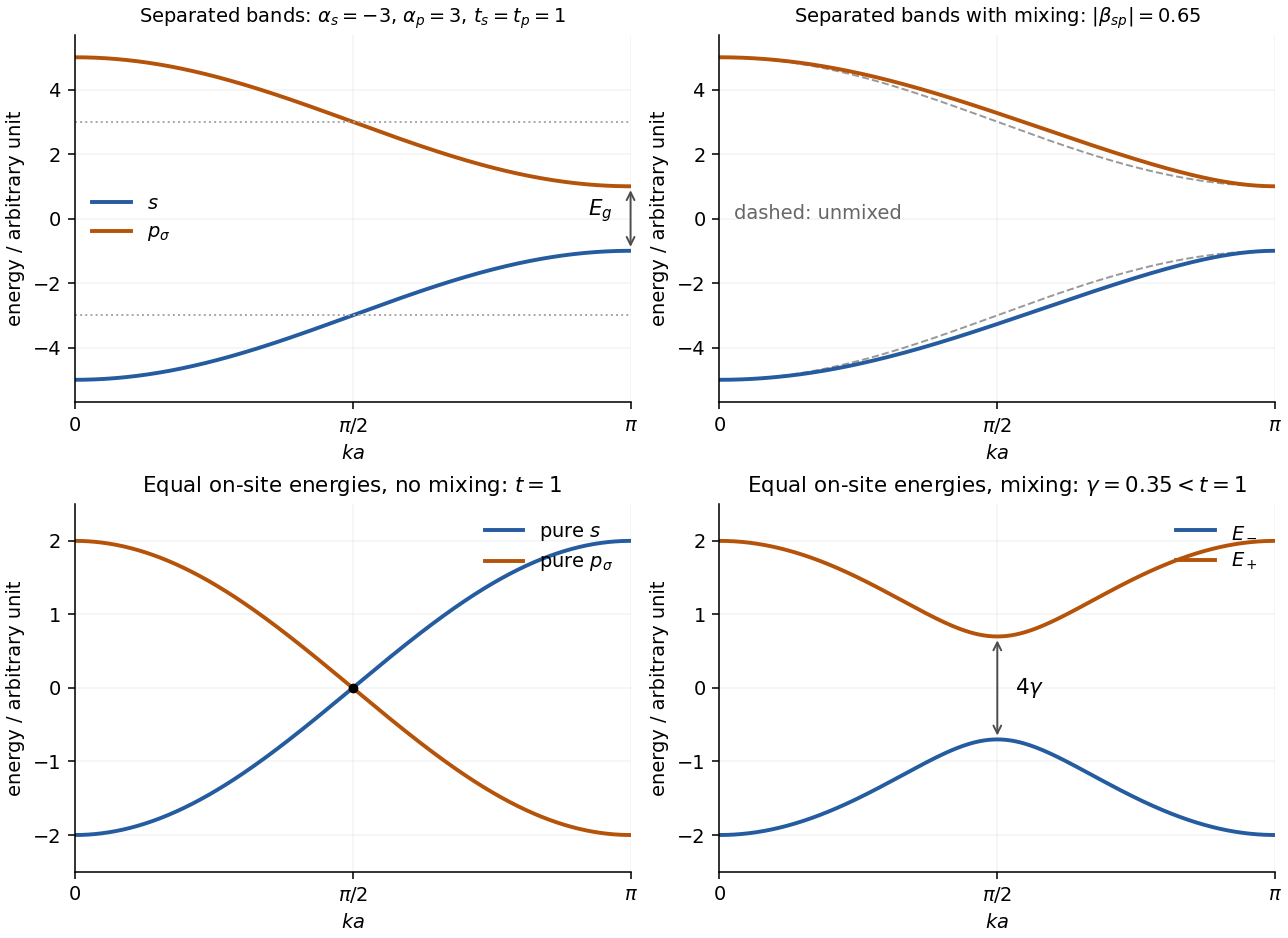
Original one-dimensional s and axial-p band sketches, comparing separated bands, mixing, and the equal-on-site-energy special case
. Details. 
The energy-band widths are the difference between their extrema:For the separated bands, the top of the band and bottom of the band are both at . HenceIt is a direct band gap at the zone boundary, because both limiting states have the same wavevector. This result uses the opposite signs of the and axial- hoppings.
The opposite spatial parity of the s orbital and axial p orbital gives opposite signs for left and right – hopping. With real , one consistent Bloch-basis convention givesThe resulting energies areThus s-p mixing in a one-dimensional tight-binding chain lowers the lower branch and raises the upper branch wherever the coupling is nonzero. For separated atomic levels, the lower branch remains mainly and the upper mainly , with increasing admixture where their uncoupled energies approach.
The upper-right panel of the figure in part (a)(ii) compares the mixed curves with dashed unmixed curves. The mixing vanishes at both and , so those endpoints remain unchanged. If the unmixed curves approach or cross in the interior, the nonzero coupling produces an avoided crossing.
Let the common on-site energy be zero and the common hopping magnitude be . Consistent with the axial- convention and the formula in part (iii), the hopping signs are and .
Without mixing,The curves cross at , , with no gap. The lower-left panel shows the continuous pure- and pure- branches. Their identities remain fixed through the crossing; the energy-ordered lower state changes from to character on passing through it.
With mixing and , the equal-on-site-energy result isFor the regime considered in part (iii), the crossing becomes an avoided crossing with gap at . The lower band has its maximum there and the upper band its minimum. Their orbital characters exchange smoothly across this region, with equal weights at its centre. The lower-right panel gives the sketch.
The zero-mixing limit recovers the crossing of case (1). A useful special limiting case is , where the square root is independent of wavevector and both bands are flat at . This flat-band limit is outside the strict assumption made in part (iii).
Use and . Direct substitution givesThe upper branch falls to a minimum at the middle point and rises symmetrically; the lower branch rises to a maximum and falls symmetrically. These are the lower-right curves in the figure in part (a)(ii).
At the lower state is pure and the upper state pure . At the assignments are reversed. At the two states have equal orbital weights because their diagonal energies coincide and the off-diagonal coupling is nonzero.
More explicitly, for the lower band and , define . ThenThe upper-band weights are interchanged. For zero mixing, the energies still reduce to the crossing limit, but the orbital weights at the exact crossing are not uniquely fixed by energy. These normalized squared amplitudes quantify the smooth change of orbital character; the Bloch-basis phase in the off-diagonal matrix element does not change them.
For , the positive branch ranges from to , and the negative branch from to . ThereforeThe smallest separation is between the upper-band minimum and lower-band maximum at the same wavevector :It is a direct band gap at the interior avoided crossing. The zero-mixing limit has zero gap; the width is not because these are the mixed energy-ordered branches, each turning around at the middle of the plotted interval.
A typical intrinsic semiconductor has a nearly full valence band ending at and a nearly empty conduction band starting at , separated byAt finite temperature, the equilibrium Fermi level lies near the middle of the gap. In the nondegenerate parabolic-band approximation,where are the two effective density of states values. Equal densities of states put it exactly at midgap; unequal masses or valley multiplicities shift it slightly. The left panel gives the requested energy-level sketch, with doped cases for comparison.
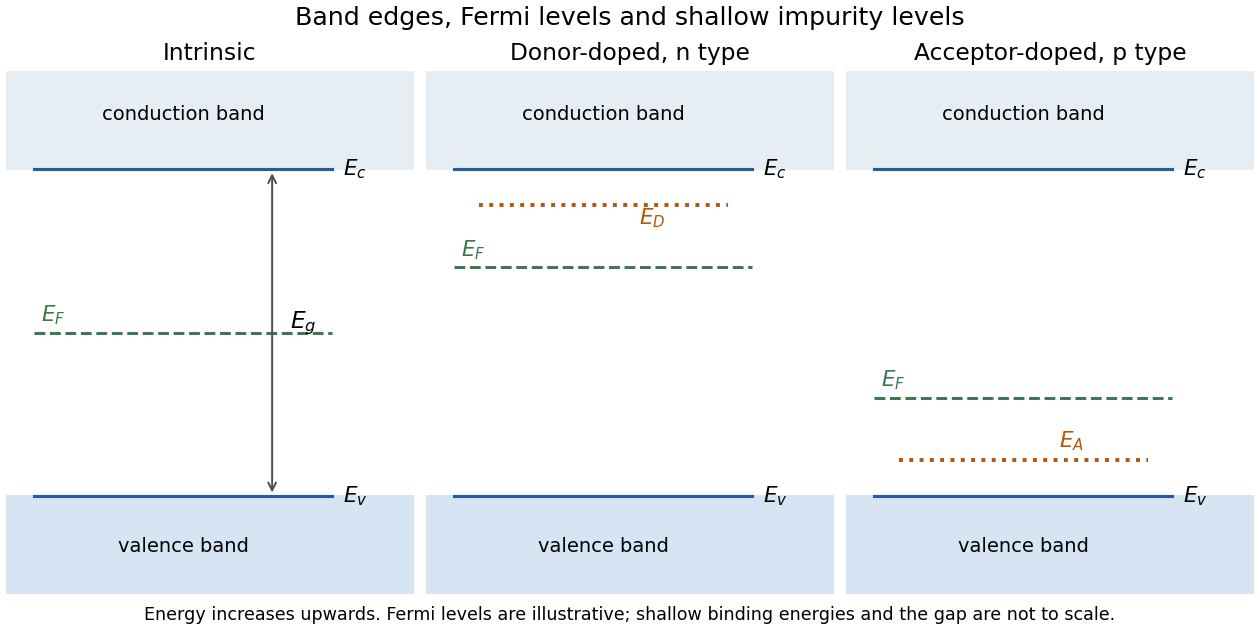
Original schematic energy levels of intrinsic, donor-doped and acceptor-doped semiconductors, including the intrinsic Fermi level and band gap
. Details. 
In a nondegenerate semiconductor, the Fermi-Dirac distribution reduces near the conduction edge to . The corresponding dilute hole probability near the valence edge givesAn intrinsic, neutral sample has . Multiplying the two expressions therefore yieldsEach excitation creates an electron-hole pair; charge neutrality is why the carrier concentration has half the gap in its activation exponent. The electrical conductivity isThus to leading exponential accuracy. The prefactor contains the mobilities and the density-of-states temperature dependence; for fixed parabolic masses, .
Measure conductivity in the intrinsic regime and plot against . If the prefactor is constant or its temperature dependence has been corrected, a slope givesUse the intrinsic branch rather than a donor freeze-out or extrinsic branch. A temperature-dependent gap or mobility changes the apparent activation energy, so a precision extraction must account for those prefactors.
Arsenic has five valence electrons, one more than silicon. As a substitutional donor impurity, it supplies a weakly bound extra electron which is largely thermally released into the conduction band at room temperature, leaving an ionized positive donor.
Consequently the mobile electron density increases far above the intrinsic value, so the conductivity increases substantially even at ppm dopant levels. The crystal remains macroscopically neutral: fixed donor charge compensates the added mobile charge.
There are three useful temperature regimes.
At low temperature, dopant freeze-out keeps most donor electrons bound. Warming ionizes donors and increases conductivity through the rising mobile-electron concentration. For an uncompensated dilute donor system, negligible holes and spin degeneracy two, charge neutrality with partial donor ionization givesDeep in freeze-out, , soThe activation scale is set by the shallow donor binding, rather than the whole band gap.
In the extrinsic regime, donors are largely ionized and is nearly constant. The temperature dependence of conductivity then mainly follows the electron mobility. Increasing phonon scattering can make conductivity fall as temperature rises, even though donors remain ionized; impurity scattering can give a different mobility trend at lower temperature.
At sufficiently high temperature, thermally generated electron–hole pairs overwhelm the dopant population. The intrinsic, gap-activated increase in conductivity returns. The boundaries depend on donor concentration, compensation and scattering, so no one exponential describes the entire doped-sample curve.
The extra electron is bound to an approximately singly charged donor through a dielectric-screened Coulomb attraction. In the isotropic hydrogenic donor state model, replace the vacuum electron mass by and the vacuum permittivity by :At low temperature, the donor is mainly in its state. Allowed electric-dipole transitions to states haveAssign the three printed lines to . Their independently inferred binding energies areThey are mutually close, giving . The hydrogenic impurity absorption series accumulates at the donor-ionization limit. Above about , absorption can place the electron in the conduction-band continuum, explaining the continuous spectrum.
Using the supplied and ,The corresponding effective radius isThese are the parameters inferred from the printed lines within the stipulated scalar model, rather than substituted tabulated material constants. Real impurity spectra can depart from a single hydrogenic ladder through anisotropy and short-distance impurity effects.[ref]
Warming thermally ionizes neutral donors, depleting the occupied bound ground states from which these absorption lines start. Increased scattering can also broaden the lines. Once the donors are predominantly ionized, their bound-to-bound absorption becomes weak or disappears.
The inferred binding provides the natural thermal scale:The first excitation energy similarly corresponds to about . An order-of-magnitude estimate is therefore a temperature of order . This is not a sharp onset: significant ionization can start below that scale because free carriers have a large translational density of states. The precise loss of line strength requires donor density and compensation, as in part (ii), rather than just equating one energy with .
Gallium has three valence electrons, one fewer than silicon, and acts as an acceptor impurity. A neutral acceptor can be described as a negatively charged centre binding an electron hole. Thermal release of these holes gives a p-type semiconductor.
At low temperature, the bound hole can absorb far-IR photons in transitions between acceptor levels. The simplest scalar hydrogenic acceptor state model predictsso one expects a discrete bound-hole absorption series followed by a photoionization continuum. In that idealization, the first lines would be at , and , with threshold .
The hole effective mass is not supplied, so the electron mass cannot be reused to give numerical Ga line positions. In a real valence band, multiple hole bands, anisotropic masses and spin-orbit effects can split and complicate the series; acceptor spectra are generally less accurately described by one scalar hydrogenic ladder.[ref]
Optical Properties of Solids by Mildred S. Dresselhaus. Section 7.3, printed p. 79: departures from the hydrogenic model for degenerate valence bands and acceptors
Articles by others on the same topic
There are currently no matching articles.