In the orthogonal nearest-neighbour tight-binding model,The on-site integral sets the band centre, while the hopping integral describes coupling between neighbouring orbitals. With a consistent phase convention, the bonding combination at the zone centre has .
For p orbitals directed along the chain, useHere every positive lobe points in the same spatial direction. Neighbouring equal-sign coefficients then bring opposite-sign facing lobes together and make the zone-centre combination antibonding; the alternating zone-boundary combination is bonding. Thus the usual axial hopping has the opposite sign to hopping. Orbital phase and the sign of one-dimensional hopping must be treated consistently; replacing only by while silently keeping the same physical hopping sign would give the wrong band ordering.
Write and , soThe labelled key points of the two dispersion relations areThe band rises from centre to boundary and the axial band falls. The separated-band assumption requires . The upper-left panel shows a representative pair, with the other panels supplying the requested comparisons in part (b).
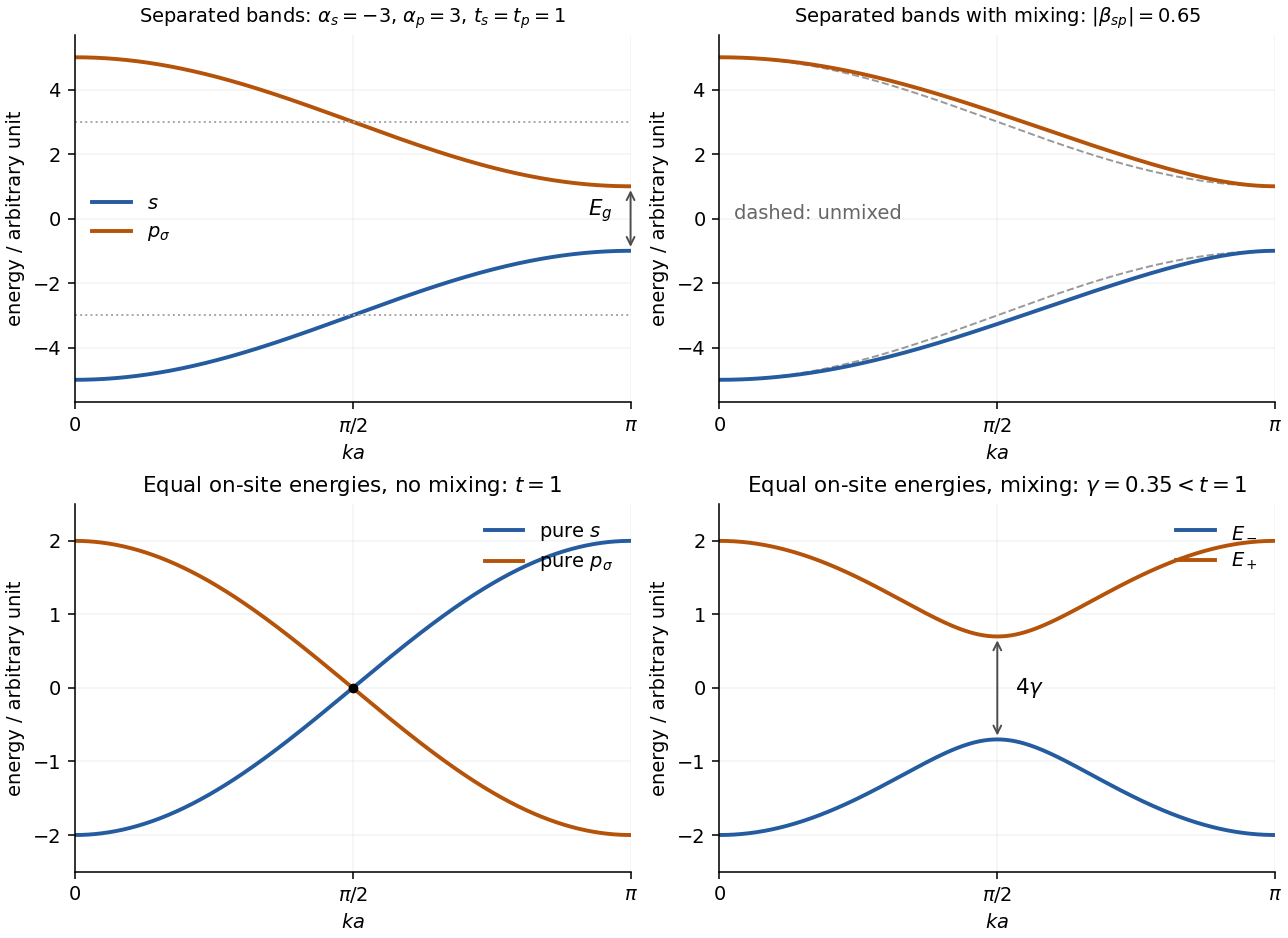
Original one-dimensional s and axial-p band sketches, comparing separated bands, mixing, and the equal-on-site-energy special case
. Details. 
The energy-band widths are the difference between their extrema:For the separated bands, the top of the band and bottom of the band are both at . HenceIt is a direct band gap at the zone boundary, because both limiting states have the same wavevector. This result uses the opposite signs of the and axial- hoppings.
The opposite spatial parity of the s orbital and axial p orbital gives opposite signs for left and right – hopping. With real , one consistent Bloch-basis convention givesThe resulting energies areThus s-p mixing in a one-dimensional tight-binding chain lowers the lower branch and raises the upper branch wherever the coupling is nonzero. For separated atomic levels, the lower branch remains mainly and the upper mainly , with increasing admixture where their uncoupled energies approach.
The upper-right panel of the figure in part (a)(ii) compares the mixed curves with dashed unmixed curves. The mixing vanishes at both and , so those endpoints remain unchanged. If the unmixed curves approach or cross in the interior, the nonzero coupling produces an avoided crossing.
Let the common on-site energy be zero and the common hopping magnitude be . Consistent with the axial- convention and the formula in part (iii), the hopping signs are and .
Without mixing,The curves cross at , , with no gap. The lower-left panel shows the continuous pure- and pure- branches. Their identities remain fixed through the crossing; the energy-ordered lower state changes from to character on passing through it.
With mixing and , the equal-on-site-energy result isFor the regime considered in part (iii), the crossing becomes an avoided crossing with gap at . The lower band has its maximum there and the upper band its minimum. Their orbital characters exchange smoothly across this region, with equal weights at its centre. The lower-right panel gives the sketch.
The zero-mixing limit recovers the crossing of case (1). A useful special limiting case is , where the square root is independent of wavevector and both bands are flat at . This flat-band limit is outside the strict assumption made in part (iii).
Use and . Direct substitution givesThe upper branch falls to a minimum at the middle point and rises symmetrically; the lower branch rises to a maximum and falls symmetrically. These are the lower-right curves in the figure in part (a)(ii).
At the lower state is pure and the upper state pure . At the assignments are reversed. At the two states have equal orbital weights because their diagonal energies coincide and the off-diagonal coupling is nonzero.
More explicitly, for the lower band and , define . ThenThe upper-band weights are interchanged. For zero mixing, the energies still reduce to the crossing limit, but the orbital weights at the exact crossing are not uniquely fixed by energy. These normalized squared amplitudes quantify the smooth change of orbital character; the Bloch-basis phase in the off-diagonal matrix element does not change them.
For , the positive branch ranges from to , and the negative branch from to . ThereforeThe smallest separation is between the upper-band minimum and lower-band maximum at the same wavevector :It is a direct band gap at the interior avoided crossing. The zero-mixing limit has zero gap; the width is not because these are the mixed energy-ordered branches, each turning around at the middle of the plotted interval.
Articles by others on the same topic
There are currently no matching articles.