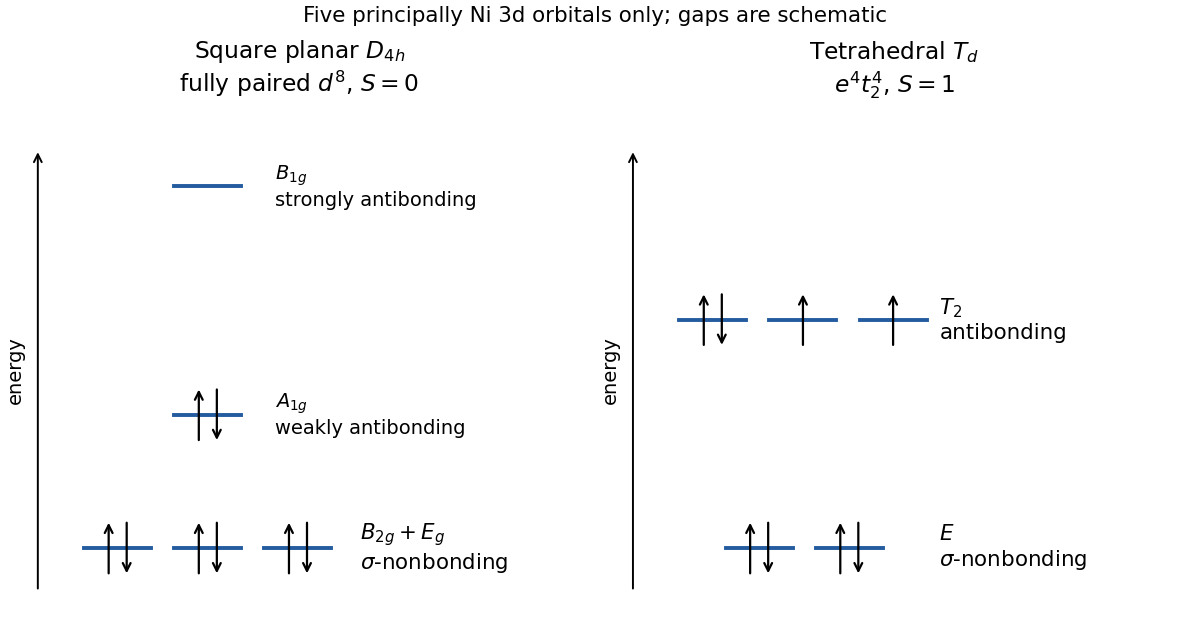
Each cyanide contributes charge , so the formal nickel oxidation state is and the metal has . The requested diagram retains only the five principally metal- molecular orbitals; the mainly ligand bonding molecular orbitals lie below them and are omitted.
In the square, points directly towards all four ligand donors and gives the highest, strongly antibonding molecular orbital, . The function also has an allowed interaction, but its in-plane overlap is smaller. Including the allowed nickel mixing gives a principally level with relatively weak antibonding character. The and metal functions have no ligand partner in the sigma bond donor basis and are nonbonding in this minimal model. The useful qualitative ordering is thereforeThe three nonbonding functions are shown together because the sigma-only model does not determine their finer splitting. Additional electrostatic and pi backbonding interactions can change the ordering of the lower levels; molecular symmetry alone does not fix these energy gaps.[ref]
Bonding in Molecules by John E. McGrady. 2022 lecture notes, square-planar sigma-only molecular-orbital discussion, printed pp. 60–61
In the tetrahedron, the ligand combinations interact with the metal functions, producing higher -derived antibonding molecular orbitals. The metal pair has no sigma donor partner and remains nonbonding:The diagram fills both arrangements with eight metal electrons; the square is shown in its fully paired state.

Articles by others on the same topic
There are currently no matching articles.