Choose the ground-state energy as zero and write . The molecular partition function must sum individual states, so the triply degenerate excited level contributes three Boltzmann factors:The probabilities of occupying the two levels areEach of the three individual excited states has probability . At high temperature the four states become equiprobable, so the two levels have probabilities and , not each. This is the distinction between a level and its state degeneracy.
Use the additive-volume two-level system implicit in the model: each excited particle increases the volume by the same increment. The difference between the two endpoint volumes is , so that increment is .
If particles are excited, . Linearity of the expectation gives , henceAs , . As , only three quarters of the particles are excited on average, giving , rather than the all-excited endpoint . These limits also check the inclusion of state degeneracy.
The definition uses a fixed reference volume, so it is a reference-volume thermal expansion coefficient:Let . Sincewe obtainIt is positive and has units of inverse temperature. Equivalently, : the response reflects changes in the thermally occupied excited population. The usual instantaneous fractional thermal expansion coefficient would instead equal ; substituting that different definition would change the answer.
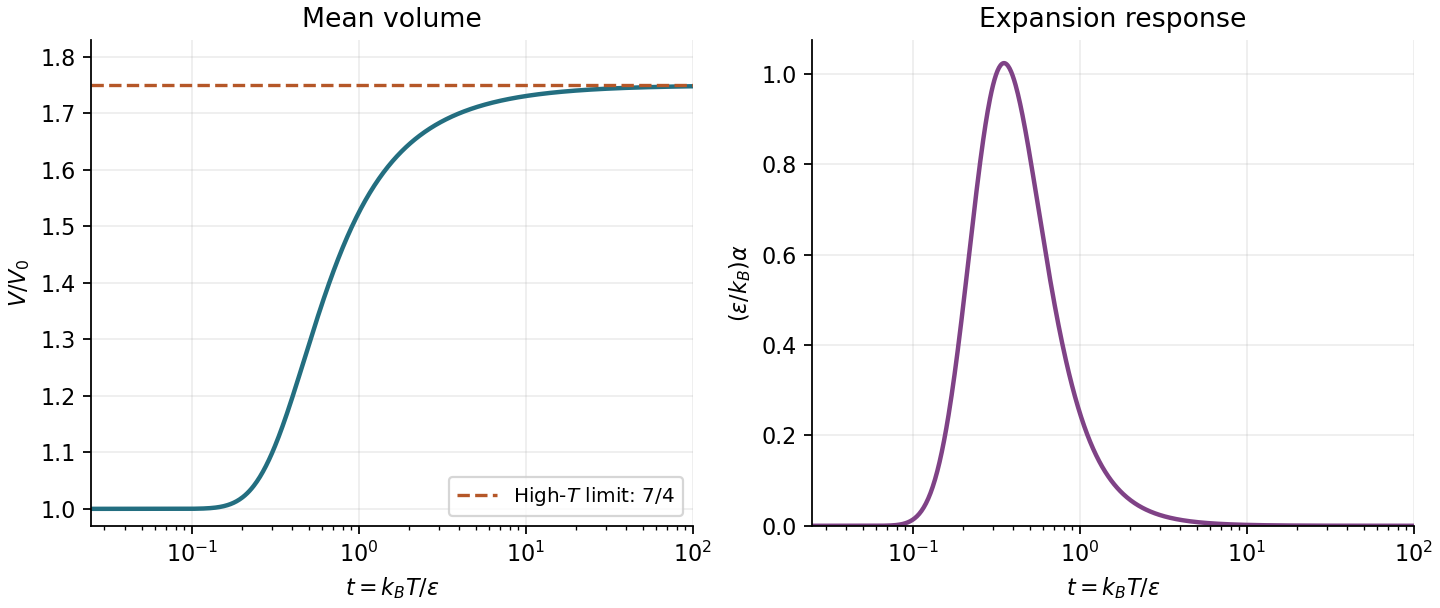

At low temperature, , so the denominator in the exact expression approaches one:The exponential suppression dominates the factor. Almost all particles remain in the ground state, so very little volume change is thermally accessible.
At high temperature, , and thereforeThe excited fraction has already approached , so further heating barely changes it. Both limits are consistent with a bounded two-level system; the high-temperature vanishing does not imply that ordinary materials cease expanding when additional levels or other mechanisms become accessible.
Articles by others on the same topic
There are currently no matching articles.